


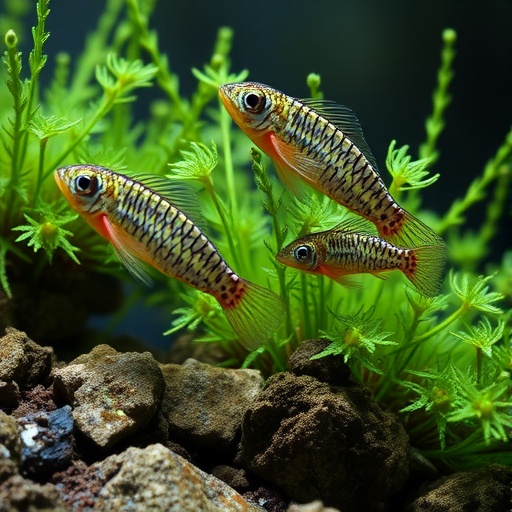
In an intriguing exploration of the resilience of aquatic life, a recent study has unveiled critical insights into the survival mechanisms of the freshwater fish species, Gymnocypris Przewalskii. Commonly referred to as the Przewalskii’s bitterling, this unique fish adapts remarkably to the challenges posed by saline-alkaline stress, an increasingly prevalent environmental challenge in many ecosystems. The research team, led by Gao Z., Wang L., and Cui Y., employed advanced methods of morphology, transcriptome, and physiological analysis to decode the adaptation strategies utilized by juvenile members of this species.
Saline-alkaline stress poses a significant threat to freshwater organisms, particularly in regions where water sources are rapidly changing due to anthropogenic influences. Increased salinity can lead to osmoregulatory challenges for fish, as they must balance the intake of water and salts to maintain homeostasis. The study begins with a comprehensive overview of the environmental parameters that contribute to saline-alkaline conditions, including the rise in evaporation rates in arid climates and the influx of saline waters from agricultural runoff.
To understand how Gymnocypris Przewalskii juveniles cope with these adverse conditions, the researchers conducted morphological assessments, which revealed fascinating structural adaptations. These adaptations included alterations in body shape and fin morphology that likely enhance the fish’s ability to maneuver in saline-alkaline environments. Such morphological changes are crucial as they directly influence the fish’s swimming efficiency and ability to escape predators or navigate towards food sources.
Additionally, the study places a strong emphasis on transcriptomic analyses, providing a window into the gene expression changes that accompany the fish’s adaptive responses. By sequencing the RNA of these juveniles exposed to varying saline-alkaline levels, the team identified significant upregulation of genes associated with osmoregulation, stress response, and detoxification pathways. This genetic response marks a pivotal point where molecular biology intersects with ecology, demonstrating how evolutionary pressures shape the genetic makeup of species in challenging environments.
The physiological analyses revealed that juvenile Gymnocypris Przewalskii exhibit remarkable resilience through various mechanisms, such as improved ion transport efficiency and enhanced cellular repair processes. These adaptations not only support survival but also influence growth rates and reproductive success, ultimately ensuring the continuation of the species. The interplay between morphology, gene expression, and physiological traits paints a holistic picture of how organisms can thrive despite challenging environmental stressors.
The implications of this research extend beyond the boundaries of aquatic ecology. Understanding the adaptive mechanisms of Gymnocypris Przewalskii can provide broader insights into the evolutionary processes that govern species survival in changing climates. This knowledge could inform conservation strategies for other vulnerable freshwater species facing similar saline-alkaline stress.
As the study highlights, urban and agricultural development increasingly impacts natural water bodies, leading to rising salinity levels and altering the ecological balance. The findings underscore the urgent need for sustainable water management practices to preserve freshwater ecosystems. By recognizing the adaptability of Gymnocypris Przewalskii, there lies hope for learning how other species may also navigate these emerging challenges.
In conclusion, the research led by Gao and colleagues provides a significant contribution to our understanding of fish adaptation in the face of environmental stressors. The study not only highlights the specific strategies employed by Gymnocypris Przewalskii juveniles but also draws attention to the broader implications for ecological resilience. As we grapple with climate change and habitat modification, findings such as these serve as vital reminders of nature’s ingenuity and the need for proactive measures to protect our planet’s biodiversity.
This compelling study is a must-read for anyone engaged in the fields of marine biology, environmental science, or conservation. It reinforces the interconnectedness of morphology, genetics, and physiology and exemplifies the potential for scientific research to inform future strategies for coping with an uncertain ecological future.
Through the intricate dance of adaptation, Gymnocypris Przewalskii stands as a testament to nature’s resilience. As scholars continue to investigate the depths of this remarkable fish’s capabilities, the hope remains that such knowledge will inspire conservation efforts and foster a deeper appreciation for the complex life forms that share our world.
Cite Scienmag News
Drew Townsend. (October 8, 2025). Gymnocypris Przewalskii Juveniles Adapt to Saline-Alkaline Stress. Scienmag. https://scienmag.com/gymnocypris-przewalskii-juveniles-adapt-to-saline-alkaline-stress/
Drew Townsend. "Gymnocypris Przewalskii Juveniles Adapt to Saline-Alkaline Stress." Scienmag, 8 October 2025, https://scienmag.com/gymnocypris-przewalskii-juveniles-adapt-to-saline-alkaline-stress/. Accessed 4 September 2026.
Drew Townsend. "Gymnocypris Przewalskii Juveniles Adapt to Saline-Alkaline Stress." Scienmag. October 8, 2025. https://scienmag.com/gymnocypris-przewalskii-juveniles-adapt-to-saline-alkaline-stress/


