


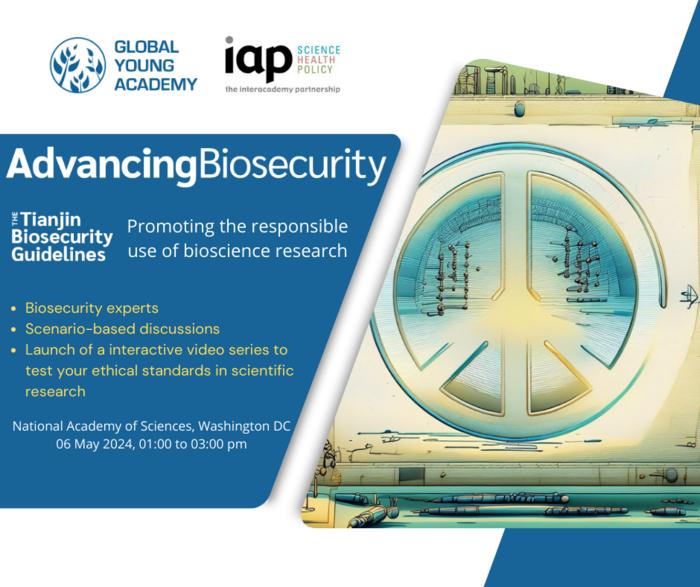
From 7-10 May 2024, distinguished early- to mid-career scientists and scholars from around the world will convene in Washington, D.C., for the GYA’s 2024 Annual General Meeting (AGM) and International Conference of Young Scientists, which this year features an InterAcademy Partnership-funded project on biosecurity.

Credit: GYA/IAP
From 7-10 May 2024, distinguished early- to mid-career scientists and scholars from around the world will convene in Washington, D.C., for the GYA’s 2024 Annual General Meeting (AGM) and International Conference of Young Scientists, which this year features an InterAcademy Partnership-funded project on biosecurity.
The “Advancing Global Biosecurity Governance through the Promotion of the Tianjin Biosecurity Guidelines” (Advancing Biosecurity) project stands as a joint initiative within the IAP Biosecurity Working Group, comprising representatives from four international academies (Global Young Academy; African Academy of Science; Caribbean Academy of Science; and Islamic World Academy of Science) and three national academies (Academia Nacional de Medicina de Buenos Aires, Argentina; National Academies of Science, Engineering and Medicine, United States of America; and Pakistan Academy of Science).
The Advancing Biosecurity project was coordinated by the GYA through the efforts of Co-Chair Felix Moronta (International Centre for Genetic Engineering and Biotechnology, Italy), who states: “My hope is that the resources we introduce at this workshop will be widely disseminated and embraced. The Tianjin Biosecurity Guidelines provide a framework to strengthen biosecurity by preventing the misuse of biological knowledge, tools, and technologies. I urge fellow life scientists and research institutions to unite in our commitment to ethical and safe bioscience research by endorsing and championing the guidelines.”
The Advancing Biosecurity workshop will bring together experts on biosecurity and ethics, feature scenario-based discussions, encourage participants to explore ethical dilemmas in bioscience and share their insights. As a special highlight, an interactive video series will be launched, which provides a unique and engaging way to reinforce the Tianjin Biosecurity Guidelines.
The IAP has been a key partner in the development of the ‘Tianjin Biosecurity Guidelines for Codes of Conduct for Scientists’. IAP Coordinator Peter McGrath played a key role in drafting and editing elements of the text.
The event, hosted by the National Academies of Science, Engineering, and Medicine, also serves as the culmination of the Advancing Biosafety project.
All AGM workshops will be held at the National Academies of Sciences, Engineering and Medicine building on 2101 Constitution Avenue, Washington, D.C.
See the full AGM & Conference programme here.
About IAP
The InterAcademy Partnership harnesses the expertise of the world’s leading scientific minds to advance sound policies, improve public health, promote excellence in science education, and achieve other critical development goals. Our academy members constitute more than 30,000 leading scientists, engineers, and health professionals in over 100 countries.
About the Global Young Academy
The vision of the GYA is science for all; science for the future, and its mission is to give a voice to young scientists and researchers around the world. The GYA, founded in 2010, is an independent science academy of 200 outstanding early- to mid-career researchers from six continents who are selected from across disciplines based on their academic excellence and commitment to engage with society. GYA members serve five-year terms, and the GYA presently counts members and alumni from 100 countries. The GYA administrative Office is publicly funded and hosted at the German National Academy of Sciences Leopoldina. The wide array of GYA activities are supported by a range of international public and private funders.
Social media tags: #gyagm2024 #AdvancingBiosecurity
Cite Scienmag News
Courtney Benton. (April 25, 2024). GYA biosecurity workshop Annual General Meeting to unveil interactive video series and social media toolkit. Scienmag. https://scienmag.com/gya-biosecurity-workshop-annual-general-meeting-to-unveil-interactive-video-series-and-social-media-toolkit/
Courtney Benton. "GYA biosecurity workshop Annual General Meeting to unveil interactive video series and social media toolkit." Scienmag, 25 April 2024, https://scienmag.com/gya-biosecurity-workshop-annual-general-meeting-to-unveil-interactive-video-series-and-social-media-toolkit/. Accessed 4 September 2026.
Courtney Benton. "GYA biosecurity workshop Annual General Meeting to unveil interactive video series and social media toolkit." Scienmag. April 25, 2024. https://scienmag.com/gya-biosecurity-workshop-annual-general-meeting-to-unveil-interactive-video-series-and-social-media-toolkit/

