


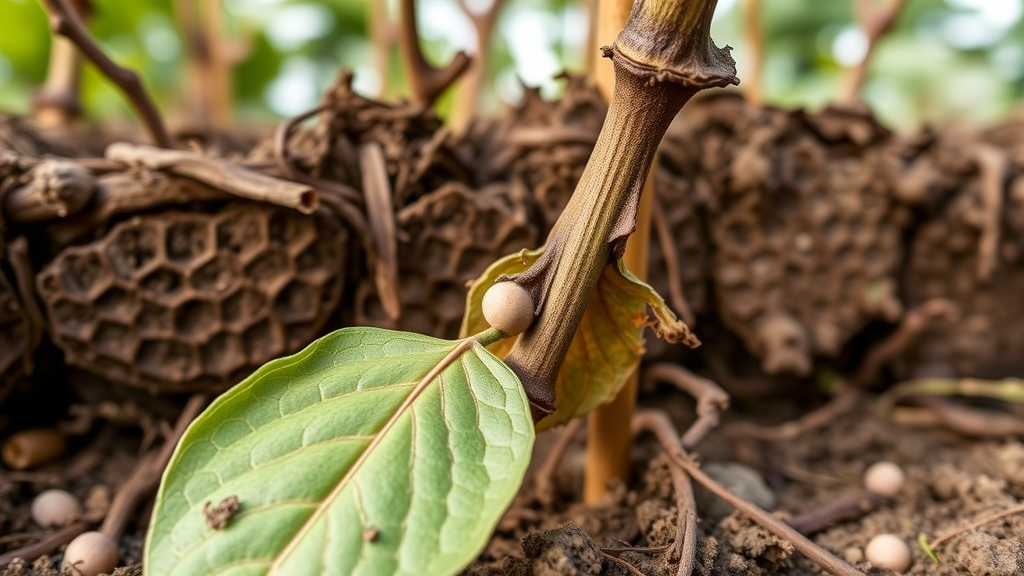
A new genetic study from India has revealed how resistance to one of groundnut’s most destructive diseases is passed from one generation to the next, and the answer carries immediate consequences for breeders racing to develop tougher varieties. Researchers at Acharya N.G. Ranga Agricultural University in Andhra Pradesh set out to determine the inheritance pattern of resistance to stem rot, a devastating soil-borne disease of groundnut (Arachis hypogaea L) caused by the fungus Sclerotium rolfsii. Their findings, published in the Indian Journal of Genetics and Plant Breeding, show that resistance in the resistant line they studied is governed by a single gene acting through incomplete dominance, a mode of inheritance in which the hybrid offspring display an intermediate phenotype rather than fully resembling one parent or the other.
Stem rot, also known as southern blight, has plagued groundnut growers for more than a century. The pathogen attacks the collar region of the plant at the soil line, producing wilting, yellowing and ultimately the death of entire plants, often in circular patches within a field. Warm, moist conditions favor the fungus, which survives between seasons as sclerotia, hard resting structures that can persist in soil for years. Because chemical control of soil-borne pathogens is expensive, environmentally problematic and only partially effective, host-plant resistance has long been regarded as the most sustainable strategy for managing the disease. Understanding the genetics of that resistance is the essential first step toward breeding it into commercially acceptable cultivars.
The research team, led by C. Suvarna of the Department of Genetics and Plant Breeding at S.V. Agricultural College, Tirupati, together with R. P. Vasanthi, K. Viswanath, C. Kiran Kumar Reddy, Y. Amaravathi and M. Reddi Sekhar, designed their experiment around a line x tester mating scheme. Twenty crosses were generated by pairing five susceptible genotypes, TCGS 1694, TCGS 2245, Dheeraj, Kadiri-6 and Narayani, with a single stem rot resistant genotype, TCGS 1862, which served as the male parent in every combination. From these twenty crosses, the five most informative combinations were selected for detailed genetic analysis of disease response across generations.
The first clue to the underlying genetics came from the F1 generation, the immediate offspring of each cross. When the researchers screened the F1 plants for stem rot reaction, they found that all of them were moderately resistant rather than fully resistant like the resistant parent or fully susceptible like the susceptible parents. This intermediate performance is the classic signature of incomplete dominance, sometimes called semi-dominance, in which the heterozygous state expresses a phenotype halfway between the two homozygous alternatives. Had resistance been completely dominant, the F1 plants would have matched the resistant parent; had it been recessive, they would have succumbed like the susceptible parents.
The decisive evidence emerged from the F2 generation, produced by self-pollinating the F1 plants. Under incomplete dominance with a single segregating gene, Mendelian expectations predict a distinctive three-class phenotypic ratio of one susceptible to two moderately resistant to one resistant individual. When the team scored the F2 populations for disease reaction and subjected the observed counts to chi-square goodness-of-fit testing, the segregation patterns conformed closely to that 1:2:1 ratio. The fit was consistent across all five crosses, indicating that the same genetic mechanism operated regardless of which susceptible background the resistance allele had been introduced into.
Because F2 ratios alone can occasionally mislead, the researchers extended their analysis into the F3 generation, derived by selfing individual F2 plants. Progeny testing in F3 provides a more powerful discrimination among genetic hypotheses, because the families bred from homozygous F2 plants breed true while those from heterozygous plants continue to segregate. The F3 data confirmed what the F2 segregation had suggested: resistance to stem rot in this material behaves as a single-locus trait with incomplete dominance, and the moderately resistant class corresponds to the heterozygous genotype at that locus. This two-generation confirmation strengthens the conclusion considerably and gives breeders a reliable genetic model to work with.
The practical implications of incomplete dominance for breeding programs are significant. With this mode of gene action, selection in early segregating generations is effective for the resistant class, but the heterozygotes that make up half the population in each segregating generation will express only partial resistance. Breeders seeking durable, high-level resistance therefore need to advance material to later generations, allowing homozygosity to accumulate, before fixing the trait in a released variety. Alternatively, the intermediate expression of heterozygotes means that marker-assisted selection, once molecular markers linked to the resistance locus are identified, could accelerate the recovery of homozygous resistant individuals without waiting for multiple generations of field screening.
The study also situates itself within a broader body of work on stem rot genetics in groundnut. Previous research has identified resistant germplasm lines, including reports of groundnut accessions tolerant to Sclerotium rolfsii dating back to early surveys of the crop’s genetic resources. More recently, quantitative trait locus mapping and genotyping-by-sequencing studies in cultivated peanut have revealed multiple genomic regions and substantial epistatic interactions associated with stem rot resistance, suggesting that in some genetic backgrounds the trait may be more complex than a single gene. The present findings do not contradict that complexity; rather, they demonstrate that in the specific resistant line TCGS 1862, a major locus with incomplete dominance explains the observed segregation, making this line a particularly valuable donor for resistance breeding.
The economic stakes of this work are considerable. Groundnut is a major oilseed and food legume cultivated across tropical and subtropical regions, with India among the world’s leading producers. Yield losses from stem rot can be severe, particularly in rainfed production systems where warm soils and humidity favor pathogen development. Varieties that combine the agronomic quality of popular susceptible cultivars such as Kadiri-6 with the resistance of TCGS 1862 could substantially reduce crop losses and lower dependence on fungicide applications. The single-gene, incompletely dominant architecture identified here means that backcross breeding programs can transfer the resistance into elite backgrounds with predictable outcomes, tracking the allele through segregating generations using disease screening or linked molecular markers.
The researchers acknowledge the collaborative infrastructure that made the study possible, with experimental material supplied by ICRISAT, Patancheru and the Regional Agricultural Research Station, Tirupati, and the work conducted at the Dry Land Farm of S.V. Agricultural College with support from Acharya N.G. Ranga Agricultural University. As stem rot continues to threaten groundnut production under changing climatic conditions that favor soil-borne pathogens, the demonstration that resistance in TCGS 1862 follows a simple, tractable inheritance pattern offers breeders a clear roadmap. Future work will likely focus on tagging the resistance locus with molecular markers, validating its performance across diverse environments, and pyramiding it with resistance to other major groundnut diseases to build varieties equipped for the challenges of modern agriculture.
Subject of Research: Inheritance of stem rot resistance in groundnut (Arachis hypogaea L)
Article Title: Inheritance of Stem Rot Resistance in Groundnut (Arachis hypogaea L)
Article References: Suvarna, C., Vasanthi, R. P., Viswanath, K., Reddy, C. K. K., Amaravathi, Y., & Sekhar, M. R. (2026). Inheritance of Stem Rot Resistance in Groundnut (Arachis hypogaea L). Indian Journal of Genetics and Plant Breeding, 86(3), 354-357. https://doi.org/10.1007/s44489-026-00029-w
Image Credits: AI Generated
DOI: 10.1007/s44489-026-00029-w
Keywords: groundnut, stem rot resistance, Sclerotium rolfsii, incomplete dominance, plant breeding, genetics, F2 segregation, disease resistance, Arachis hypogaea, quantitative genetics, Inheritance, Stem
Cite Scienmag News
Juliet Wilcox. (September 22, 2026). Groundnut Stem Rot Resistance Is Inherited Through Incomplete Dominance, Study Finds. Scienmag. https://scienmag.com/groundnut-stem-rot-resistance-is-inherited-through-incomplete-dominance-study-finds/
Juliet Wilcox. "Groundnut Stem Rot Resistance Is Inherited Through Incomplete Dominance, Study Finds." Scienmag, 22 September 2026, https://scienmag.com/groundnut-stem-rot-resistance-is-inherited-through-incomplete-dominance-study-finds/. Accessed 5 October 2026.
Juliet Wilcox. "Groundnut Stem Rot Resistance Is Inherited Through Incomplete Dominance, Study Finds." Scienmag. September 22, 2026. https://scienmag.com/groundnut-stem-rot-resistance-is-inherited-through-incomplete-dominance-study-finds/


