

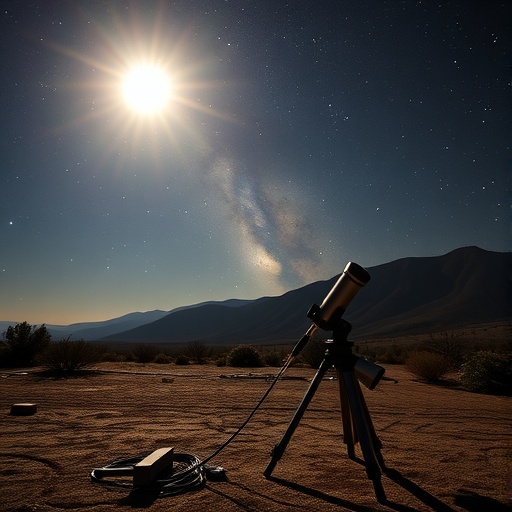
In the quest for discovering Earth-like exoplanets, astronomers have long grappled with the formidable challenge of imaging these distant worlds directly, especially those orbiting Sun-like stars. The immense brightness contrast and minuscule angular separations between these planets and their host stars have made such observations exceedingly difficult. However, a groundbreaking new approach promises to revolutionize this field by hybridizing the unparalleled resolving power of next-generation ground-based telescopes with the innovative concept of a shared orbiting starshade in space.
This pioneering strategy involves coupling massive terrestrial observatories—such as the Extremely Large Telescope (ELT), the Thirty Meter Telescope (TMT), and the Giant Magellan Telescope (GMT)—with a colossal starshade deployed in Earth’s orbit. Measuring approximately 99 meters in diameter, the starshade acts as a colossal cosmic shield, casting a deep and sharp shadow that effectively blocks out the overwhelming glare of a star. This shadow drastically reduces the starlight contaminating observations, allowing faint reflected light from orbiting exoplanets to emerge from obscurity.
Despite the transformative advantages of the starshade, Earth’s atmosphere remains a significant hurdle. Turbulence induced by atmospheric layers continuously blurs incoming light, disrupting the clarity needed for such delicate observations. To counter this, adaptive optics systems integrated within the ground-based telescopes dynamically adjust mirror shapes in real-time to compensate for atmospheric distortions. Notably, the ELT’s advanced adaptive optics machinery has been modeled to demonstrate its capability to restore image sharpness sufficiently to rival space-based observations, even through Earth’s turbulent sky.
The core of this new system’s potential lies in its ability to leverage the finest angular resolution achievable from Earth with the profound contrast enhancement uniquely provided by the orbiting starshade. By projecting a precise shadow well above the atmosphere’s disruptive layers, the starshade eliminates a substantial fraction of stellar light before it ever enters the telescope. This dual approach enables ground-based platforms to reach contrasts on the order of 10^−10, the threshold required for detecting reflected light signatures from terrestrial exoplanets analogous to Earth.
An intricate and realistic modeling of the entire system has been conducted, focusing particularly on the ELT’s performance under moderate weather conditions. The simulations encompass wavelengths spanning from the ultraviolet through the near-infrared (300 to 1,000 nanometers), where key biosignature molecules can be detected. Crucially, the adaptive optics’ Strehl ratio — a measure of image quality — was varied in the analysis to confirm that atmospheric turbulence corrections impose minimal penalties on sensitivity across this broad spectral range.
Beyond mere detection, the hybrid system advances exoplanet characterization by enabling spectral measurements. The reflected light spectra can reveal the presence of major molecular constituents such as oxygen and water vapor—substances intimately tied to the possibility of life. Identifying these markers from an Earth-analog exoplanet orbiting a Sun-like star represents a monumental leap toward answering whether our cosmic neighborhood harbors life.
The simulations further demonstrate promise by showcasing simulated images and spectra of a Solar System analogue, encompassing planetary bodies roughly akin to Venus, Earth, and Saturn. These synthetic observations affirm that with current technology complemented by the starshade, even relatively faint planetary signals can be teased out, heralding a new era for comparative planetology beyond our solar system.
Historically, direct imaging attempts suffered from the overwhelming brightness of host stars, forcing astronomers to depend heavily on indirect detection methods such as transit photometry or radial velocity measurements. Although powerful, these techniques provide limited insights, often failing to reveal atmospheric compositions or surface conditions. By contrast, the hybrid starshade-telescope concept enables direct reflected-light spectroscopy, paving the way for detailed studies of exoplanet atmospheres, climate, and potentially even seasonal changes.
Moreover, this hybrid configuration offers a cost-effective mitigation strategy by sharing the starshade among multiple giant telescopes, effectively distributing the high implementation expense of such a massive orbital structure. This democratizes deep-contrast imaging capabilities across the astronomical community and accelerates the availability of high-fidelity data.
Technological hurdles remain in deploying and maintaining precise starshade alignment from orbit, but ongoing advances in spacecraft navigation and formation flying instill optimism. The synergy highlighted in these studies underscores how ground-based adaptive optics and space-based starlight suppression can synergistically surmount challenges that neither could overcome alone.
Comparing this innovative hybrid method with upcoming space-only missions shows complementary strengths. While dedicated space telescopes boast stable, turbulence-free environments, they face limitations in aperture size and mission duration. Ground-based observatories harness the massive collecting areas needed for faint target spectroscopy, but have been hampered by atmospheric interference—now mitigated by the shared starshade.
Future work anticipates refining adaptive optics performance under variable atmospheric conditions and enhancing starshade positioning precision. Additionally, integrating high-contrast imaging coronagraphs within the telescopes’ optical trains can offer further improvements by removing residual scattered starlight, creating an even cleaner observational window.
The prospect of detecting biosignatures such as oxygen, ozone, and water vapor on exo-Earths, using a combination of Earth’s largest telescopes and a strategically deployed starshade, reshapes our roadmap for exoplanet science. This breakthrough would mark an epochal expansion of humanity’s reach into the cosmos, transforming speculative habitats into tangible worlds awaiting exploration.
In summary, the marriage of gigantic terrestrial optics with an orbital starshade represents a visionary yet technically achievable pathway toward realizing the long-sought goal of imaging and characterizing Earth analogs around Sun-like stars. By transcending the limitations imposed by our atmosphere and stellar glare, this hybrid framework unveils new territories for studying life beyond Earth through direct observational evidence.
As this concept advances from theoretical simulation toward experimental implementation, it holds the promise not only to revolutionize exoplanet discovery but also to deepen our understanding of planetary system architectures, atmospheric dynamics, and potentially, the universality of life itself across the galaxy.
Subject of Research: Observation and characterization of Earth-like exoplanets using hybrid space–ground telescope systems combined with an orbiting starshade.
Article Title: The observation of Earth-like exoplanets with ground-based telescopes and a shared orbiting starshade.
Article References:
Soliman, A., Mather, J., Shaklan, S. et al. The observation of Earth-like exoplanets with ground-based telescopes and a shared orbiting starshade. Nat Astron (2026). https://doi.org/10.1038/s41550-026-02787-9
Image Credits: AI Generated


