


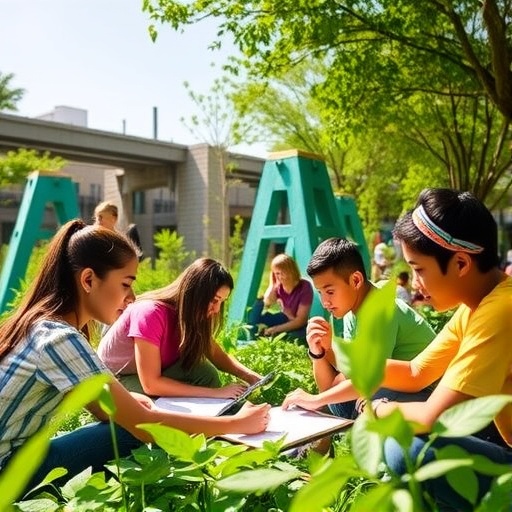
In an unprecedented exploration of the relationship between urban environments and educational achievement, researchers have unveiled a comprehensive study focusing on the influence of green spaces on learning outcomes among an extensive cohort of Brazilian students. This investigation, spanning over 3 million students across Brazil, provides compelling evidence that access to natural environments within urban settings significantly enhances cognitive performance and academic success.
The sheer scale of the study marks a significant contribution to urban sustainability research, leveraging large-scale data analytics to understand complex socio-environmental interactions. By integrating educational records with high-resolution environmental mapping, the researchers meticulously quantified the extent of green space exposure for each student’s residential vicinity. This methodological approach opens a new frontier in educational and environmental sciences, emphasizing the quantifiable benefits of urban greening on human development.
Fundamentally, the study interrogates how proximity to parks, gardens, and other vegetated areas correlates with measurable improvements in students’ academic results. The premise is rooted in a growing body of literature suggesting that natural environments can alleviate cognitive fatigue, reduce stress, and provide restorative experiences that enhance concentration and memory retention. Such cognitive mechanisms are crucial underpinnings of educational performance, especially in densely populated and socioeconomically diverse urban landscapes.
Using advanced geospatial analysis techniques, the researchers employed satellite imagery combined with local land use data to create detailed maps of green spaces within cities. These environmental indicators were then cross-referenced with anonymized student test scores in standardized assessments covering a spectrum of subjects including mathematics, science, and language arts. The fusion of environmental and educational datasets allowed for robust multivariate analyses controlling for confounding factors such as socioeconomic status, school quality, and urban density.
A pivotal insight from the findings is the dose-dependent relationship where increasing exposure to green spaces correlates with progressive improvements in academic outcomes. Notably, students residing in the greenest neighborhoods exhibited significantly higher test scores compared with peers in more urbanized and less vegetated areas. This suggests that urban planning policies that prioritize green infrastructure could yield substantial educational dividends, especially in underserved communities where educational disparities are most pronounced.
Beyond mere correlation, the study explores potential causal pathways, drawing upon psychological theories of environmental cognition. The presence of green spaces is hypothesized to foster attentional restoration—a process where the mind recovers from mental fatigue through interaction with nature. This restoration can enhance executive functions critical for problem-solving and learning, thereby translating environmental quality into academic achievement.
The researchers also highlight the socio-economic implications of their findings. In Brazilian urban centers, where inequalities in access to quality education and living conditions persist, green spaces emerge as an equitable lever for enhancing learning environments. The data indicate that the positive impact of green spaces is especially pronounced among students from lower-income neighborhoods, hinting at the capacity of urban greening to mitigate educational inequities.
In terms of policy relevance, this research advocates for the integration of green space development within urban educational strategies. By designing cities that incorporate accessible and diverse vegetative landscapes, planners can create nurturing contexts that support cognitive health and scholastic advancement. Importantly, the study calls for interdisciplinary collaboration among urban planners, educators, and environmental scientists to optimize the educational benefits of sustainable urban design.
The investigation utilizes rigorous statistical models, including mixed-effect regression analyses, to account for clustered data structures and potential spatial autocorrelation. This technical robustness strengthens the validity of the conclusions, offering clear evidence that green space exposure is an independent predictor of student performance beyond traditional factors such as income and school resources.
Further, the study situates itself within the broader discourse on planetary health and sustainable development, emphasizing how urban environmental quality directly interfaces with human capital formation. By empirically linking green spaces with educational outcomes, the research underscores the role of environmental stewardship in fostering societal progress and resilience, particularly in rapidly urbanizing contexts like Brazil.
Interestingly, the study also addresses potential confounds related to urban noise and air pollution, factors known to adversely affect cognitive functions. The analysis reveals that green spaces may buffer these environmental stressors, providing a multi-faceted advantage that enhances the overall quality of life and learning potential for city dwellers.
While the study is observational, the vast sample size and sophisticated analytical framework provide persuasive evidence supporting urban greening as a viable intervention to improve educational performance. This has wide-ranging implications not only for Brazil but for global cities grappling with balancing urban density and quality of life.
Future research directions pointed out by the authors include longitudinal assessments to track how changes in urban green space over time influence educational trajectories and cognitive development. Additionally, integrating physiological measurements of stress and attention alongside performance data could deepen understanding of the underlying neurobiological mechanisms.
In sum, this landmark study by Gardin and Requia manifests the intricate interplay between natural environments and human learning, revealing green spaces as a potent yet underutilized resource for enhancing educational equity and city sustainability. Such findings catalyze a paradigm shift, inviting policymakers and communities to envision urban futures where learning flourishes amid vibrant, verdant landscapes.
Cite Scienmag News
Courtney Benton. (November 25, 2025). Green Spaces Boost Learning in 3 Million Brazilian Students. Scienmag. https://scienmag.com/green-spaces-boost-learning-in-3-million-brazilian-students/
Courtney Benton. "Green Spaces Boost Learning in 3 Million Brazilian Students." Scienmag, 25 November 2025, https://scienmag.com/green-spaces-boost-learning-in-3-million-brazilian-students/. Accessed 4 September 2026.
Courtney Benton. "Green Spaces Boost Learning in 3 Million Brazilian Students." Scienmag. November 25, 2025. https://scienmag.com/green-spaces-boost-learning-in-3-million-brazilian-students/


