

Sunday, May 24, 2026
Science
No Result
View All Result
  • Login
  • HOME
  • SCIENCE NEWS
  • CONTACT US
  • HOME
  • SCIENCE NEWS
  • CONTACT US
No Result
View All Result
Scienmag
No Result
View All Result
Home Science News Marine

Greek Island was home to Bronze Age purple dye workshop

June 12, 2024
in Marine
Reading Time: 3 mins read
0
More than just a color: Archaeological, analytical, and procedural aspects of Late Bronze Age purple-dye production at Cape Kolonna, Aegina
67
SHARES
605
VIEWS
Share on FacebookShare on Twitter
ADVERTISEMENT

The Greek island of Aegina was home to a Late Bronze Age purple dye workshop, according to a study published June 12, 2024 in the open-access journal PLOS ONE by Lydia Berger of Paris Lodron University of Salzburg, Austria and colleagues.

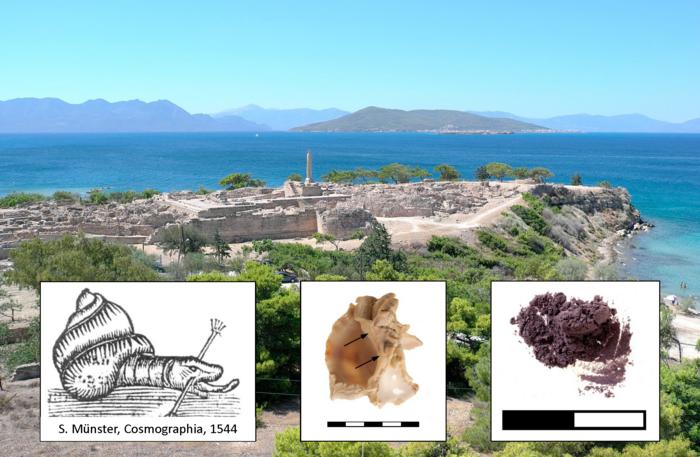
More than just a color: Archaeological, analytical, and procedural aspects of Late Bronze Age purple-dye production at Cape Kolonna, Aegina

Credit: Aegina Kolonna excavation, Department of Classics, Paris Lodron University of Salzburg, CC-BY 4.0 (

The Greek island of Aegina was home to a Late Bronze Age purple dye workshop, according to a study published June 12, 2024 in the open-access journal PLOS ONE by Lydia Berger of Paris Lodron University of Salzburg, Austria and colleagues.

Colored dyes were a significant commodity in the Mediterranean region during the Late Bronze Age, and understanding the production of these dyes is valuable for interpretations of culture and trade at the time. In this study, Berger and colleagues describe the site of a purple dye workshop from the 16th century BC located at Aegina Kolonna in the Saronic Gulf.

The presence of a dye workshop at this site is inferred from three main lines of evidence: purple pigment preserved on ceramic fragments, which are likely remnants of dye containers; dyeing tools, including grinding stones and a waste pit; and crushed shells of marine snails whose bodies are harvested for these pigments. Analysis of the shells and the chemical composition of the pigments indicate that the workshop predominantly used one species of Mediterranean snail, the banded dye-murex.

Excavation at this site also uncovered many burnt bones from young mammals, mainly piglets and lambs. The authors hypothesize that these could be the remains of animals ritually sacrificed as spiritual offerings to protect the site of production, a practice known from other cultural sites, although the exact connection between these bones and the dye production is not yet fully clear.

This site provides valuable insights into the tools and processes of Mycenaean purple dye production. Further research might reveal more information about the scale of dye production at Kolonna Aegina, the details of the on-site procedures, and the use of this dye in regional trade.

The authors add: “For the first time, the discovery of remarkable quantities of well-preserved pigment, together with a large number of crushed mollusk shells and a few functional facilities, allow a detailed insight into the production of purple-dye on the Greek island of Aegina around 3600 years ago. Chemical analysis by HPLC, malacological, zoological, and archaeological studies illustrate the technical process and peculiarities of early dye production and prove a workshop within the Late Bronze Age settlement.”

#####

In your coverage please use this URL to provide access to the freely available article in PLOS ONE:

Citation: Berger L, Forstenpointner G, Frühauf P, Kanz F (2024) More than just a color: Archaeological, analytical, and procedural aspects of Late Bronze Age purple-dye production at Cape Kolonna, Aegina. PLoS ONE 19(6): e0304340.

Author Countries: Austria

Funding: The author(s) received no specific funding for this work.


Journal

PLoS ONE

DOI

10.1371/journal.pone.0304340

Method of Research

Observational study

Subject of Research

Animals

Article Title

More than just a color: Archaeological, analytical, and procedural aspects of Late Bronze Age purple-dye production at Cape Kolonna, Aegina

Article Publication Date

12-Jun-2024

COI Statement

The authors have declared that no competing interests exist.

Share27Tweet17
Previous Post

Ambivalence + polarized views can promote political violence

Next Post

Mount Sinai Health System to lead discussions on the impact of climate change on health and the potential of brain-computer interfaces at the 2024 Aspen Ideas: Health and Aspen Ideas Festival

Related Posts

Rapid Drought-to-Flood Shifts Worsen Climate Governance — Marine
Marine

Rapid Drought-to-Flood Shifts Worsen Climate Governance

May 22, 2026
HKUST Scientists Uncover Carbon Storage Capacity and Biological Roles in Carbon Cycling within South China Sea Coral Reef Ecosystems — Marine
Marine

HKUST Scientists Uncover Carbon Storage Capacity and Biological Roles in Carbon Cycling within South China Sea Coral Reef Ecosystems

May 22, 2026
Unlocking the Ocean’s Medicine Cabinet: Scientists Pioneer New Horizons in Marine Peptide Drug Discovery — Marine
Marine

Unlocking the Ocean’s Medicine Cabinet: Scientists Pioneer New Horizons in Marine Peptide Drug Discovery

May 22, 2026
Beluga Whales Show Signs of Mirror Self-Recognition in Captivity, Study Finds — Marine
Marine

Beluga Whales Show Signs of Mirror Self-Recognition in Captivity, Study Finds

May 20, 2026
Understanding Climate Warming Through Paleoclimatic Insights — Marine
Marine

Understanding Climate Warming Through Paleoclimatic Insights

May 20, 2026
New Study Reveals Early Complex Life Thrived in Oxygen-Rich Seas, Upending Traditional Evolutionary Theories — Marine
Marine

New Study Reveals Early Complex Life Thrived in Oxygen-Rich Seas, Upending Traditional Evolutionary Theories

May 20, 2026
Next Post

Mount Sinai Health System to lead discussions on the impact of climate change on health and the potential of brain-computer interfaces at the 2024 Aspen Ideas: Health and Aspen Ideas Festival

  • Mothers who receive childcare support from maternal grandparents show more parental warmth, finds NTU Singapore study

    Mothers who receive childcare support from maternal grandparents show more parental warmth, finds NTU Singapore study

    27649 shares
    Share 11056 Tweet 6910
  • University of Seville Breaks 120-Year-Old Mystery, Revises a Key Einstein Concept

    1052 shares
    Share 421 Tweet 263
  • Bee body mass, pathogens and local climate influence heat tolerance

    680 shares
    Share 272 Tweet 170
  • Researchers record first-ever images and data of a shark experiencing a boat strike

    543 shares
    Share 217 Tweet 136
  • Groundbreaking Clinical Trial Reveals Lubiprostone Enhances Kidney Function

    529 shares
    Share 212 Tweet 132
Science

Embark on a thrilling journey of discovery with Scienmag.com—your ultimate source for cutting-edge breakthroughs. Immerse yourself in a world where curiosity knows no limits and tomorrow’s possibilities become today’s reality!

RECENT NEWS

  • Comparing Robust Intelligent Controls for 3-DOF Robots
  • Predicting Flashover on Polluted Insulators with CNN-LSTM
  • New Framework Enhances Survey Response Quality Assessment
  • Synechococcus Leads Ocean’s Picocyanobacteria Sediment Record

Categories

  • Agriculture
  • Anthropology
  • Archaeology
  • Athmospheric
  • Biology
  • Biotechnology
  • Blog
  • Bussines
  • Cancer
  • Chemistry
  • Climate
  • Earth Science
  • Editorial Policy
  • Marine
  • Mathematics
  • Medicine
  • Pediatry
  • Policy
  • Psychology & Psychiatry
  • Science Education
  • Social Science
  • Space
  • Technology and Engineering

Subscribe to Blog via Email

Success! An email was just sent to confirm your subscription. Please find the email now and click 'Confirm Follow' to start subscribing.

Join 5,146 other subscribers

© 2025 Scienmag - Science Magazine

Welcome Back!

Login to your account below

Forgotten Password?

Retrieve your password

Please enter your username or email address to reset your password.

Log In
No Result
View All Result
  • HOME
  • SCIENCE NEWS
  • CONTACT US

© 2025 Scienmag - Science Magazine
