


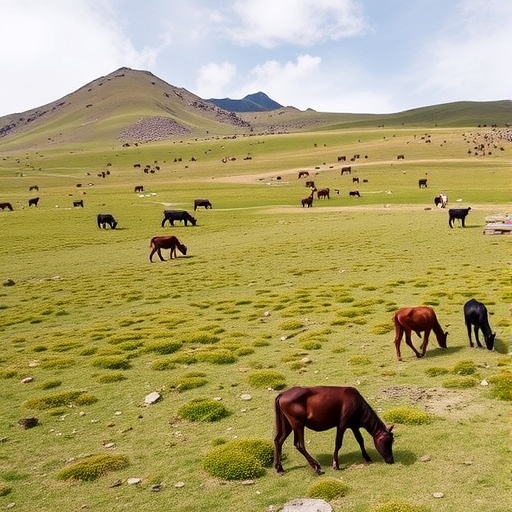
A new metagenomic study from the northeastern Qinghai–Tibet Plateau has revealed that the identity of grazing livestock may help shape not only alpine grassland vegetation, but also the microscopic communities responsible for carbon, nitrogen, and phosphorus cycling in soil. Published in Plant and Soil, the research compares soils associated with Tibetan sheep grazing, yak grazing, and mixed grazing in the Tianzhu alpine grassland. The findings suggest that different herbivores are linked to distinct microbial communities and contrasting collections of functional genes—genetic markers that indicate the biochemical capabilities of soil microorganisms. Although the study does not directly measure rates of carbon storage, greenhouse-gas production, or nutrient transformation, it provides a detailed molecular snapshot of how grazing systems may be associated with the hidden biological machinery beneath alpine pastures.
Soil microorganisms are central to the functioning of grassland ecosystems. Bacteria, archaea, and fungi decompose plant residues, transform organic matter, release or immobilize nutrients, and influence whether carbon remains in the soil or returns to the atmosphere as carbon dioxide or methane. They also regulate the movement of nitrogen through processes such as fixation, nitrification, denitrification, and ammonium assimilation. Phosphorus, an essential but often poorly available nutrient, is mobilized by microorganisms capable of breaking down organic phosphorus compounds or releasing phosphorus bound to soil minerals. Because these processes are carried out by diverse microbial populations, a change in community composition can alter the potential for multiple ecosystem functions at once. In high-elevation grasslands, where low temperatures, short growing seasons, fragile soils, and strong seasonal constraints already limit biological activity, these microbial changes may be especially important.
The researchers used metagenomic sequencing to investigate the genetic composition of soil microbial communities under three livestock systems. Unlike conventional microbial surveys that target a small genetic region to identify organisms, metagenomics sequences large numbers of DNA fragments from the entire microbial community. These fragments can be compared with reference databases to estimate which organisms are present and to identify genes associated with specific biochemical pathways. In this study, the approach enabled the researchers to examine both taxonomic patterns—such as the relative abundance and diversity of major microbial groups—and functional profiles related to carbon fixation, nitrogen transformations, phosphorus acquisition, and methane oxidation. The resulting data do not show that a particular gene is actively being expressed or that a specific process is occurring at a measured rate. Instead, they indicate the potential biological functions represented in the soil community.
The clearest contrast emerged between soils associated with Tibetan sheep and those associated with yaks. Tibetan sheep grazing, designated SG in the study, was linked with a higher relative abundance of Pseudomonadota, a large bacterial phylum that includes many metabolically versatile organisms. The sheep-grazed soils also showed greater bacterial richness, meaning that they contained a larger number of detected bacterial groups. The researchers found that genes connected with carbon fixation, nitrogen cycling, and phosphorus acquisition were generally more abundant under sheep grazing. Carbon-fixation genes are involved in pathways through which microorganisms convert inorganic carbon into organic compounds. Nitrogen-cycling genes may support several stages of nitrogen transformation, while phosphorus-acquisition genes can help microbes obtain phosphorus from chemically or biologically complex sources. Together, these patterns point to a soil microbiome with a comparatively strong genetic representation of nutrient-related functions, though the study does not establish whether these functions operate faster in the field.
Yak grazing, designated YG, produced a different microbial signature. These soils were associated with higher relative abundances of Actinomycetota, a bacterial group known for its ability to degrade complex organic materials and produce a wide variety of secondary metabolites, and Ascomycota, one of the largest fungal phyla. Yak-grazed soils also displayed greater bacterial and fungal diversity than the sheep-grazed soils. Diversity is not automatically equivalent to improved ecosystem functioning, but a more diverse community can contain a wider range of metabolic strategies and may respond differently to environmental stress. In addition, genes associated with methane oxidation were more abundant under yak grazing. Methane-oxidizing microorganisms, commonly known as methanotrophs, use methane as an energy or carbon source and can act as a biological filter that consumes methane before it escapes from soil into the atmosphere. The presence of more methane-oxidation genes suggests increased potential for this pathway, but direct measurements of methane flux would be required to determine whether yak-grazed soils actually remove more methane.
Mixed grazing, involving both Tibetan sheep and yaks, was included to examine whether combining livestock types produces a unique microbial pattern rather than simply an intermediate one. The abstract reports that grazing systems were associated with distinct microbial community composition, diversity, and functional profiles, indicating that the mixed system formed part of a broader contrast among management regimes. The ecological explanation may involve several interacting mechanisms. Yaks and sheep differ in body size, feeding behavior, diet selectivity, trampling pressure, dung and urine deposition, and the spatial distribution of their effects. Their grazing can also change plant biomass, root growth, litter inputs, soil compaction, and the quantity and quality of organic substrates entering the soil. These changes may create different environmental niches for bacteria and fungi, influencing which organisms persist and which metabolic genes become relatively prominent.
Among the soil properties examined, ammonium nitrogen, soil organic carbon, and available phosphorus were most strongly associated with variation in microbial functional genes. Ammonium is a readily usable inorganic form of nitrogen and can influence microbial competition, nitrification, and plant–microbe interactions. Soil organic carbon provides both an energy source and a structural reservoir for microbial communities, while available phosphorus represents the fraction of phosphorus that can be accessed relatively easily by plants and microorganisms. The association between these properties and functional genes suggests that grazing may influence microbial potential indirectly by altering the soil chemical environment. Livestock return nutrients through dung and urine, remove plant tissue, redistribute organic matter, and modify the root systems that supply carbon compounds to soil. However, because the research is observational in its comparison of grazing systems, the relationships cannot be interpreted as proof that livestock type alone caused every microbial difference.
The carbon, nitrogen, and phosphorus results are particularly significant because these elements are tightly connected. Microbial carbon metabolism affects the release of nitrogen and phosphorus from organic matter. Nitrogen availability can constrain plant productivity and determine how much carbon enters the soil through roots and residues. Phosphorus limitation can restrict both plant growth and microbial investment in enzymes or transport systems used to acquire nutrients. A grazing system that increases the genetic potential for phosphorus acquisition may therefore reflect a soil environment in which phosphorus is more difficult to obtain, rather than a simple improvement in nutrient supply. Similarly, a greater abundance of nitrogen-cycling genes does not necessarily mean that more nitrogen is available to plants; it may indicate intensified competition, nutrient scarcity, or greater turnover. Functional genes are best understood as components of an ecological potential whose consequences depend on soil temperature, moisture, oxygen availability, substrates, and microbial activity.
The study also reinforces a growing movement in ecology toward examining livestock as ecological engineers rather than treating grazing as a single, uniform disturbance. Sheep and yaks are both herbivores, but they interact with alpine landscapes in different ways. A yak’s larger body mass may affect soil structure and vegetation height differently from a sheep’s more selective feeding pattern. Their excreta can differ in chemical composition and decomposition behavior, while the animals may occupy different microsites and forage at different intensities. These distinctions could help explain why yak-associated soils supported greater bacterial and fungal diversity and more methane-oxidation genes, whereas sheep-associated soils contained more bacterial richness and a higher representation of several C, N, and P functional categories. The results suggest that grazing management may need to consider not only stocking intensity and grazing duration, but also the identity and combination of livestock species.
At the same time, the authors emphasize the limits of interpreting DNA-based evidence. Metagenomic sequencing can reveal which genes are present and estimate their relative abundance, but it cannot by itself demonstrate that the corresponding proteins are produced or that the associated reactions occur at a particular rate. A gene for methane oxidation does not equal a measured reduction in methane emissions; a carbon-fixation gene does not directly quantify carbon sequestration; and a phosphorus-acquisition gene does not prove that more phosphorus becomes available to plants. Future research will need to combine metagenomics with transcriptomics, enzyme assays, stable-isotope tracing, soil-respiration measurements, methane and nitrous-oxide flux monitoring, and long-term observations of soil carbon and nutrient stocks. Controlled experiments would also help separate the effects of livestock species from differences in vegetation, soil texture, climate, and grazing history.
Despite these cautions, the Tianzhu study offers a valuable view of how grazing-associated soil microbiomes may differ across an alpine grassland landscape. Its central message is not that one livestock system is universally beneficial and another universally harmful, but that each system is linked with a distinct microbial configuration and a different balance of functional potential. Tibetan sheep grazing was associated with Pseudomonadota, greater bacterial richness, and stronger representation of genes related to carbon fixation and nutrient acquisition. Yak grazing was associated with Actinomycetota, Ascomycota, higher bacterial and fungal diversity, and more methane-oxidation genes. By connecting these patterns with ammonium nitrogen, soil organic carbon, and available phosphorus, the research highlights the chemical pathways through which grazing may influence microbial ecology. In the fragile highlands of the Qinghai–Tibet Plateau, understanding these microscopic responses could become an important part of designing grazing systems that sustain both livestock production and the long-term biological integrity of alpine soils.
Cite Scienmag News
Chloe Pearson. (August 26, 2026). Grazing Systems Reshape Soil Microbes and Nutrient Cycling in Tianzhu Alpine Grasslands. Scienmag. https://scienmag.com/grazing-systems-reshape-soil-microbes-and-nutrient-cycling-in-tianzhu-alpine-grasslands/
Chloe Pearson. "Grazing Systems Reshape Soil Microbes and Nutrient Cycling in Tianzhu Alpine Grasslands." Scienmag, 26 August 2026, https://scienmag.com/grazing-systems-reshape-soil-microbes-and-nutrient-cycling-in-tianzhu-alpine-grasslands/. Accessed 4 September 2026.
Chloe Pearson. "Grazing Systems Reshape Soil Microbes and Nutrient Cycling in Tianzhu Alpine Grasslands." Scienmag. August 26, 2026. https://scienmag.com/grazing-systems-reshape-soil-microbes-and-nutrient-cycling-in-tianzhu-alpine-grasslands/


