


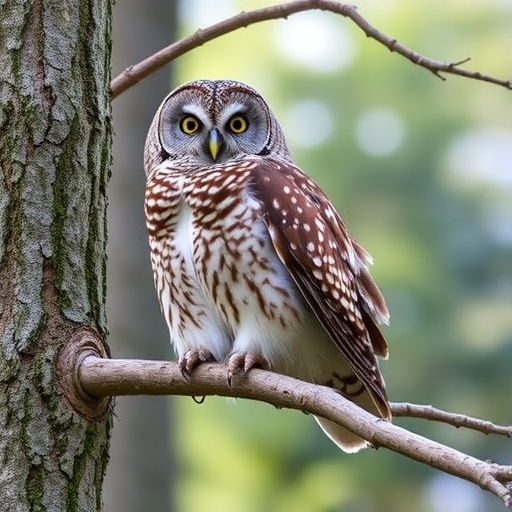
BLUE LAKE, Calif., Aug. 13, 2026 — An invasive owl is occupying the same ancient forests that northern spotted owls need for survival, according to a new study that uses GPS tracking to reveal the scale of the ecological conflict. Researchers found that barred owls consistently selected the tallest, oldest and most structurally complex forests in northwestern California—habitat characterized by large trees, multilayered canopies, dense vegetation and abundant cavities. These are also the forests most important to northern spotted owls for nesting and roosting. The findings suggest that barred owls are not merely expanding into the spotted owl’s range; they are concentrating in the precise locations where the threatened native species has the greatest need for refuge.
The study, published in Biological Conservation by scientists at the Integral Ecology Research Center, tracked 56 barred owls across approximately 4,070 square kilometers of forest. Using GPS telemetry, the researchers were able to examine habitat selection at the level of individual birds rather than relying only on broad distribution maps or occasional field observations. The resulting data showed a consistent preference for older forest structure. On average, 64 percent of a barred owl’s home range overlapped with mapped northern spotted owl habitat, while 38 percent overlapped with the highest-quality nesting and roosting forest. The overlap indicates that habitat protection alone may not be enough if an aggressive competitor continues to occupy the same stands.
Barred owls are native to eastern North America, where they evolved in forest communities without northern spotted owls. During the twentieth century, however, they expanded westward through a combination of natural range expansion and landscape changes that created connected forest corridors. In the Pacific Northwest and northern California, barred owls now occur throughout much of the range of the northern spotted owl, a species already pressured by logging, habitat fragmentation, wildfire and other environmental changes. The two owls are similar in size and use many of the same forest resources, but barred owls are generally more adaptable in diet and habitat use. Their arrival has created a form of biological interference in which the native owl can lose access to otherwise suitable habitat.
The GPS results also revealed an unexpected difference between the ecology of barred owls in California and their ecology in their native range. In northwestern California, an individual barred owl occupied an average home range of 6.7 square kilometers. That area is approximately 28 times larger than the home ranges previously measured by the same research group for barred owls in Louisiana. A large home range does not necessarily mean that every part of it is used equally, but it does indicate that each invading bird can influence a substantial area of forest. When territories overlap key nesting and roosting stands, even a relatively small number of barred owls may affect the distribution and behavior of spotted owls across a much wider landscape.
The researchers say the competition extends beyond the two owl species. Barred owls are generalist predators capable of hunting a broad range of animals, including flying squirrels, tree voles, salamanders, reptiles and small mammals. Some of these species are important prey for spotted owls, while others represent additional components of the old-growth food web. Barred owls have also been documented taking prey that northern spotted owls rarely pursue, including small carnivores such as western spotted skunks. This flexibility may allow barred owls to persist in a wider range of conditions and intensify pressure on multiple parts of the forest community. The study’s authors caution that the wider ecological consequences remain incompletely understood and require further investigation.
The most hopeful result came from areas where barred owls had been removed through a permitted research and management program. Because the physical structure of old-growth forest remains after the invasive birds are removed, the habitat can potentially become available to spotted owls again. Drawing on records from 1,171 barred owls removed across the region, the study estimated that more than 1,800 square kilometers of spotted owl habitat had been reopened for possible recolonization. Nearly 1,150 square kilometers of that area consisted of the highest-quality nesting and roosting forest. The calculation does not mean that spotted owls immediately occupy every cleared territory, but it demonstrates how predator management can restore access to habitat that still exists biologically but has become unavailable in practice.
“Habitat isn’t just trees, it’s trees a spotted owl can actually live in,” said Vitek Jirinec, a research scientist at the Integral Ecology Research Center and lead author of the study. “Managing the invader is proving just as critical as protecting the trees themselves.” The distinction is central to the conservation problem. A forest may remain intact according to satellite imagery, vegetation maps or legal habitat designations, yet functionally fail to support a target species if a dominant competitor controls the area. By combining movement data with detailed forest measurements, the researchers were able to quantify this difference between physical habitat and accessible habitat.
The findings support ongoing regional efforts involving the University of Wisconsin–Madison, the U.S. Department of Agriculture, the Hoopa Valley Tribe, the U.S. Forest Service, the California Department of Fish and Wildlife and other partners. These programs use removal operations as part of a broader research strategy designed to measure how spotted owls respond when barred owls are no longer present. Management is controversial because it requires the deliberate removal of one native North American bird from areas where it has expanded naturally, but conservation agencies regard the action as necessary to prevent the continued decline of the northern spotted owl. The research was funded primarily through the California Department of Fish and Wildlife’s Cannabis Restoration Grant Program.
Greta Wengert, co-founder and co-director of the Integral Ecology Research Center and principal investigator on the study, said the conflict should be viewed as a threat to an entire old-growth community rather than to one endangered species alone. “Spotted owls are the reason this study exists, but they’re part of a much larger old-growth food web,” she said. The new evidence suggests that protecting that food web will require two parallel approaches: preserving the remaining ancient forests and managing the invasive predator that occupies them. The study, titled “Invasive barred owls select old-forest structure: Functional habitat loss for spotted owls and a threat to old-forest fauna,” was published in Biological Conservation on Aug. 7, 2026. Its authors argue that long-term monitoring will be essential to determine whether reopened territories translate into sustained spotted owl recovery.
News Publication Date: 13-Aug-2026
Web References: https://doi.org/10.1016/j.biocon.2026.112035; https://IERCecology.org
References: Jirinec, V., Gabriel, M. W., Higley, J. M., et al. 2026. “Invasive barred owls select old-forest structure: Functional habitat loss for spotted owls and a threat to old-forest fauna.” Biological Conservation 322: 112035. DOI: 10.1016/j.biocon.2026.112035.
Keywords
barred owls, northern spotted owls, invasive species, old-growth forests, GPS telemetry, wildlife conservation, habitat loss, biological conservation, forest ecology, California
Cite Scienmag News
Margaret Porter. (August 13, 2026). GPS Study Shows Barred Owl Management Gives Spotted Owls a Fighting Chance. Scienmag. https://scienmag.com/gps-study-shows-barred-owl-management-gives-spotted-owls-a-fighting-chance/
Margaret Porter. "GPS Study Shows Barred Owl Management Gives Spotted Owls a Fighting Chance." Scienmag, 13 August 2026, https://scienmag.com/gps-study-shows-barred-owl-management-gives-spotted-owls-a-fighting-chance/. Accessed 3 September 2026.
Margaret Porter. "GPS Study Shows Barred Owl Management Gives Spotted Owls a Fighting Chance." Scienmag. August 13, 2026. https://scienmag.com/gps-study-shows-barred-owl-management-gives-spotted-owls-a-fighting-chance/


