


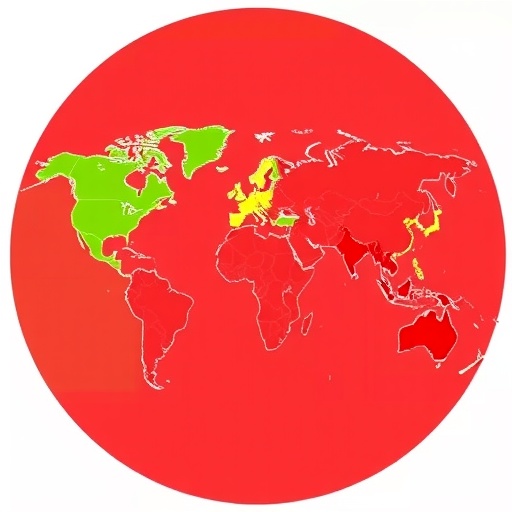
A groundbreaking new study has reshaped our understanding of global greenhouse gas emissions by spotlighting the critical role of asset ownership in driving carbon footprints. Traditionally, emissions accounting has focused on where goods are produced or consumed, but this paradigm overlooks a crucial dimension: who owns the firms behind these emissions. By extending the boundaries of emissions responsibility to corporate asset holders worldwide, the research reveals an alarming concentration of carbon footprints among the wealthiest individuals and institutions, surging disparities that outstrip even general wealth inequality.
This pioneering analysis, spanning the years 2010 to 2022, meticulously links emissions data to asset ownership across 197 jurisdictions, integrating rich datasets on wealth distribution, investment portfolios, capital stock, and foreign direct investment flows. The study transcends previous national-level estimates to present a comprehensive global map that defines ownership-based emissions, exposing the uneven distribution of carbon footprints tied to asset control. Such a refined lens unearths hidden patterns of carbon inequality embedded within global finance and investment structures, transforming our grasp of who truly bears carbon responsibility.
At the core of the findings lies a stark reality: ownership-based emissions exhibit profound inequality, surpassing disparities observed in traditional production or consumption-based accounting frameworks. This amplified inequality emerges because affluent investors disproportionately hold carbon-intensive asset classes, such as fossil fuel infrastructure, heavy industry, and resource extraction operations. Through ownership channels, a small global elite commands a substantially larger share of emissions than previously appreciated, revealing a powerful link between extreme wealth concentration and climate impact.
Equally significant is the dynamic evolution of foreign ownership emissions, which are increasingly reshaping the global emissions landscape. The study documents how emissions tied to foreign investors have grown steadily in importance, effectively shifting carbon accountability between regions. This transnational ownership of emissions challenges existing frameworks that typically assign responsibility based solely on geographic production or consumption. By mapping these cross-border linkages, the research demonstrates how capital flows can transfer carbon burdens internationally, complicating efforts to equitably allocate climate mitigation responsibilities.
A particularly striking insight emerges when examining major Western European countries. While these economies have succeeded in reducing their national, production-based emissions, their ownership-based emissions have stubbornly resisted decline. This divergence signals that domestic decarbonization policies may be undermined by continued exposure to foreign-owned, carbon-intensive assets in their investment portfolios. Thus, despite progress visible on national emission inventories, the embedded carbon responsibilities within asset ownership remain unchanged or even growing, suggesting significant policy blind spots.
The implications of this research reverberate beyond academic circles, pressing urgent questions for climate governance. Current policy instruments, such as carbon border adjustment mechanisms, primarily address emissions transferred via international trade linked to consumption. However, these measures fail to capture emissions associated with corporate ownership structures, which underpin production activities. As a result, emissions embedded in ownership networks remain largely unaccounted for, presenting a critical gap in climate accountability systems that risks weakening global mitigation ambitions.
Technically, the study employs an innovative methodological framework that integrates economic and environmental data streams at unprecedented resolution. By linking detailed wealth and portfolio data to country-level capital stock and production emissions, the authors construct a granular picture of ownership-based carbon footprints. This approach leverages international investment and financial data to allocate emissions not merely by where fuels are burned or products consumed, but by the ultimate beneficiaries of corporate assets, bridging the gap between finance, economics, and environmental science.
Beyond highlighting inequality, the research elucidates the structural mechanisms reinforcing the carbon intensity of wealthy asset holders. Wealthier individuals and institutional investors allocate capital disproportionately to sectors characterized by entrenched emissions profiles, including heavy industry, mining, fossil fuels, and transportation infrastructure. This sectoral allocation crystallizes ownership-based carbon footprints that are significantly larger than typical wealth metrics would suggest, indicating that decarbonizing elite investment portfolios could be as pivotal as targeted consumer behavior changes or industrial efficiency improvements.
Moreover, the international dimension of ownership-based emissions calls for a reassessment of global climate equity principles. Traditional divisions between developed and developing countries may not accurately reflect the diffuse nature of carbon responsibility embedded in financial globalization. Wealth accumulated in high-income regions often funds emissions-intensive production in middle- and low-income areas, creating complex interdependences that transcend national borders. Recognizing ownership as a determinant of emissions shifts the discourse toward a more nuanced negotiation of responsibilities, incorporating the role of global capital and financial power.
The authors underscore that ownership-based carbon footprints tend to concentrate even more than wealth itself, illustrating a hyper-inequality phenomenon. This means that within the distribution of wealth holders, those at the top have a disproportionately heavier carbon footprint than their share of assets alone might indicate. This finding complicates the narrative that economic growth can be decoupled from emissions, suggesting instead that top-tier investors’ structural asset choices perpetuate an intensified carbon burden. Rectifying this may require novel policy tools that target financial flows and investment criteria directly.
Importantly, this ownership-focused perspective opens new avenues for climate mitigation strategies. By targeting asset owners, regulators and policymakers can influence emission drivers upstream, addressing the source rather than just the surface manifestation of carbon release. Stricter climate-related financial disclosure, carbon screening of investment portfolios, and reorientation of capital markets toward low-carbon assets could be more impactful when ownership is considered explicitly. In this context, investors become not just financiers but active agents shaping the trajectory of emissions reduction.
Equally, this research spotlights the need for improved international coordination. As foreign ownership-based emissions become more prominent, unilateral national efforts become insufficient to comprehensively address the problem. International frameworks must evolve to incorporate ownership-linked accountability, possibly through multinational standards for emission attribution or coordinated financial regulations that address cross-border capital flows. Such cooperation would be essential to prevent leakage of responsibilities and to build transparent, fair mechanisms for emission reduction.
Underlying this complex portrait is the recognition that climate finance and carbon justice are deeply intertwined with wealth concentration and global capital allocation. Climate action thus demands a holistic understanding of economic power and asset distribution, not only technological innovation or consumer lifestyle change. Only by revealing these hidden layers of carbon responsibility can global policy mobilize the full spectrum of actors integral to decarbonizing the economy in line with global climate goals.
Looking forward, the study calls for expanded data collection and methodological refinement to further unravel the entangled webs of ownership-based emissions. Greater transparency in corporate asset ownership, investment disclosures, and capital flows at multinational scales will be essential. Enhanced tracking and standardization can empower stakeholders—from policymakers to civil society—to hold the most influential emitters accountable, ensuring climate mitigation efforts are both effective and equitable.
In conclusion, this pioneering work breaks new ground in revealing the substantial role of asset ownership in shaping global emission patterns. By exposing the disproportionate carbon footprints linked to the wealthiest asset holders and the rising importance of foreign ownership emissions, it challenges existing norms and tools designed to assign climate responsibility. Bridging economics, finance, and environmental science, the research demands a fundamental rethink of how the global community measures, manages, and mitigates its carbon legacy.
Cite Scienmag News
Sloane Callahan. (June 17, 2026). Global Inequality in Carbon Footprint Ownership Revealed. Scienmag. https://scienmag.com/global-inequality-in-carbon-footprint-ownership-revealed/
Sloane Callahan. "Global Inequality in Carbon Footprint Ownership Revealed." Scienmag, 17 June 2026, https://scienmag.com/global-inequality-in-carbon-footprint-ownership-revealed/. Accessed 4 September 2026.
Sloane Callahan. "Global Inequality in Carbon Footprint Ownership Revealed." Scienmag. June 17, 2026. https://scienmag.com/global-inequality-in-carbon-footprint-ownership-revealed/


