


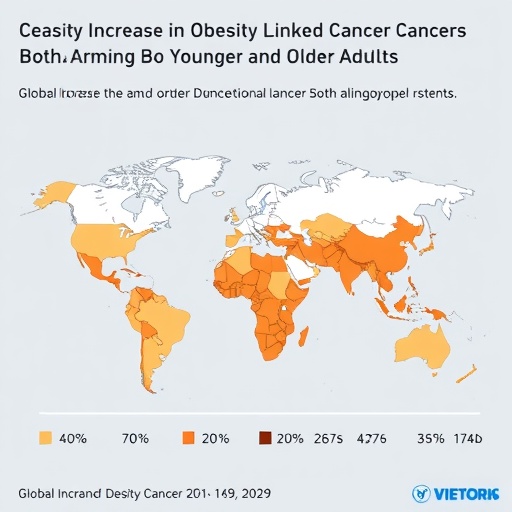
In a sweeping international comparative analysis, ground-breaking research reveals a notable escalation in obesity-related cancer incidence among both younger and older adult populations worldwide. This comprehensive study, recently published in the Annals of Internal Medicine, challenges previous assumptions that certain cancer types chiefly affect younger adults, underscoring a paradigm shift in understanding cancer epidemiology in the 21st century. Utilizing expansive, multi-continental data spanning nearly two decades, the investigation presents compelling evidence that obesity-driven carcinogenesis is a pervasive force influencing cancer trends across diverse age-demographics and global regions.
The researchers conducted a meticulous surveillance study, scrutinizing annual cancer incidence data from 2003 to 2017, gathered from 42 countries across Asia, Europe, Africa, North and South America, and Australasia through the International Agency for Research on Cancer’s GLOBOCAN database. They focused on 13 cancer types identified in earlier studies as rising in younger adults, including leukemia, colorectal, stomach, breast, prostate, endometrial, gallbladder, kidney, liver, esophageal, oral, pancreatic, and thyroid cancers. By segmenting the cohorts into younger adults (20-49 years) and older adults (50 years and above), the researchers provided granular insight into age-related cancer patterns, which revealed unexpected concordances.
Contrary to previous beliefs that rising incidences of certain cancers were isolated to younger populations, this analysis discovered that six cancer types—thyroid, breast, colorectal, kidney, endometrial cancer, and leukemia—are experiencing increased incidence rates in both younger and older adults across more than three-quarters of the scrutinized countries. The results indicate that carcinogenic exposures and risk factors, largely correlated with obesity, are exerting their effects broadly across adulthood rather than being confined to specific age brackets. This widespread rise prompts urgent reevaluation of age-specific cancer prevention strategies and public health policies.
The relationship between obesity and cancer is mechanistically complex and multi-factorial. Excess adiposity induces systemic inflammation, alters hormone levels, disrupts cell metabolism, and fosters a pro-carcinogenic microenvironment. Endometrial and kidney cancers, which showed the strongest associations with obesity in this study, exemplify how adipose tissue not only serves as an energy reservoir but also an endocrine organ. Its dysregulated secretory profile contributes to oncogenic signaling pathways, increased cellular proliferation, and impaired apoptosis, thereby accelerating tumorigenesis.
Of particular note, colorectal cancer incidence presents an intriguing dichotomy. While its rates surge in younger adults more sharply than in their older counterparts across nearly 70% of studied countries, the data suggest divergent underlying influences. In older adults, enhanced cancer screening and early detection efforts may contribute to observed trends, whereas in younger adults, novel carcinogenic exposures—potentially environmental, dietary, or microbiome-related—may be driving the increasing burden. These nuances emphasize the importance of tailored research exploring etiologic heterogeneity within cancer subtypes.
Conversely, the study found declining incidence rates for liver, oral, esophageal, and stomach cancers in the younger demographic for over half of the countries analyzed. These decreases may reflect successful public health interventions targeting causative agents such as tobacco use, alcohol consumption, and viral hepatitis. The contrasting temporal patterns among these cancers further illuminate the complex interplay of lifestyle, infection, and genetic factors influencing carcinogenesis.
The implications of these findings extend beyond epidemiology, informing urgent shifts in cancer research priorities and healthcare strategies. Recognizing that obesity-related cancer risk transcends age groups mandates integrated, lifespan-oriented prevention programs emphasizing weight management, physical activity, and metabolic health. Moreover, healthcare systems must anticipate and adapt to increasing burdens of obesity-linked malignancies in both younger and older patients, optimizing diagnostic vigilance and personalized treatment pathways.
Researchers stress caution in narrowly focusing investigations solely on younger adults, as historically done, given that many obesity-related cancers are concurrently rising in older populations. A broadened scope in scientific inquiry will better elucidate shared and distinct pathogenic mechanisms across the adult age spectrum, refine risk stratification tools, and inform equitable resource allocation.
Methodologically, this study leverages robust, longitudinal, and internationally harmonized datasets, overcoming inherent challenges in cross-national cancer surveillance such as varying registry quality and diagnostic standards. The rigorous analytical approach enhances the validity of observed trends and underscores the value of global collaborations in combating cancer’s evolving landscape.
In essence, the rising tide of obesity-linked cancers across adult populations worldwide signals a critical juncture. It demands comprehensive, multidisciplinary interventions spanning behavioral, clinical, and policy domains to stem this alarming trajectory. Future research must delve deeper into the molecular drivers, environmental modifiers, and sociocultural determinants underpinning this pattern, fostering innovative prevention and management paradigms.
Simultaneously, public health entities should elevate obesity as a formidable oncogenic risk factor in awareness campaigns and screening guidelines. Robust efforts to curb obesity prevalence worldwide could yield substantial dividends in diminishing the incidence of these impactful cancers, alleviating morbidity and mortality across societies.
Ultimately, this watershed study reshapes the cancer prevention narrative, highlighting the extensive and enduring impact of obesity on cancer incidence across adulthood and unequivocally calling for global, coordinated action to address this burgeoning health crisis.
Cite Scienmag News
Daisy Hatcher. (October 20, 2025). Global Increase in Obesity-Linked Cancers Among Both Younger and Older Adults. Scienmag. https://scienmag.com/global-increase-in-obesity-linked-cancers-among-both-younger-and-older-adults/
Daisy Hatcher. "Global Increase in Obesity-Linked Cancers Among Both Younger and Older Adults." Scienmag, 20 October 2025, https://scienmag.com/global-increase-in-obesity-linked-cancers-among-both-younger-and-older-adults/. Accessed 6 September 2026.
Daisy Hatcher. "Global Increase in Obesity-Linked Cancers Among Both Younger and Older Adults." Scienmag. October 20, 2025. https://scienmag.com/global-increase-in-obesity-linked-cancers-among-both-younger-and-older-adults/


