

Monday, July 20, 2026
Science
No Result
View All Result
  • Login
  • HOME
  • SCIENCE NEWS
  • CONTACT US
  • HOME
  • SCIENCE NEWS
  • CONTACT US
No Result
View All Result
Scienmag
No Result
View All Result
Home Science News Psychology & Psychiatry

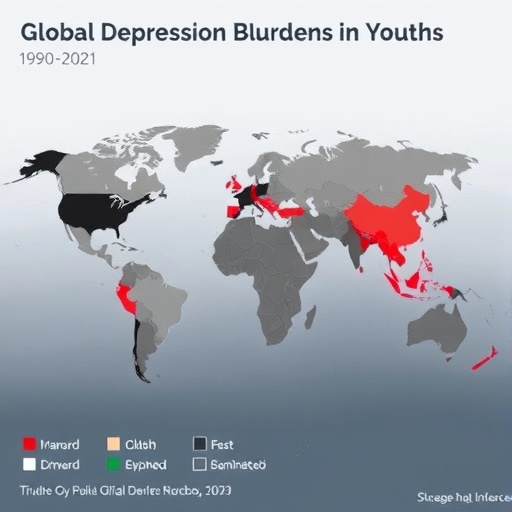
Global Depression Burden in Youths: 1990–2021

August 6, 2025
in Psychology & Psychiatry
Reading Time: 2 mins read
0
Global Depression Burden in Youths: 1990–2021
67
SHARES
605
VIEWS
Share on FacebookShare on Twitter
ADVERTISEMENT

The global burden of depression in adolescents and young adults, 1990–2021: systematic analysis of the global burden of disease study

BMC Psychiatry

volume 25, Article number: 767 (2025)
Cite this article

Background

Depression is a leading cause of disability among adolescents and young adults, yet comprehensive assessments of its global burden and associated risk factors in this population remain limited. This study aimed to evaluate the global, regional, and national trends in depression burden among individuals under 30 years of age from 1990 to 2021, and to identify key risk factors and disparities.

Methods

We analyzed data from the Global Burden of Disease Study 2021, focusing on depression incidence and disability-adjusted life years (DALYs) among individuals aged under 30. Temporal trends were assessed using an age-period-cohort (APC) model. We further examined trends using estimated annual percentage change (EAPC), frontier analysis, and inequality metrics to provide a comprehensive evaluation.

Results

From 1990 to 2021, both the incidence of depression and related DALYs in individuals under 30 increased by over 50%. Males experienced a larger proportional increase, although females had an age-standardized incidence rate (ASIR) 23 times higher than males in 2021. The highest burden was observed in the 20–24 age group, while the fastest growth occurred among those aged 15–19. Individuals born after 2000 showed a higher prevalence of depression. High sociodemographic index (SDI) regions—particularly high-income North America and Greenland—had the highest ASIR and age-standardized DALY rate (ASDR). The most prominent risk factors were bullying victimization (61.8%), childhood sexual abuse (12.0%), and intimate partner violence (12.6%). Notable regional disparities were observed, with countries like Switzerland, Norway, Monaco, and Germany showing rapid increases in depression burden.

Conclusions

The burden of depression among young people has risen substantially over the past three decades, with disproportionate impacts on females, post-2000 birth cohorts, and those in high-SDI regions. Interventions targeting modifiable risk factors—particularly bullying, childhood abuse, and intimate partner violence—are essential to reduce the burden. Tailored, region-specific strategies are necessary to effectively address disparities and improve mental health outcomes in youth.

Liu, Z., Kuai, M. The global burden of depression in adolescents and young adults, 1990–2021: systematic analysis of the global burden of disease study.
BMC Psychiatry 25, 767 (2025). https://doi.org/10.1186/s12888-025-07201-8

https://doi.org/10.1186/s12888-025-07201-8

Tags: adolescent mental health statisticscomprehensive assessment of depression in adolescentsdisability-adjusted life years in young adultsfactors influencing depression in young peopleglobal burden of disease study analysisglobal depression trends in youthsinternational youth mental health initiativesmental health challenges for young adultsmental health in adolescents 1990-2021regional disparities in adolescent depressionrisk factors for youth depressiontrends in youth depression prevalence
Share27Tweet17
Previous Post

Stable 4.8V Cathodes via Supersaturated High-Valence Design

Next Post

Cultivating Shade Trees Reduces Chocolate’s Environmental Footprint

Related Posts

Rannasangpei crocin-1 improves valproate-induced autism-like behaviors by reducing oxidative stress
Psychology & Psychiatry

Rannasangpei crocin-1 improves valproate-induced autism-like behaviors by reducing oxidative stress

July 19, 2026
Gut Microbiome Metabolites Shape Development of Stress-Related Mental Disorders
Psychology & Psychiatry

Gut Microbiome Metabolites Shape Development of Stress-Related Mental Disorders

July 19, 2026
Two-week High-Frequency Aerobic Training Improves Depressive Symptoms and Frontal Function
Psychology & Psychiatry

Two-week High-Frequency Aerobic Training Improves Depressive Symptoms and Frontal Function

July 18, 2026
Neurobiological Basis of Stress and Alcohol Resilience in Male and Female Rats
Psychology & Psychiatry

Neurobiological Basis of Stress and Alcohol Resilience in Male and Female Rats

July 18, 2026
Cannabis Exposure Alters Reelin Signaling in Schizophrenia-Like Dual-Hit Mice
Psychology & Psychiatry

Cannabis Exposure Alters Reelin Signaling in Schizophrenia-Like Dual-Hit Mice

July 17, 2026
Prefrontal intermittent theta-burst stimulation alters hemodynamic responses in major depression
Psychology & Psychiatry

Prefrontal intermittent theta-burst stimulation alters hemodynamic responses in major depression

July 17, 2026
Next Post
Cultivating Shade Trees Reduces Chocolate’s Environmental Footprint

Cultivating Shade Trees Reduces Chocolate’s Environmental Footprint

  • Mothers who receive childcare support from maternal grandparents show more

    Mothers who receive childcare support from maternal grandparents show more parental warmth, finds NTU Singapore study

    27656 shares
    Share 11059 Tweet 6912
  • University of Seville Breaks 120-Year-Old Mystery, Revises a Key Einstein Concept

    1061 shares
    Share 424 Tweet 265
  • Bee body mass, pathogens and local climate influence heat tolerance

    682 shares
    Share 273 Tweet 171
  • Researchers record first-ever images and data of a shark experiencing a boat strike

    546 shares
    Share 218 Tweet 137
  • Groundbreaking Clinical Trial Reveals Lubiprostone Enhances Kidney Function

    531 shares
    Share 212 Tweet 133
Science

Embark on a thrilling journey of discovery with Scienmag.com—your ultimate source for cutting-edge breakthroughs. Immerse yourself in a world where curiosity knows no limits and tomorrow’s possibilities become today’s reality!

RECENT NEWS

  • Rannasangpei crocin-1 improves valproate-induced autism-like behaviors by reducing oxidative stress
  • Sleep Quality Links Synergistically with Frailty to Increase Cardiometabolic Multimorbidity in Elderly Chinese
  • Gut Microbiome Metabolites Shape Development of Stress-Related Mental Disorders
  • Cognitive reserve helps older adults resist frailty and recover better

Categories

  • Agriculture
  • Anthropology
  • Archaeology
  • Athmospheric
  • Biology
  • Biotechnology
  • Blog
  • Bussines
  • Cancer
  • Chemistry
  • Climate
  • Earth Science
  • Editorial Policy
  • Marine
  • Mathematics
  • Medicine
  • Pediatry
  • Policy
  • Psychology & Psychiatry
  • Science Education
  • Social Science
  • Space
  • Technology and Engineering

Subscribe to Blog via Email

Success! An email was just sent to confirm your subscription. Please find the email now and click 'Confirm Follow' to start subscribing.

Join 5,146 other subscribers

© 2025 Scienmag - Science Magazine

Welcome Back!

Login to your account below

Forgotten Password?

Retrieve your password

Please enter your username or email address to reset your password.

Log In
No Result
View All Result
  • HOME
  • SCIENCE NEWS
  • CONTACT US

© 2025 Scienmag - Science Magazine
