


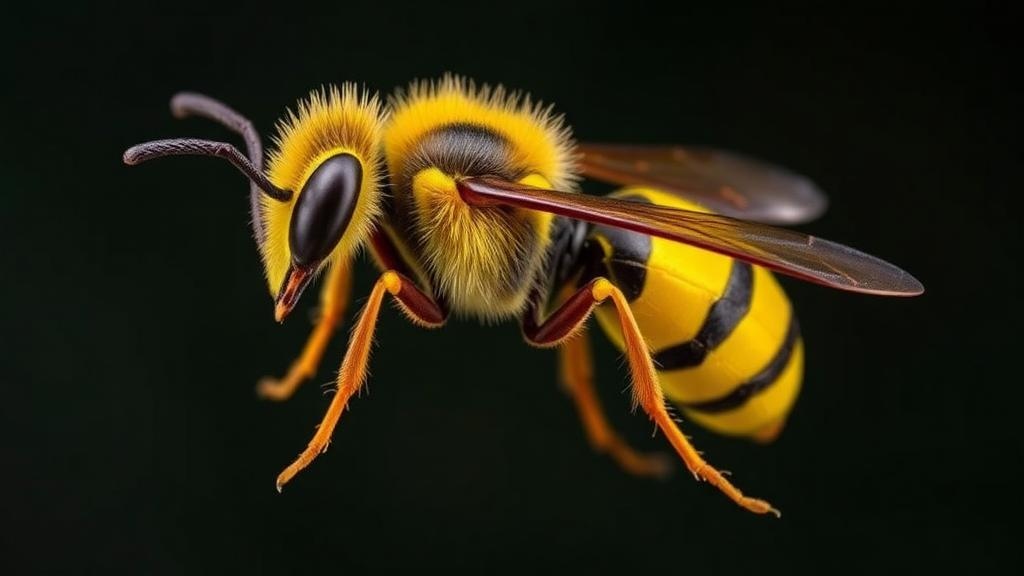
Deep in the forested slopes of China’s Dabie Mountains, an unusually large and strikingly patterned solitary wasp has been hiding in plain sight. Researchers examining wasp specimens preserved at the Institute of Zoology of the Chinese Academy of Sciences have now confirmed that three of these individuals, one female and two males collected in Anhui Province in 2023, belong to a species entirely new to science. The insect has been named Megaodynerus flavogaster, a name drawn from the Latin words for yellow and belly, a nod to the extensive yellow markings that decorate its abdomen. The discovery, published in the Journal of Hymenoptera Research, also delivers something the scientific world has never had before: a description of the male of the genus Megaodynerus, complete with high-resolution images of its anatomy.
Potter wasps, the members of the subfamily Eumeninae, are among the most diverse and recognizable of all solitary wasps. Famous for the mud nests that many species construct and provision with paralyzed prey for their young, they are found on every continent except Antarctica. Yet even within such a well-studied group, some lineages remain almost completely unknown. Megaodynerus is one of them. Established by the Austrian taxonomist Josef Gusenleitner in 2012, the genus was based on a single species, Megaodynerus maximus, described from a specimen collected in Laos. For nearly a decade it remained a one-species genus, until a second species, Megaodynerus bimaculus, turned up in Hunan Province in 2021. Until now, no male of the genus had ever been formally described, a gap that made it difficult to place Megaodynerus within the evolutionary tree of potter wasps.
The new species stands out immediately on account of its size. Female Megaodynerus flavogaster measure around 16.7 millimeters in body length, with a forewing of roughly 15 millimeters, while the males are smaller at 10.5 to 11.4 millimeters. These are giants by the standards of most eumenine wasps, and the genus as a whole is notable for females reaching 16.2 to 18.0 millimeters. The holotype female was collected in Tiantangzhai Town in Jinzhai County, Lu’an City, at an altitude of about 703 meters on 15 May 2023, while the two paratype males came from Yuexi County in Anqing City, at 716 meters, on 2 June 2023. All three specimens are now housed in the National Animal Collection Resource Center in Beijing.
Distinguishing a new species in a group with few relatives requires a careful inventory of anatomical details, and the authors of the study, Long, Chen and Li, worked through the specimens under high-magnification stereomicroscopes, photographing them with a KEYENCE VHX-5000 digital microscope system. The new species differs from both of its known relatives in a consistent combination of features. Most tellingly, the metanotum, a plate on the upper surface of the middle section of the body, lacks the median longitudinal groove seen in M. bimaculus. Where the dorsal and rear surfaces of the propodeum, the rear segment of the thorax, meet, M. flavogaster bears a raised, rounded carina, a ridge that is absent in its Hunan relative. The color pattern is equally distinctive: the first and second segments of the metasoma, the wasp’s abdomen, are almost entirely brownish yellow apart from their front margins and a median black spot, and the third and fourth segments carry apical brownish yellow bands.
The detailed description reveals a wasp of considerable architectural complexity. The head is slightly wider than long in frontal view, with a clypeus about 1.1 times as wide as long, marked by small, sparse, shallow punctures and a shallow apical emargination flanked by blunt lateral points. The mandibles carry four prominent teeth. The frons is distinctly reticulo-punctate, covered in a net-like pattern of pits, and in the female the vertex bears two connected cephalic foveae, specialized depressions densely packed with pubescence whose function in these wasps remains a subject of study. The mesoscutum, the large dorsal plate of the thorax, carries two deep longitudinal furrows toward its rear, a trait Megaodynerus shares with the related genus Symmorphus, one of several clues to its family connections.
The males finally on record bring their own revelations. In the male, the clypeus is wholly yellow with a broader and deeper apical emargination forming acute lateral teeth, and the last antennal segment, A13, is bent back into a hook-like structure reaching the base of A11. The epicnemial carina, a ridge on the side of the thorax, is much more strongly developed than in the female, and the penis valve widens abruptly at its apex, features that will now allow researchers to identify male Megaodynerus for the first time and to include them in comparative and phylogenetic work. The male’s antennal hook is in fact one of the defining characters of the genus, listed in its diagnosis alongside an elongate first metasomal segment that is slightly wider than long and clearly narrower than the second.
To make sense of this small but growing genus, the authors assembled an updated identification key covering all three known species worldwide, together with a global distribution map. The key separates the species by a handful of reliable characters: the proportions and color of the female clypeus, the presence or absence of a median furrow on the metanotum, the presence or absence of a carina on the propodeum, and the extent of yellow on the abdominal segments. Such keys are the working tools of field biology, allowing any researcher with a microscope to place a specimen confidently within the genus and to recognize M. flavogaster in the mountains of eastern China.
Perhaps the most intriguing implication of the study concerns biogeography. With records from Laos, Fujian, Hunan and now Anhui, the known range of Megaodynerus stretches across what has generally been treated as the boundary between the Oriental and Palearctic zoogeographic realms. The new records from the Dabie Mountains represent the northernmost limit of the genus, in a region considered part of the Palearctic and a classic transitional zone along its southern margin. The authors argue that Megaodynerus cannot simply be written off as an Oriental genus, a conclusion that complicates assumptions about where these wasps evolved and how their ancestors dispersed across eastern Asia.
For all their impressive size, Megaodynerus wasps remain extraordinarily difficult to encounter. Only a handful of specimens have ever been collected, and virtually nothing is known of their habitat requirements, nesting behavior, prey preferences or life history. Their phylogenetic position within Eumeninae is likewise unresolved, though shared traits with Symmorphus and a broad clypeus reminiscent of Orancistrocerus offer starting points for future molecular work. The authors hope that documenting the new species and mapping its distribution will raise awareness of the genus and stimulate the fieldwork needed to fill these gaps. In a region where mountaintop forests are under pressure from development and climate change, finding a giant wasp genus with three known species and unknown biology is a reminder of how much remains undiscovered, even in groups as familiar as the potter wasps, and how much depends on the patient curation of museum collections where such discoveries so often begin.
Subject of Research: Taxonomic description of a new potter wasp species and the first known males of the rare genus Megaodynerus
Article Title: Taxonomic notes on the rare genus Megaodynerus Gusenleitner, 2012 ( Hymenoptera , Vespidae , Eumeninae ): a new species from China, with an updated key to all known species
Article References: Long, S.-Z., Chen, B., & Li, T.-J. (2025). Taxonomic notes on the rare genus Megaodynerus Gusenleitner, 2012 (Hymenoptera, Vespidae, Eumeninae): a new species from China, with an updated key to all known species. Journal of Hymenoptera Research, 98, 1031-1037. https://doi.org/10.3897/jhr.98.172639
Image Credits: AI Generated
Keywords: Megaodynerus, Vespidae, Eumeninae, potter wasps, taxonomy, new species, China, Anhui, Dabie Mountains, Hymenoptera, male description, distribution
Cite Scienmag News
Gavin Prescott. (October 17, 2026). Giant yellow-bellied wasp from China’s mountains reveals secrets of a rare genus. Scienmag. https://scienmag.com/giant-yellow-bellied-wasp-from-chinas-mountains-reveals-secrets-of-a-rare-genus/
Gavin Prescott. "Giant yellow-bellied wasp from China’s mountains reveals secrets of a rare genus." Scienmag, 17 October 2026, https://scienmag.com/giant-yellow-bellied-wasp-from-chinas-mountains-reveals-secrets-of-a-rare-genus/. Accessed 17 October 2026.
Gavin Prescott. "Giant yellow-bellied wasp from China’s mountains reveals secrets of a rare genus." Scienmag. October 17, 2026. https://scienmag.com/giant-yellow-bellied-wasp-from-chinas-mountains-reveals-secrets-of-a-rare-genus/


