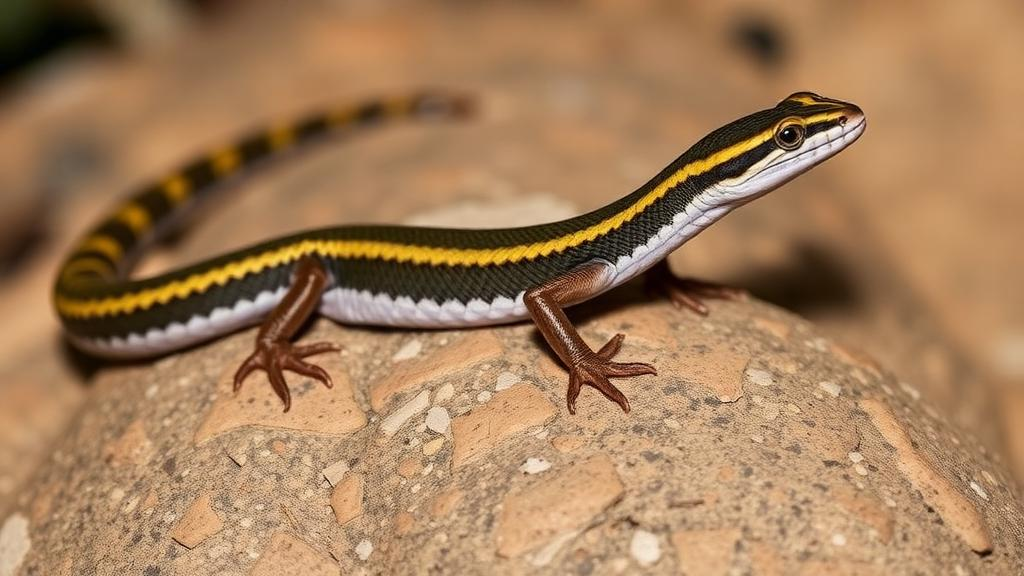
Deep in the montane forests of Yunnan Province, China, herpetologists have stumbled upon a lizard that breaks one of the most consistent rules of its genus. A newly described skink, formally named Scincella gigas, measures 125 millimeters from snout to vent and more than 316 millimeters in total length, even though part of its tail had regrown after an earlier injury. That may not sound enormous by lizard standards, but for Scincella — a genus of small, secretive ground skinks whose members almost never exceed 80 millimeters in snout-vent length — it is a staggering outlier, roughly a quarter again larger than the biggest species previously known. The discovery, published in the journal Zoosystematics and Evolution, raises the number of recognized Scincella species to 58 and adds a conspicuous giant to a group long defined by its miniaturization.
The story began during field surveys in May 2026 in Fengyi Town, Dali City, within the Dali Bai Autonomous Prefecture. The research team, led by scientists affiliated with Qinghai University, encountered a single adult female skink in an unusual and poignant circumstance: it had fallen into an artificial concrete water reservoir and was found severely weakened, nearly unable to move. The claws on all four limbs were extensively worn or broken, suggesting the animal had spent a long time struggling to climb the smooth walls before being rescued. Despite its compromised condition, the specimen’s sheer size — far beyond anything recorded in the genus — immediately signaled that the researchers were looking at something extraordinary.
Preliminary examination of the rescued animal revealed a suite of features characteristic of Scincella: relatively short limbs, a transparent palpebral disc in the lower eyelid, and a lower secondary temporal scale overlapping the upper one. Yet the animal was unmistakably not any known species. To resolve its identity, the team turned to integrative taxonomy, combining detailed morphological analysis with molecular phylogenetics — an approach that has transformed reptile systematics over the past decade, particularly in species groups with conservative external anatomy and widespread cryptic lineages.
For the genetic work, the researchers extracted total genomic DNA from preserved liver tissue and amplified four mitochondrial gene fragments: 12S and 16S ribosomal RNA genes, cytochrome c oxidase subunit I (CO1), and cytochrome b. The final concatenated alignment comprised 2,207 base pairs. These new sequences were analyzed alongside 150 sequences from 68 individuals representing 38 nominal Scincella species, with two other skink genera serving as outgroups. Bayesian Inference analyses in MrBayes and Maximum Likelihood analyses in IQ-TREE, each with substitution models selected under the Akaike information criterion, both recovered the Dali specimen as a distinct lineage within the genus, positioned outside a major clade corresponding to the S. potanini–S. monticola complex — although that particular relationship received only weak statistical support.
The genetic distances were unambiguous. Uncorrected pairwise p-distances showed the new species differing from all examined congeners by at least 4.4 percent in 16S (versus S. chengduensis) and up to 10.0 percent (versus S. rufocaudata), and by at least 14.2 percent in CO1 (versus S. fansipanensis) and up to 21.6 percent (versus S. reevesii). These values are comparable to or exceed the distances separating many currently recognized Scincella species, whose interspecific 16S distances in the dataset ranged from 2.0 to 13.7 percent and CO1 distances from 7.6 to 23.4 percent. Combined with the morphology, the molecular evidence left little doubt that the giant skink represented an undescribed taxon.
That morphology is itself remarkable. Beyond its exceptional size, the holotype — an adult female deposited in the herpetological collection of Qinghai University under catalogue number QHU R2026003 — displays a unique combination of scalation characters. Most striking is the presence of three prefrontal scales arranged in a single transverse row; every other known species in the genus has two, and one, S. apraefrontalis, lacks prefrontals entirely. The new species also has six supraciliaries, seven supralabials separated from the eye by a row of small scales, 28 midbody scale rows, 80 paravertebral scale rows, and 81 ventral scale rows including the gular region. Its third pair of chin shields is separated medially by four small scales, its limbs are too short for the toes and fingers to meet when adpressed against the body, and in life it bears broad dorsolateral stripes with distinctly serrated margins — each indentation carrying an irregular white blotch.
The coloration, documented in life before preservation, is equally distinctive. The dorsum is brown with a median series of large, irregular black blotches running from the neck down the body and tail, flanked by broad dark dorsolateral stripes. The flanks fade from pale brown to flesh-brown toward the belly, dotted with small white and black spots, while the tail sides show a striking pattern of white spots arranged in regular transverse rows against a greyish-brown background densely speckled with black — producing a banded black-and-white appearance. The ventral surfaces are creamy yellow-white and largely immaculate, with small black spots on the head and neck that fade away along the body.
In formal recognition of its proportions, the species was named Scincella gigas, from the Latinized Greek gígas, meaning giant. The authors proposed
Subject of Research: Description of a new giant species of ground skink (Scincella gigas) from Yunnan Province, China, based on morphological and molecular evidence
Article Title: A mountain giant: description of the largest known species of the genus Scincella Mittleman, 1950 ( Squamata , Scincidae ) from Yunnan Province, China
Article References: Xu, Y., Deng, J., Qi, S., Ma, S., Zhang, T., Cai, B., Wang, H., Sun, F., Nguyen, T. V., Poyarkov, N. A., & Peng, L. (2026). A mountain giant: description of the largest known species of the genus Scincella Mittleman, 1950 (Squamata, Scincidae) from Yunnan Province, China. Zoosystematics and Evolution, 102(4), 1047-1063. https://doi.org/10.3897/zse.102.204139
Image Credits: AI Generated
Keywords: Scincella gigas, skink, new species, Yunnan, China, herpetology, taxonomy, mitochondrial DNA, phylogenetics, gigantism, montane forest, biodiversity
Cite Scienmag News
Margaret Porter. (October 16, 2026). Giant skink discovered in China’s mountains rewrites the record books for a genus of tiny lizards. Scienmag. https://scienmag.com/giant-skink-discovered-in-chinas-mountains-rewrites-the-record-books-for-a-genus-of-tiny-lizards/
Margaret Porter. "Giant skink discovered in China’s mountains rewrites the record books for a genus of tiny lizards." Scienmag, 16 October 2026, https://scienmag.com/giant-skink-discovered-in-chinas-mountains-rewrites-the-record-books-for-a-genus-of-tiny-lizards/. Accessed 16 October 2026.
Margaret Porter. "Giant skink discovered in China’s mountains rewrites the record books for a genus of tiny lizards." Scienmag. October 16, 2026. https://scienmag.com/giant-skink-discovered-in-chinas-mountains-rewrites-the-record-books-for-a-genus-of-tiny-lizards/