


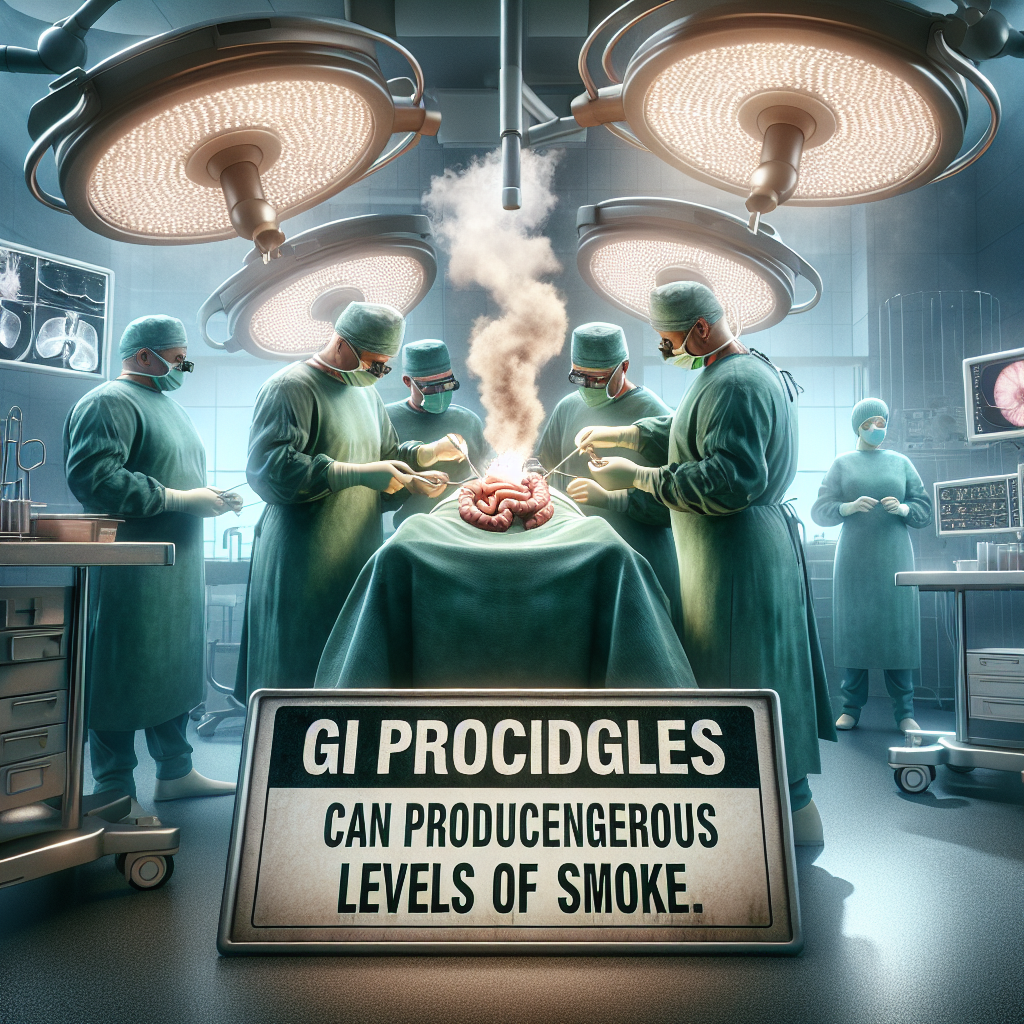
BETHESDA, MD. (May 9, 2024) — Health care professionals attending certain smoke-producing endoscopic gastrointestinal procedures, including a procedure that uses electrical current to remove polyps, could be exposed to dangerous toxin levels equivalent to smoking a cigarette during each procedure and face “significant health risks” over their careers, according to a study scheduled for presentation at Digestive Disease Week® (DDW) 2024.
BETHESDA, MD. (May 9, 2024) — Health care professionals attending certain smoke-producing endoscopic gastrointestinal procedures, including a procedure that uses electrical current to remove polyps, could be exposed to dangerous toxin levels equivalent to smoking a cigarette during each procedure and face “significant health risks” over their careers, according to a study scheduled for presentation at Digestive Disease Week® (DDW) 2024.
“Surgeons in the operating room have regulations and guidelines to mitigate smoke exposure, but that does not exist for gastrointestinal endoscopy,” said Trent Walradt, MD, a research fellow at Brigham and Women’s Hospital and lead author of the study. “When you’re using cautery, it generates a smoke plume. We wanted to know whether the smoke that’s produced during some of our endoscopic procedures is dangerous.”
Researchers placed equipment in an endoscopy lab during 27 procedures at Brigham and Women’s Hospital to evaluate air quality before and during four different types of gastrointestinal endoscopic procedures that produce smoke, such as procedures to stop bleeding, reduce the size of the opening to the small intestine after gastric bypass, or to remove cancerous and pre-cancerous polyps near muscle.
The study found that the peak level of volatile organic compounds reached twice the maximum safe level determined by the Environmental Protection Agency. Elevated levels of ultrafine particles and fine inhalable particles less than 2.5 micrometers were found during all the procedures, with the highest average levels occurring during argon plasma coagulation, a procedure that uses argon gas and an electrical current to cauterize and remove tissue. The intensity and length of exposure during a single procedure was similar to smoking a cigarette.
“Over the course of a career, endoscopic smoke may pose significant health risks to personnel in the endoscopy suite,” said Chris Thompson, MD, director of endoscopy at Brigham and Women’s Hospital and principal investigator on the study. “If you’re doing four or five procedures a day, that’s five cigarettes a day. Over the course of a week, it’s like you’re smoking a pack of cigarettes. That’s not acceptable.”
“We’re in the early phases of this, but I think our findings are very important, and quite frankly, a little concerning and surprising,” Thompson said.
Procedures included in the study were argon plasma coagulation, gastric endoscopic submucosal dissection, colonic endoscopic submucosal dissection and ampullary sphincterotomy.
Additional research is needed to better understand the threat, but researchers say possible solutions are the use of insufflators, devices that deliver gas to open up space within the body during surgery, or other devices to remove smoke during procedures, using masks, or making changes to how procedures are performed to produce less smoke.
“As we develop new tools and techniques, more procedures are generating this smoke,” Walradt said. “As we’re pushing those limits and doing more to help patients, we need to be aware of the side effects and protect ourselves too.”
DDW Presentation Details
Dr. Walradt will present data from the study, “An unrecognized threat: Evaluation of air-pollutant exposure during smoke-generating endoscopy procedures,” abstract Mo1121, on Monday, May 20, at 12:30 p.m. EDT. For more information about featured studies, as well as a schedule of availability for featured researchers, please visit www.ddw.org/press.
###
Digestive Disease Week® (DDW) is the largest international gathering of physicians, researchers and academics in the fields of gastroenterology, hepatology, endoscopy and gastrointestinal surgery. Jointly sponsored by the American Association for the Study of Liver Diseases (AASLD), the American Gastroenterological Association (AGA), the American Society for Gastrointestinal Endoscopy (ASGE) and the Society for Surgery of the Alimentary Tract (SSAT), DDW is an in-person and online meeting from May 18-21, 2024. The meeting showcases more than 5,600 abstracts and hundreds of lectures on the latest advances in GI research, medicine and technology. More information can be found at www.ddw.org
Cite Scienmag News
Ophelia Keating. (May 9, 2024). GI procedures can produce dangerous levels of smoke. Scienmag. https://scienmag.com/gi-procedures-can-produce-dangerous-levels-of-smoke/
Ophelia Keating. "GI procedures can produce dangerous levels of smoke." Scienmag, 9 May 2024, https://scienmag.com/gi-procedures-can-produce-dangerous-levels-of-smoke/. Accessed 3 September 2026.
Ophelia Keating. "GI procedures can produce dangerous levels of smoke." Scienmag. May 9, 2024. https://scienmag.com/gi-procedures-can-produce-dangerous-levels-of-smoke/


