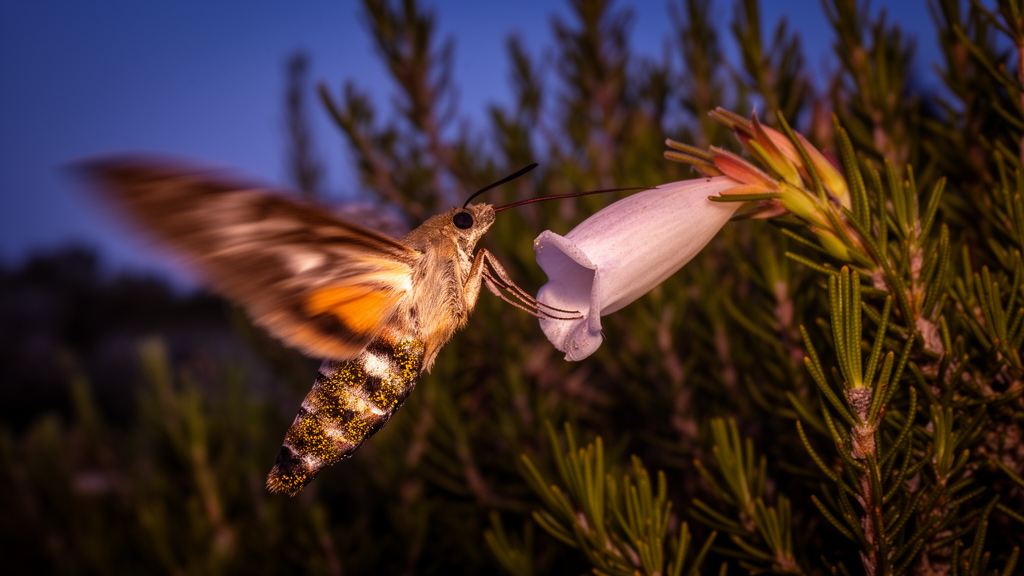
On the slopes of Table Mountain National Park, after dark and with the help of motion-activated cameras, researchers have captured something no one had ever documented before: hawkmoths hovering at the long, pale nectar spurs of a fynbos orchid and flying off with its pollen packages stuck to their proboscides. The observations, published in African Invertebrates, mark the first confirmed case of nocturnal hawkmoth pollination on the Cape Peninsula, one of the most botanically diverse corners of the planet, and they challenge a long-standing assumption that this specialized pollination system is essentially absent from the region’s famous shrublands.
The plant at the center of the discovery is Satyrium candidum, an orchid bearing white, scented flowers with nectar spurs roughly 30 millimeters long, a textbook example of what botanists call the sphingophilous pollination syndrome. Flowers adapted to hawkmoths typically combine deep nectar-bearing tubes with strong, mostly nocturnal scent, a combination that excludes short-tongued insects and favors hovering moths with long proboscides. Earlier surveys of South African flora had suggested that such systems, while widespread in the summer-rainfall grasslands and savannas of the east, are strikingly rare in the winter-rainfall fynbos of the west. The new fieldwork suggests the rarity may be partly an artifact of how difficult these moths are to observe.
Between 18 October and 1 November 2025, the research team studied a population of around 40 Satyrium candidum plants growing in flat sandy ground among sandstone outcrops about one kilometer northeast of St. James Peak, in fynbos that had burned two years earlier. Because hawkmoths forage quickly at dusk and after dark, the team combined old-fashioned direct observation, three evening sessions of 45 minutes each beginning at sunset, with a modern technique that is transforming nocturnal pollination ecology: Bushnell NatureView motion-activated cameras positioned roughly 30 centimeters from orchid inflorescences on 12 evenings, set to record only at night with sensitivity turned high to catch any visiting insect.
The payoff came in four documented visits across three nights: one seen directly and three captured on camera footage. In every case the moths foraged extensively from the nectar spurs, and in two cases the moths were visibly carrying the orchid’s pollinaria, the paired pollen structures that glue onto a pollinator’s proboscis and are later transferred to another flower’s stigma. Three of the four moths could be identified as Hyles livornica, the striped hawkmoth, a wide-ranging species whose proboscis length of about 30.5 millimeters, measured in an earlier study, almost exactly matches the mean spur length of 28.7 millimeters recorded for S. candidum. The fourth moth could not be reliably identified but may also have been H. livornica.
Camera traps and direct observations also recorded numerous settling moths, which either approached the inflorescences without landing or briefly landed to probe only one or a few flowers. None of these smaller moths carried pollinaria, and their behavior makes functional sense given the orchid’s measurements. The standing crop of nectar averaged 0.70 microliters with a sugar concentration averaging 41.8 percent, a reading that understates the true value because three flowers exceeded the 50 percent limit of the refractometer. The distance from the rostellum to the top of the nectar column, effectively the minimum proboscis needed to reach any reward, averaged 21.2 millimeters, longer than the proboscides of the region’s settling moths, which typically fall short of 20 millimeters. The concentrated, viscous nectar may also explain the moths’ long foraging bouts, since viscous solutions take longer to imbibe.
Pollination success in the studied flowers was strikingly high: 19 of 24 flowers had lost at least one pollinarium and 12 had pollen massulae deposited on their stigmas, leaving only five flowers, about 21 percent, with no signs of pollination. Supplementary observations elsewhere in the fynbos reinforced the pattern. At Franschhoek Pass in 2008 a large unidentified hawkmoth was seen visiting several S. candidum flowers, and in the mountains southeast of the Mount Hebron nature reserve in 2011, three visits by large hawkmoths were recorded, two of them carrying pollinaria, alongside visits by a small hawkmoth species and by pollinaria-free settling moths.
To place these observations in context, the authors combed museum collections and citizen science data. The Iziko Museum in Cape Town holds 53 South African hawkmoth species, all present outside the Western Cape Province but only 21 recorded within it, while iNaturalist lists 74 South African species, with just 30 in the Western Cape. Not a single South African hawkmoth species is unique to the Western Cape. Yet of the 78 hawkmoth species recorded nationally, 18 have been documented as pollinators of South African plants, and 8 of those occur in the Western Cape. Crucially, museum specimens of hawkmoths from the Cape Peninsula date back as far as 1862, indicating the moths are long-term residents rather than recent arrivals exploiting garden plants in the Cape Town metropolitan area.
This matters because the Peninsula hosts several other plants with hawkmoth-adapted flowers whose pollinators had never been confirmed there. Bonatea speciosa, an orchid of coastal thicket, has been shown to be hawkmoth-pollinated in coastal forest bordering fynbos in the southern Cape, and Harveya capensis, a parasitic plant with a long floral tube, is likewise a likely candidate. Marloth’s early twentieth-century records of hawkmoth pollination on the Peninsula cannot be verified for lack of spatiotemporal detail, and in one case he misinterpreted a long floral tube of Gethyllis as a nectar reservoir. The new study suggests that the apparent absence of hawkmoth pollination on the Peninsula reflects the difficulty of observing fast-flying nocturnal insects rather than a genuine biological gap.
Still, the broader picture confirms that fynbos is genuinely poorer in hawkmoth pollination systems than the rest of South Africa. Only about 12 plant species, spread across just a few lineages, are known to be hawkmoth-pollinated in the Cape Floristic Region, compared with nearly three times as many species across many families elsewhere in the country. The authors weigh competing explanations: the fynbos region is smaller in area and species richness than the rest of the country, but other comparably small regions such as coastal KwaZulu-Natal are rich in hawkmoth systems, and the species-count difference exceeds what floristic size alone would predict. Sampling bias is also possible, since published studies do not represent a random or evenly distributed sample of plant communities.
A long-standing hypothesis holds that fynbos limits hawkmoths at the larval stage. Hawkmoth caterpillars typically feed on broad, soft-leaved plants, whereas fynbos vegetation is dominated by tough, sclerophyllous foliage, and many key larval host groups are rare or absent from the biome. Yet native hosts are not altogether missing: the polyphagous larvae of Hyles livornica feed on a diverse range of taxa including fynbos elements, Temnora pylas larvae feed on the Cape plant Anthospermum aethiopicum, and common pollinating Hippotion species use Zantedeschia aethiopicum, widespread across the Cape Floristic Region, as a host. Some apparent Cape hawkmoth records may be inflated by cultivated plants, as with Theretra capensis feeding on grapevines in wine regions, but the guild of native sphingophilous plants in fynbos implies that hawkmoths have been present over evolutionary time scales, sustaining a small but real pollination niche. Settling moths, by contrast, show specialized larval associations with typical fynbos plants such as Erica, Cliffortia and Proteaceae, and may play a comparatively larger role in this vegetation.
The authors conclude that the hawkmoth pollination niche is available to fynbos plants, including those on the Cape Peninsula, but appears more restricted than in other South African regions. Testing that conclusion rigorously will require objective comparisons of hawkmoth-flower systems inside and outside fynbos, ideally supplemented by pollination network studies with adequate nocturnal effort, systematic light trapping to quantify moth abundance, and pollen-load metabarcoding to identify which plants the moths actually visit across the landscape. For now, the sight of Hyles livornica probing a white orchid on Table Mountain’s slopes, pollen riding on its proboscis, has rewritten the pollination map of one of the world’s great floral kingdoms and demonstrated how much still hides in the hours after sunset.
Subject of Research: Hawkmoth pollination of the orchid Satyrium candidum in fynbos vegetation on the Cape Peninsula
Article Title: Nocturnal hawkmoth pollination in fynbos vegetation: A critical re-appraisal and first observations from the Cape Peninsula
Article References: Van der Niet, T., & Johnson, S. D. (2026). Nocturnal hawkmoth pollination in fynbos vegetation: A critical re-appraisal and first observations from the Cape Peninsula. African Invertebrates, 67(1), 93-107. https://doi.org/10.3897/afrinvertebr.67.181280
Image Credits: AI Generated
DOI: 10.3897/afrinvertebr.67.181280
Keywords: hawkmoth, pollination, fynbos, Cape Peninsula, orchid, Satyrium candidum, Hyles livornica, Sphingidae, nocturnal pollination, Table Mountain National Park, camera traps, Cape Floristic Region
Cite Scienmag News
Julie Wynn. (October 15, 2026). Ghostly Night Flyers Revealed as First Hawkmoth Pollinators of Cape Peninsula Fynbos. Scienmag. https://scienmag.com/ghostly-night-flyers-revealed-as-first-hawkmoth-pollinators-of-cape-peninsula-fynbos/
Julie Wynn. "Ghostly Night Flyers Revealed as First Hawkmoth Pollinators of Cape Peninsula Fynbos." Scienmag, 15 October 2026, https://scienmag.com/ghostly-night-flyers-revealed-as-first-hawkmoth-pollinators-of-cape-peninsula-fynbos/. Accessed 15 October 2026.
Julie Wynn. "Ghostly Night Flyers Revealed as First Hawkmoth Pollinators of Cape Peninsula Fynbos." Scienmag. October 15, 2026. https://scienmag.com/ghostly-night-flyers-revealed-as-first-hawkmoth-pollinators-of-cape-peninsula-fynbos/