A new peer-reviewed study argues that the country’s real problem is not a shortage of laws but a persistent gap between what those laws prescribe and what municipalities can actually deliver on the ground.
The research, published in Environmental Systems Research, evaluated Ghana’s existing legislative frameworks governing solid waste management in order to identify systemic gaps and to explore how informal waste pickers might be integrated into a formal, inclusive and sustainable circular economy. Its central finding is stark: despite a robust legislative framework, a significant functional disconnect exists between policy formulation and local implementation.
The stakes are visible in Ghana’s cities. The study notes that rapid urbanisation has outpaced municipal infrastructure, leaving cities such as Accra struggling to manage daily waste. Municipalities and private waste management companies are contending with significant volumes of uncollected municipal solid waste and a high reliance on unsanitary disposal methods, including open dumping and burning, which the authors link to increasing greenhouse gas emissions and public health problems.
To map the governance landscape, the researchers employed a convergent mixed-methods design. They used a semi-structured questionnaire to collect data from 13 purposively selected expert stakeholders drawn from different governing bodies. The design combined a quantitative descriptive analysis, intended to identify systemic trends, with a qualitative thematic analysis of open-ended responses, which the authors say ensured a complete evaluation of the municipal solid waste governance landscape in Ghana.
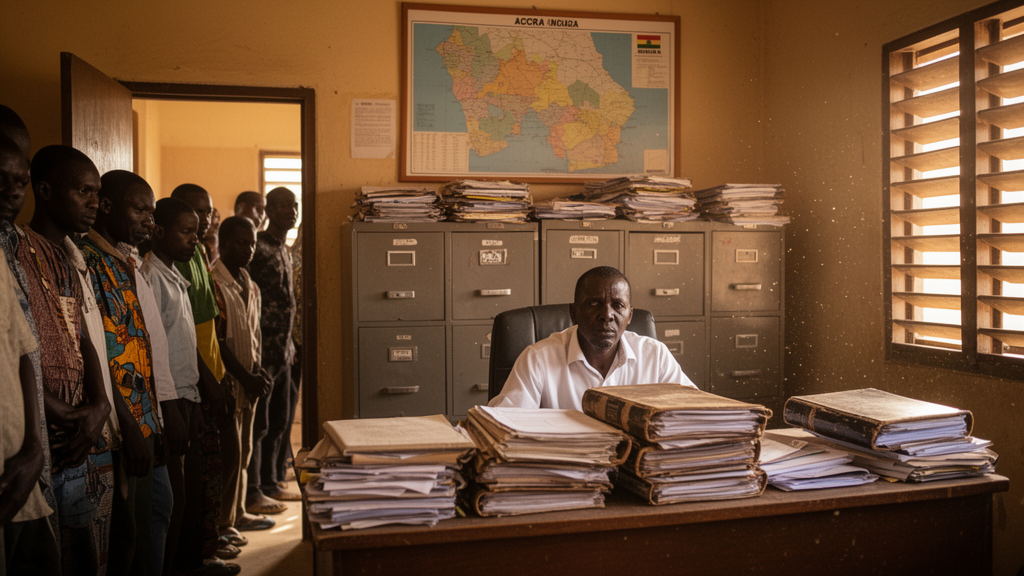
What emerged from that analysis is described as an institutional maze. The findings reveal fragmented law enforcement, financial constraints and the absence of formal monitoring systems as defining features of the current system. In other words, responsibility for waste is spread across institutions in ways that make coherent enforcement difficult, while the resources needed to carry out mandates and the mechanisms needed to track performance are both lacking.
Informal waste pickers, the findings show, lack recognition, social protection and technical support.
The circular economy framing is central to the paper’s argument. Rather than treating waste solely as a disposal problem, the authors position solid waste as a resource stream whose recovery could be organised through inclusive governance. The research explores the potential to integrate informal waste pickers into that formal system, an approach that would recognise their existing role while extending social protection and technical support to them.
On the basis of its findings, the study recommends data-driven modelling approaches that align and integrate institutional frameworks with inclusive social policies. The specific tools named include optimisation methods, multi-criteria decision-making tools and life-cycle assessments. The authors present these as ways to build an evidence-based roadmap for transitioning to a resilient governance framework, offering practical insights for building urban sustainability capable of addressing climate change.
The study is published as open access research, with the article shared early to provide faster access to peer-reviewed, accepted work; this version is subject to further edits and will be replaced by the final Version of Record. Its scope is defined by the 13 expert stakeholders consulted and by the legislative and institutional landscape of Ghana, so the findings speak most directly to that national context.
Subject of Research: Governance gaps and informal waste picker inclusion in Ghana's municipal solid waste management
Article Title: Towards circular economy: policies and acts governing municipal solid waste management and innovation opportunities for inclusive solid waste management in Ghana
Article References: Kusi-Appiah, M., Kusi-Appiah, F., Liu, L., Murphy, R. J., & Seymour, V. (2026). Towards circular economy: policies and acts governing municipal solid waste management and innovation opportunities for inclusive solid waste management in Ghana. Environmental Systems Research. https://doi.org/10.1186/s40068-026-00493-z
Image Credits: AI Generated
DOI: 10.1186/s40068-026-00493-z
Keywords: Ghana, municipal solid waste, circular economy, waste governance, informal waste pickers, policy implementation, environmental degradation, greenhouse gas emissions, mixed methods, urban sustainability, Towards, circular
Cite Scienmag News
Sloane Callahan. (October 29, 2026). Ghana’s waste laws look strong on paper, but a new study finds an institutional maze in practice. Scienmag. https://scienmag.com/ghanas-waste-laws-look-strong-on-paper-but-a-new-study-finds-an-institutional-maze-in-practice/
Sloane Callahan. "Ghana’s waste laws look strong on paper, but a new study finds an institutional maze in practice." Scienmag, 29 October 2026, https://scienmag.com/ghanas-waste-laws-look-strong-on-paper-but-a-new-study-finds-an-institutional-maze-in-practice/. Accessed 4 November 2026.
Sloane Callahan. "Ghana’s waste laws look strong on paper, but a new study finds an institutional maze in practice." Scienmag. October 29, 2026. https://scienmag.com/ghanas-waste-laws-look-strong-on-paper-but-a-new-study-finds-an-institutional-maze-in-practice/