


Artificial intelligence has swept into classrooms and curricula around the world, yet a stubborn gap persists between what students learn about AI on paper and what they can actually build with their own hands. A new case report published in Frontiers of Digital Education by Yoshiyasu Takefuji of the Faculty of Data Science at Musashino University in Tokyo argues that the missing ingredient is practical exposure to hardware, and it proposes a surprisingly simple remedy built from a low-cost Arduino Nano microcontroller, an open-source protocol called Firmata, and Google’s MediaPipe computer vision library. The paper, published on 25 September 2025, describes a teaching framework in which learners control physical IoT devices with hand gestures, all without ever needing to update the firmware on the microcontroller itself.
The problem Takefuji identifies is one that many educators will recognize. Despite the rapid growth of AI as an academic subject, hands-on learning opportunities remain scarce. Students, educators, and even professional software engineers often have limited knowledge of hardware because they have had little exposure to the Internet of Things, AI libraries, and human-machine interfaces. The gap is worsened, he writes, by the absence of demonstrated examples and by the lack of academic hardware journals where working designs can be shared and scrutinized. In other words, the ecosystem that supports AI software education, with its abundance of datasets, notebooks, and tutorials, simply does not exist in comparable form for the physical side of computing.
One of the most significant practical barriers is the cumbersome process of updating IoT firmware. Firmware is the low-level software permanently stored on a microcontroller that tells it how to behave. Traditionally, whenever a developer wants to add a new feature to an IoT device, such as recognizing a different gesture or driving a new type of actuator, the firmware must be rewritten, recompiled, and flashed onto the chip. For beginners this process is intimidating, and for educators managing a classroom full of devices it is slow and error-prone. Security researchers have also noted that firmware update mechanisms are a recurring weak point in deployed IoT systems, making any architecture that reduces the frequency of updates potentially attractive beyond the classroom.
Takefuji’s solution eliminates the need for firmware updates altogether by inverting the usual division of labor between the host computer and the microcontroller. Using the Python Firmata library, all of the application logic lives on the host computer, where it can be edited and rerun as often as needed, while the microcontroller runs a single, unchanging Firmata sketch that simply relays commands. The Firmata protocol, a serial communication standard designed for exactly this purpose, enables seamless, real-time interaction between the host and the Arduino. When the application changes, only the Python program on the computer changes; the device’s firmware stays untouched. For a learner, this means the entire creative cycle of modifying code and immediately seeing a physical result happens in a familiar software environment rather than in the unfamiliar territory of embedded development.
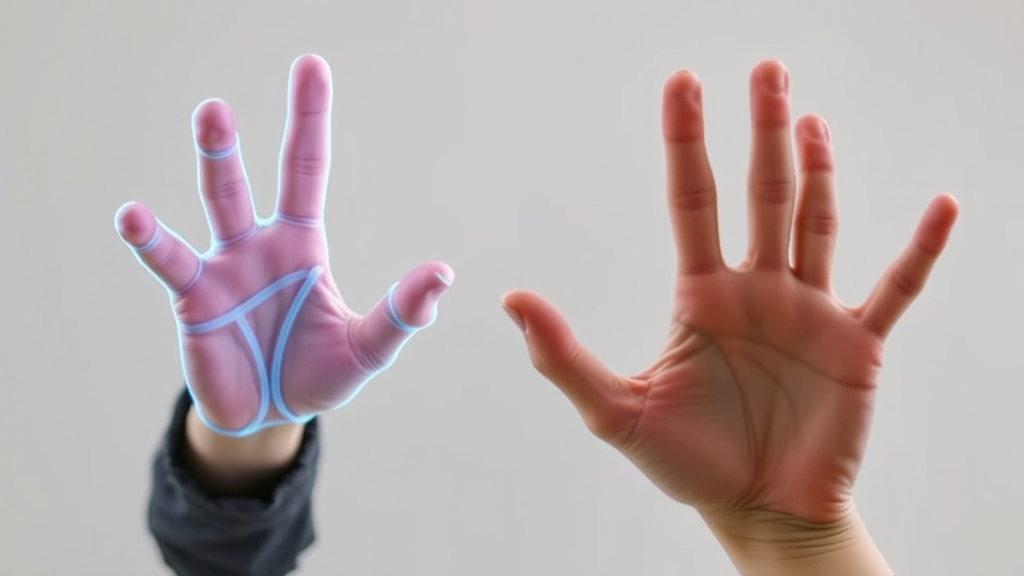
The second half of the framework addresses the AI side of the problem. Modern AI libraries are powerful but can appear opaque to newcomers, and implementing computer vision from scratch is far beyond the reach of most introductory courses. Takefuji points to MediaPipe, Google’s open-source framework for building perception pipelines, as a way of abstracting these complex tasks into manageable components. MediaPipe can process a live camera feed and output precise hand landmark coordinates, identifying the positions of individual joints and fingertips in each frame. Those coordinates arrive as simple numerical data that a beginner can immediately put to work, without needing to understand the neural networks, image processing stages, and mathematical transformations running beneath the surface.
The combination is what makes the approach pedagogically potent. Because MediaPipe delivers ready-made hand landmark coordinates, a student can map a fingertip position directly onto an Arduino output, such as an LED or a servo motor, without performing detailed calculations of their own. A raised index finger might switch a device on; a closed fist might switch it off; the vertical position of a hand might set a motor’s speed. The paper’s supplementary materials include demonstration videos showing these interactions in action, giving educators concrete, reproducible examples of what their students can achieve. The abstraction works in both directions: the AI library hides the difficulty of perception, and the Firmata protocol hides the difficulty of embedded hardware.
Takefuji argues that the contributions are relevant to a wide professional audience, including mathematicians, AI engineers, software engineers, hardware engineers, IoT engineers, and network programmers. That breadth reflects a broader anxiety in the technology sector about the widening divide between software and hardware competence. National policy documents, including Japan’s 2016 white paper on information and communications and its 2019 AI strategy, have emphasized the need to cultivate AI talent at scale, and similar concerns about falling behind in AI research have been voiced in the United States. Yet curricula that teach AI purely through software exercises risk producing graduates who have never wired a sensor, driven a motor, or thought about the latency and constraints of real devices.
The gesture-controlled systems described in the paper also connect to a lively applied research area. Recent studies have demonstrated finger-gesture-controlled wheelchairs enabled by IoT connectivity, gesture-driven smart home control systems based on flexible sensors, and AI-IoT platforms integrated into elderly care. By giving students an accessible entry point into the same underlying skills, reading sensor data, interpreting human motion, and commanding physical actuators over a network, the classroom framework doubles as preparation for assistive technology, smart environments, and Industry 4.0 applications. The same architectural pattern, with intelligence concentrated on the host and the device kept simple, mirrors designs used in commercial IoT deployments where over-the-air update complexity and security are genuine concerns.
The report is also notable for its economy. An Arduino Nano is one of the cheapest microcontroller boards on the market, a webcam is built into nearly every laptop, and both Firmata and MediaPipe are free and open source. This matters for educational equity: schools do not need specialized laboratory equipment to adopt the approach, and learners can continue experimenting at home with hardware costing a few dollars. The paper follows a small but growing tradition of demonstrating that inexpensive open-source hardware, from orbital shakers for laboratory screening to zebrafish tracking systems, can support serious scientific and educational work when paired with well-designed software abstractions.
There are, of course, limits to what a case report can establish. The paper presents a working demonstration and a teaching rationale rather than a controlled study of learning outcomes, and educators adopting the framework would still need to design assessments and integrate it into broader curricula. The reliance on a host computer also means the approach trades some of the autonomy that makes standalone IoT devices useful in the field. But as a response to a well-documented gap, the contribution is direct and practical: it removes the two most intimidating obstacles to hands-on AI education, embedded firmware development and complex computer vision implementation, and replaces them with tools that a motivated beginner can master in an afternoon. If the goal of AI education is not merely to produce people who can talk about intelligent systems but people who can build them, then lowering the barrier between a line of Python code and a moving piece of hardware may be one of the most valuable lessons a course can teach.
Subject of Research: A teaching framework using the Firmata protocol and MediaPipe gesture recognition to control Arduino IoT devices without firmware updates
Article Title: Enhancing AI Education Through Practical IoT Applications and Gesture Recognition
Article References: Takefuji, Y. (2025). Enhancing AI Education Through Practical IoT Applications and Gesture Recognition. Frontiers of Digital Education, 2(4), Article 29. https://doi.org/10.1007/s44366-025-0066-7
Image Credits: AI Generated
DOI: 10.1007/s44366-025-0066-7
Keywords: artificial intelligence, Internet of Things, gesture recognition, Firmata protocol, MediaPipe, Arduino Nano, AI education, firmware updates, human-machine interfaces, computer vision, Python, STEM education
Cite Scienmag News
Courtney Benton. (September 27, 2026). Gesture Control and Python Firmata Offer a New Path for Hands-On AI Education. Scienmag. https://scienmag.com/gesture-control-and-python-firmata-offer-a-new-path-for-hands-on-ai-education/
Courtney Benton. "Gesture Control and Python Firmata Offer a New Path for Hands-On AI Education." Scienmag, 27 September 2026, https://scienmag.com/gesture-control-and-python-firmata-offer-a-new-path-for-hands-on-ai-education/. Accessed 5 October 2026.
Courtney Benton. "Gesture Control and Python Firmata Offer a New Path for Hands-On AI Education." Scienmag. September 27, 2026. https://scienmag.com/gesture-control-and-python-firmata-offer-a-new-path-for-hands-on-ai-education/


