

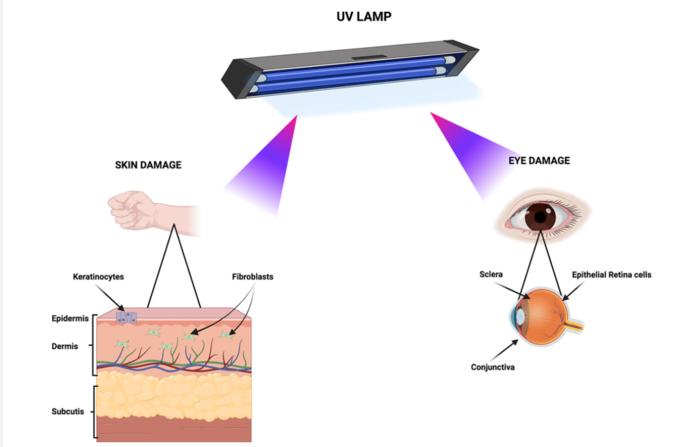
“Despite the potential advantages of utilizing UV-C radiation for deactivating pathogens such as SARS-CoV-2, the prevailing conclusion remains that UV-C radiation poses concurrent risks to human health.”

Credit: 2024 Alessio et al.
“Despite the potential advantages of utilizing UV-C radiation for deactivating pathogens such as SARS-CoV-2, the prevailing conclusion remains that UV-C radiation poses concurrent risks to human health.”
BUFFALO, NY- May 21, 2024 – A new research paper was published in Aging (listed by MEDLINE/PubMed as “Aging (Albany NY)” and “Aging-US” by Web of Science) Volume 16, Issue 9, entitled, “Germicidal lamps using UV-C radiation may pose health safety issues: a biomolecular analysis of their effects on apoptosis and senescence.”
The battle against the COVID-19 pandemic has spurred a heightened state of vigilance in global healthcare, leading to the proliferation of diverse sanitization methods. Among these approaches, germicidal lamps utilizing ultraviolet (UV) rays, particularly UV-C (wavelength ranging from 280 to 100 nm), have gained prominence for domestic use.
These light-emitting diode (LED) lamps are designed to sanitize the air, objects, and surfaces. However, the prevailing concern is that these UV lamps are often introduced into the market without adequate accompanying information to ensure their safe utilization. Importantly, exposure to absorbed UV light can potentially trigger adverse biological responses, encompassing cell death and senescence.
In this new study, researchers Nicola Alessio, Alessia Ambrosino, Andrea Boggi, Domenico Aprile, Iole Pinto, Giovanni Galano, Umberto Galderisi, and Giovanni Di Bernardo from the University of Campania Luigi Vanvitelli, Regional Public Health Laboratory in Siena, Italy, ASL Napoli 1 Centro P.S.I. Napoli Est-Barra, and Temple University performed a series of investigations aimed at comprehending the biological repercussions of UV-C radiation exposure from readily available domestic lamps.
“Our focus centered on epithelial retinal cells, keratinocytes, and fibroblasts, components of the skin and ocular targets frequently exposed to UV irradiation.”
Their findings underscore the potential harm associated with even brief exposure to UV, leading to irreversible and detrimental alterations in both skin cells and retinal cells of the eye. Notably, epithelial retinal cells exhibited heightened sensitivity, marked by substantial apoptosis. In contrast, keratinocytes demonstrated resilience to apoptosis even at elevated UV doses, though they were prone to senescence. Meanwhile, fibroblasts displayed a gradual amplification of both senescence and apoptosis as radiation doses escalated.
“In summary, despite the potential benefits offered by UV-C in deactivating pathogens like SARS-CoV-2, it remains evident that the concurrent risks posed by UV-C to human health cannot be ignored.”
Read the full paper: DOI: https://doi.org/10.18632/aging.205787
Corresponding Authors: Umberto Galderisi, Giovanni Di Bernardo
Corresponding Emails: umberto.galderisi@unicampania.it, gianni.dibernardo@unicampania.it
Keywords: senescence, apoptosis, UV light, public health
Click here to sign up for free Altmetric alerts about this article.
About Aging:
Aging publishes research papers in all fields of aging research including but not limited, aging from yeast to mammals, cellular senescence, age-related diseases such as cancer and Alzheimer’s diseases and their prevention and treatment, anti-aging strategies and drug development and especially the role of signal transduction pathways such as mTOR in aging and potential approaches to modulate these signaling pathways to extend lifespan. The journal aims to promote treatment of age-related diseases by slowing down aging, validation of anti-aging drugs by treating age-related diseases, prevention of cancer by inhibiting aging. Cancer and COVID-19 are age-related diseases.
Aging is indexed by PubMed/Medline (abbreviated as “Aging (Albany NY)”), PubMed Central, Web of Science: Science Citation Index Expanded (abbreviated as “Aging‐US” and listed in the Cell Biology and Geriatrics & Gerontology categories), Scopus (abbreviated as “Aging” and listed in the Cell Biology and Aging categories), Biological Abstracts, BIOSIS Previews, EMBASE, META (Chan Zuckerberg Initiative) (2018-2022), and Dimensions (Digital Science).
Please visit our website at www.Aging-US.com and connect with us:
- X, formerly Twitter
- YouTube
- Spotify, and available wherever you listen to podcasts
Click here to subscribe to Aging publication updates.
For media inquiries, please contact media@impactjournals.com.
Aging (Aging-US) Journal Office
6666 E. Quaker Str., Suite 1B
Orchard Park, NY 14127
Phone: 1-800-922-0957, option 1
###
Journal
Aging-US
Method of Research
Experimental study
Subject of Research
People
Article Title
Germicidal lamps using UV-C radiation may pose health safety issues: a biomolecular analysis of their effects on apoptosis and senescence
Article Publication Date
2-May-2024

