


The study, published in the Archives of Public Health, outlines a quasi-experimental design intended to measure whether this complex intervention improves student well-being, life skills, and environmental responsibility. The initiative aims to transform schools into healthy and sustainable organizations while fostering democratic participation and collective well-being among students.
The research team, led by Dominik Röding and colleagues, describes the study as a natural experiment with a sequential design. This approach leverages the current spread of FREI DAY in German-speaking countries to observe outcomes over a three-year period. The study will survey at least 60 secondary schools, including vocational schools, and 30 primary schools across three distinct survey waves. Schools are not randomly assigned to the intervention; instead, they decide for themselves whether and when to implement the program. This self-selection process creates a non-randomized stepped-wedge design, where schools transition from a control period to an intervention period based on their implementation progress.
FREI DAY is a multi-component intervention grounded in concepts of transformative education, self-determination theory, and project-based learning. The program consists of eight implementation phases spanning two to four years. The process begins with schools obtaining information from the provider, Schule im Aufbruch gGmbH (SiA), and finding allies within the school community. Subsequent phases involve preparing a pilot implementation, executing the pilot, evaluating results, and anchoring the learning format into the school’s permanent structure. The final phases focus on preparing for full implementation and integrating the program with the broader school community and external partners.
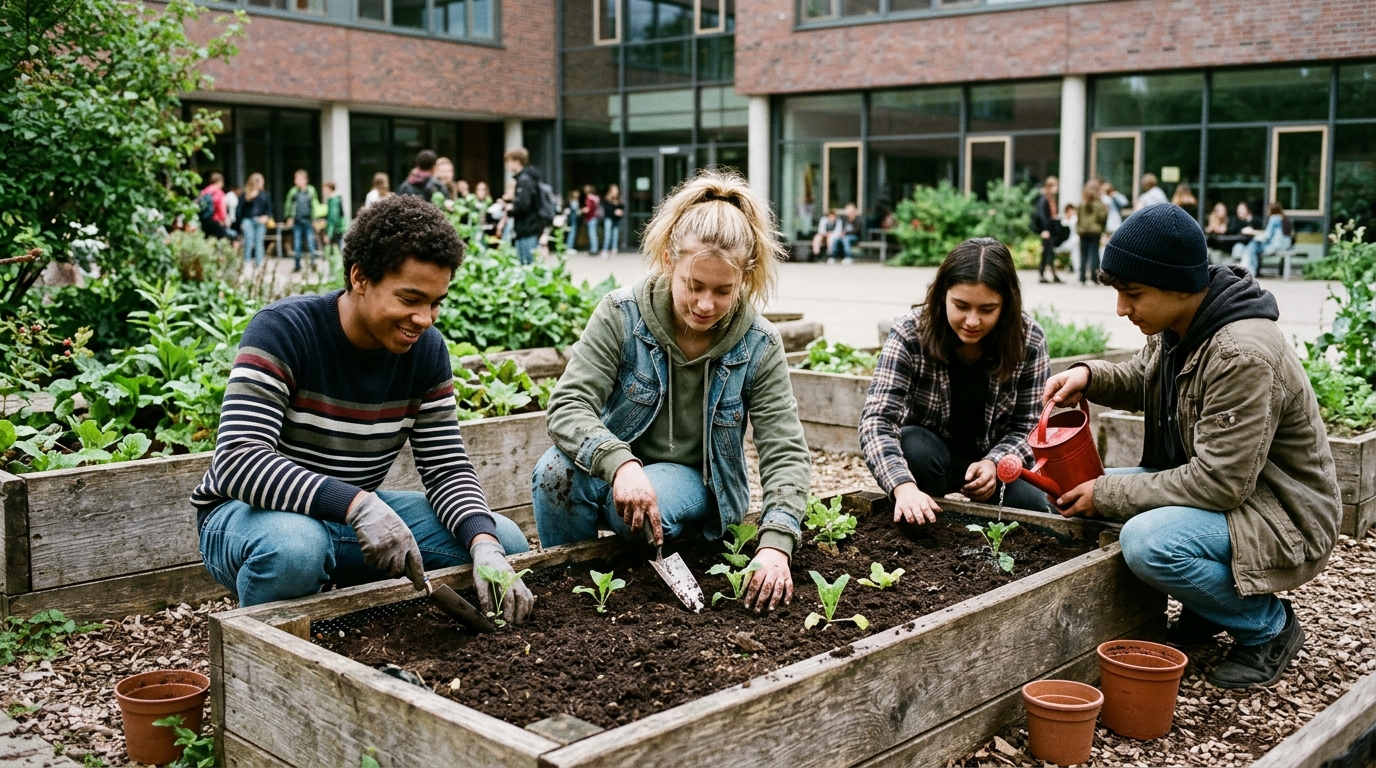
At the core of the intervention is a learning format that requires at least four hours per week of dedicated time for student projects. In these sessions, students work in small groups to develop and execute projects that address at least one of the SDGs. The projects are carried out over the course of at least one school year and are supported by internal or external collaboration partners. Teachers act as facilitators, helping students plan and execute their projects, which may involve obtaining funding, purchasing materials, and establishing relationships with local organizations. Examples of past projects include redesigning city parks, addressing everyday racism, organizing clothes swaps, and acting as energy detectives to reduce school waste.
The study aims to evaluate the effectiveness of FREI DAY on several primary student-level outcomes. Researchers hypothesize that students exposed to the program will show greater improvements in well-being, optimism, self-efficacy, environmental awareness, and environmental responsibility compared to students in schools that have not yet implemented the intervention. Secondary outcomes include social and emotional skills, such as cooperation, empathy, and perspective-taking, as well as cognitive skills like creative thinking and problem-solving. The study also examines intermediate school-level outcomes, specifically whether FREI DAY strengthens the school’s transformative capacity, including its integrated strategy for SDGs and intersectoral collaboration.
To collect data, the research team will employ a mixed-methods approach involving quantitative surveys and qualitative interviews. In each survey wave, at least 20 students per school will complete an online questionnaire assessing sociodemographic data, skills, well-being, and environmental attitudes. Additionally, five school key informants per school, including administrators, teachers, and parents, will participate in interviews to provide context on local conditions and implementation challenges. At intervention schools, members of the school board, which consists of those actively involved in implementing FREI DAY, will also be surveyed to identify facilitating and inhibiting factors.
The statistical analysis will utilize hierarchical linear models to account for the clustered nature of the data, where students are nested within schools. The study assumes a closed cohort for student-level outcomes, aiming to track the same students over the three waves. For school-level outcomes, an open cohort design will be used, allowing for changes in key informants over time. The researchers anticipate detecting weak effects at the student level, with an expected effect size of d = 0.2, and moderate effects at the school level, with an expected effect size of d = 0.5. Sample size calculations indicate that a net sample of at least 54 schools is required to perform sensitivity analyses for subgroups, such as the degree of deprivation of the school location.
Recruitment for the study began in 2025, with schools in Lower Saxony and North Rhine-Westphalia invited to participate through the FREI DAY network and governmental education institutions. A participatory preliminary phase was conducted in 2023 to develop the study design and survey instruments in collaboration with teachers and the intervention provider. The first survey wave took place between May and September 2025, with subsequent waves scheduled for 2026 and 2027. Schools that participate receive a report on the data collected at their institution after each survey, along with opportunities to discuss results in webinars. This feedback loop is designed to encourage continued participation and allow schools to use the data for their own development processes.
The study acknowledges several limitations inherent to its design. Because schools self-select into the intervention, there is a risk of selection bias and confounding by school characteristics, such as innovation readiness or leadership commitment. Although the analysis will adjust for relevant covariates, residual confounding cannot be fully excluded. Furthermore, FREI DAY is a complex intervention whose implementation may vary significantly across schools in terms of intensity and fidelity. Most outcomes rely on self-reported data, which may be influenced by social desirability or recall bias. Attrition over the three-year period may also reduce the longitudinal sample size, potentially affecting the representativeness of the findings.
Despite these limitations, the naturalistic design enhances the external validity of the study by evaluating FREI DAY under real-world implementation conditions. The results will be triangulated using a mixed-methods design, combining quantitative data with qualitative insights from focus groups and teacher interviews. The theoretical framework for the study integrates the SDGs, life skills concepts, and planetary health, allowing researchers to interpret the findings within a broader context of health promotion and environmental sustainability.
The findings of this study are expected to provide valuable recommendations for the implementation and further development of FREI DAY. The study also aims to contribute to the broader discourse on Education for Sustainable Development (ESD), which is institutionalized in Germany through a national action plan aligned with the UNESCO framework.
The research team emphasizes that this is the first study to evaluate the effectiveness of FREI DAY, filling a significant gap in the literature where previous work has consisted mainly of qualitative theses. The prospective quantitative design will allow for a more robust assessment of whether the intervention is associated with measurable changes in student outcomes. The study’s focus on both student-level and school-level outcomes reflects the holistic nature of the intervention, which seeks to transform the entire school organization. By examining the mechanisms of action and the role of local conditions, the study aims to deepen the understanding of how educational settings can foster sustainable lifestyles and collective well-being.
Subject of Research: Evaluation of the FREI DAY whole-school approach for health and sustainability in German schools
Article Title: Study protocol for a quasi-experimental evaluation of the whole school approach FREI DAY
Article References: Röding, D., Brender, R., Ünlü-Reske, S., Brager, A., Strauß, A., Kittel, J., Stolz, M., Krauth, C., Meyer, C., & Walter, U. (2026). Study protocol for a quasi-experimental evaluation of the whole school approach FREI DAY. Archives of Public Health, 84(1), Article 222. https://doi.org/10.1186/s13690-026-02088-7
Image Credits: AI Generated
DOI: 10.1186/s13690-026-02088-7
Keywords: FREI DAY, Sustainable Development Goals, School Health, Education for Sustainable Development, Quasi-experimental Study, Student Well-being, Environmental Awareness, Whole-School Approach, Germany, Public Health, protocol, quasi-experimental
Cite Scienmag News
Sloane Callahan. (November 7, 2026). German Schools to Test Sustainability Program FREI DAY. Scienmag. https://scienmag.com/german-schools-to-test-sustainability-program-frei-day/
Sloane Callahan. "German Schools to Test Sustainability Program FREI DAY." Scienmag, 7 November 2026, https://scienmag.com/german-schools-to-test-sustainability-program-frei-day/. Accessed 12 November 2026.
Sloane Callahan. "German Schools to Test Sustainability Program FREI DAY." Scienmag. November 7, 2026. https://scienmag.com/german-schools-to-test-sustainability-program-frei-day/




