

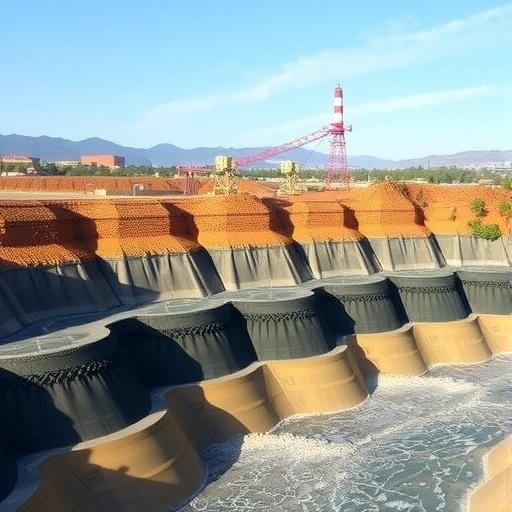
In the evolving landscape of mining operations, the closure and decommissioning of tailings storage facilities (TSFs) represent a critical juncture for environmental safety and sustainable land management. A recent comprehensive study focusing on the mining districts of Southern Spain sheds new light on the complex geotechnical challenges associated with TSF decommissioning. This research offers an unprecedented, in-depth analysis of the stability and environmental implications tied to the cessation of these massive industrial structures. It draws attention to the intricate interplay between engineering, geology, and environmental science necessary to ensure long-term safety and mitigate ecological risks.
At the heart of this investigation lies an exploration of the residual geotechnical risks that pose a threat during and after the decommissioning process. Tailings dams, inherently risky due to their construction materials—often loosely consolidated mine waste—and their exposure to natural elements, necessitate sophisticated monitoring and management plans long after mining activities cease. The study meticulously evaluates how different decommissioning strategies influence the structural integrity of TSFs, particularly under the diverse geoclimatic conditions prevailing in Southern Spain. Its nuanced approach underscores the importance of site-specific assessments in formulating sustainable closure methods.
One of the core contributions of this research is its detailed assessment of slope stability across various TSF configurations. By employing both field investigations and advanced numerical modeling techniques, the researchers have quantified the deformation patterns and potential failure mechanisms characteristic of tailings deposits. Their findings demonstrate that improper drainage and insufficient compaction during closure significantly compromise slope stability, elevating the risk of catastrophic landslides or breaches. This insight reiterates the imperative for proactive hydrological control and mechanical reinforcement in the design of closure procedures.
Furthermore, the study ventures into the behavior of pore water pressures within the tailings matrix, a subtle yet pivotal factor influencing TSF stability. Elevated pore pressures can undermine soil shear strength, triggering movements or liquefaction under seismic or heavy rainfall events. Using piezometric data alongside geotechnical parameters, the researchers delineate how decommissioning alterations—such as the installation of drainage galleries and surface water diversions—can modulate pore pressure dynamics. Their work suggests that holistic water management schemes are indispensable for sustaining post-closure stability.
Geochemical interactions are another dimension explored with notable depth in the research. Tailings materials often contain residual sulfide minerals, which, upon exposure to oxygen and water during and after decommissioning, can generate acid mine drainage (AMD). This phenomenon severely contaminates surrounding soils and aquifers. The authors emphasize that geotechnical interventions must be integrated with geochemical mitigation strategies, such as capping systems and alkaline amendments, to effectively neutralize acid-forming reactions and hinder pollutant mobilization. This integrative approach is critical for minimizing long-term environmental liabilities.
The research also investigates how vegetation establishment on reclaimed tailings surfaces influences the mechanical and hydrological properties of TSFs. Vegetative cover can enhance surface stability by root reinforcement and evaporation-driven water uptake, thereby reducing erosion and infiltration rates. However, the study warns against simplistic reforestation, noting that inappropriate plant species or too rapid revegetation can induce uneven settlements or hydraulic disruptions. Through controlled field trials, the team identifies best practices for achieving sustainable bioengineering solutions that complement structural stabilization measures.
In an innovative blend of modern techniques, the researchers utilize remote sensing and ground-based geophysical surveys to monitor TSF conditions dynamically. Such technologies enable the detection of subtle deformations, seepage pathways, and changes in soil moisture content that traditional methods might overlook. The integration of these monitoring tools into a comprehensive geotechnical assessment framework promises enhanced predictive capabilities, facilitating timely interventions and adaptive management throughout the decommissioning timeline.
Importantly, the study contextualizes its findings within the regulatory and operational frameworks governing TSF closures in Spain and analogous Mediterranean mining regions. It critiques existing guidelines for their limited consideration of long-term geotechnical behavior under climatic variability projected for the coming decades. The authors advocate for the revision of these standards to incorporate rigorous, evidence-based criteria that can better safeguard communities and ecosystems downstream from decommissioned facilities.
Economic considerations also surface prominently throughout the discourse. The intricate balance between decommissioning costs and environmental risk reduction drives decision-making processes. The study offers comparative analyses of different technological solutions, factoring in their installation complexity, maintenance demands, and efficacy in risk mitigation. These insights aim to support policymakers and industry stakeholders in optimizing resource allocation without compromising safety or ecological integrity.
The transdisciplinary nature of this research stands as a testament to the collaborative efforts among geotechnical engineers, hydrogeologists, environmental scientists, and regulators. By weaving together diverse expertise, it moves beyond isolated technical performance and embraces a systems-oriented perspective that captures the full lifecycle of TSFs. Such integrative methodologies are essential to address the intricate realities of mining legacies — providing a blueprint for best practices in TSF closure worldwide.
As global mining industries grapple with increasing environmental scrutiny and societal demands for responsible asset retirement, this study marks a pivotal advancement in knowledge. It equips engineers and decision-makers with robust scientific evidence to design safer, more resilient TSF decommissioning programs. Furthermore, the articulation of regionally tailored approaches underscores the necessity of contextual sensitivity, promoting solutions attuned to local geological and climatic challenges rather than one-size-fits-all paradigms.
In light of accelerating climate change effects, the authors highlight the urgency of embedding adaptive strategies within decommissioning planning. Anticipated shifts in precipitation patterns and extreme weather events could exacerbate TSF instability and pollution risks, rendering static closure designs obsolete. The dynamic risk assessment framework proposed offers a pathway for continuous reassessment and modification in response to evolving environmental conditions, fostering enduring protection of human and environmental health.
Moreover, the study serves as a clarion call for enhanced stakeholder engagement. The inclusion of local communities, environmental groups, and governmental bodies in co-developing decommissioning plans not only builds trust but also leverages indigenous knowledge and social insights. Such collaborative governance models can facilitate more transparent decision-making and foster shared stewardship over the rehabilitated landscapes.
Looking forward, the research team outlines avenues for further inquiry, including long-term monitoring of closed TSFs and the refinement of predictive models incorporating machine learning algorithms. These advancements promise greater precision in forecasting performance and hazards, enabling proactive management that can avert failures before they materialize. Additionally, expanding the geographical scope of similar studies will enrich the global repository of knowledge, fostering adaptable methodologies applicable across varied geological settings.
This seminal investigation ultimately bridges a crucial knowledge gap at the intersection of mining engineering and environmental protection. In unraveling the multifaceted geotechnical challenges of TSF decommissioning in Southern Spain, it not only safeguards regional ecosystems but sets a precedent for responsible mining closure strategies globally. As the mining sector evolves toward greater sustainability, such pioneering research will be instrumental in ensuring that the scars of extraction heal into landscapes of resilience and renewed ecological value.
Subject of Research: Geotechnical challenges and environmental implications of tailings storage facility (TSF) decommissioning in mining districts of Southern Spain.
Article Title: Geotechnical aspects of decommissioning tailings storage facilities (TSF) in mining districts of Southern Spain.
Article References:
Manteca, I.A., Tornero, E.T., Cantizano, F.A.J. et al. Geotechnical aspects of decommissioning tailings storage facilities (TSF) in mining districts of Southern Spain. Environ Earth Sci 85, 73 (2026). https://doi.org/10.1007/s12665-025-12777-1
Image Credits: AI Generated


