


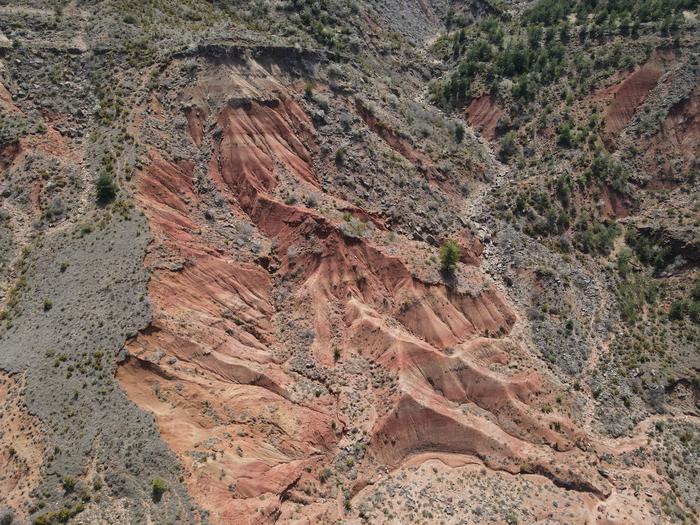
56 million years ago, the Earth experienced a major and rapid climate warming due to greenhouse gas emissions, probably due to volcanic eruptions. A team from the University of Geneva (UNIGE) has analysed sediments from this period to assess the impact of this global warming on the environment, and more specifically on soil erosion. The study revealed a four-fold increase in soil erosion due to heavy rainfall and river flooding. These results suggest that current warming could have a similar effect over time, significantly increasing flood risks. They are published in the journal Geology.

Credit: © Marine Prieur
56 million years ago, the Earth experienced a major and rapid climate warming due to greenhouse gas emissions, probably due to volcanic eruptions. A team from the University of Geneva (UNIGE) has analysed sediments from this period to assess the impact of this global warming on the environment, and more specifically on soil erosion. The study revealed a four-fold increase in soil erosion due to heavy rainfall and river flooding. These results suggest that current warming could have a similar effect over time, significantly increasing flood risks. They are published in the journal Geology.
Because of its similarities to current warming, the Paleocene-Eocene Thermal Maximum is closely studied to understand how the Earth’s environment reacts to a global rise in temperature. Occurring 56 million years ago, this episode saw the Earth warm by 5 to 8°C within 20,000 years, a very short time at the geological scale. It lasted for 200,000 years, causing major disruption to flora and fauna. According to recent IPCC reports, the Earth is now on the brink of a similar warming.
Scientists are analysing sediments from this period to obtain a more accurate ‘‘picture’’ of this past warming and its consequences and to make predictions for the future. These natural deposits are the result of soil erosion by water and wind. They were carried by rivers into the oceans. Now preserved in rocks, these geological archives provide valuable information about our past, but also our future.
Four times more erosion
‘‘Our starting hypothesis was that, during such a period of warming, the seasonality and intensity of rainfall increases. This alters the dynamics of river flooding and intensifies sediment transport from the mountains to the oceans. Our objective is to test this hypothesis and, above all, to better quantify this change,’’ explains Marine Prieur, a doctoral student in the Section of Earth and Environmental Sciences at the UNIGE Faculty of Science, and first author of this study funded by the European Union’s Horizon 2020 programme.
The research team studied a specific type of sediment, Microcodium grains, collected in the Pyrenees (around 20kg). These prisms of calcite, no more than a millimeter in size, were specifically formed at this period around the roots of plants, in the soil. However, they are also found in marine sediments, proving their erosion on the continent. Therefore, Microcodium grains are a good indicator of the intensity of soil erosion on the continents.
‘‘By quantifying the abundance of Microcodium grains in marine sediments, based on samples taken from the Spanish Pyrenees, which were submerged during the Palaeocene-Eocene, we have shown a four-fold increase in soil erosion on the continent during the climate change that occurred 56 million years ago,’’ reveals Sébastien Castelltort, a full professor in the Section of Earth and Environmental Sciences at the UNIGE Faculty of Science, who led the study.
Human action will exacerbate the phenomenon
This discovery highlights the significant impact of global warming on soil erosion through the intensification of rainfall during storm events and the increase in river flooding. This is an indicator of heavy flooding. ‘‘These results relate specifically to this area of the Pyrenees, and each geographical zone is dependent on certain unique factors. However, increased sedimentary input in the Paleocene-Eocene strata is observed worldwide. It is, therefore, a global phenomenon, on an Earth-wide scale, during a significant warming event,’’ points out Marine Prieur.
These results provide new information that can be incorporated into predictions about our future climate. In particular, to better assess the risks of flooding and soil collapse in populated areas. ‘‘We need to bear in mind that this increase in erosion has occurred naturally, under the effect of global warming alone. Today, to predict what lies ahead, we must also consider the impact of human action, such as deforestation, which amplifies various phenomena, including erosion,’’ conclude the scientists.
Journal
Geology
DOI
Method of Research
News article
Subject of Research
Not applicable
Article Title
Fingerprinting enhanced floodplain reworking during the Paleocene−Eocene Thermal Maximum in the Southern Pyrenees (Spain): Implications for channel dynamics and carbon burial
Article Publication Date
23-May-2024
Cite Scienmag News
Violet Maxwell. (June 25, 2024). Geological archives predict our climate future. Scienmag. https://scienmag.com/geological-archives-predict-our-climate-future/
Violet Maxwell. "Geological archives predict our climate future." Scienmag, 25 June 2024, https://scienmag.com/geological-archives-predict-our-climate-future/. Accessed 6 September 2026.
Violet Maxwell. "Geological archives predict our climate future." Scienmag. June 25, 2024. https://scienmag.com/geological-archives-predict-our-climate-future/

