


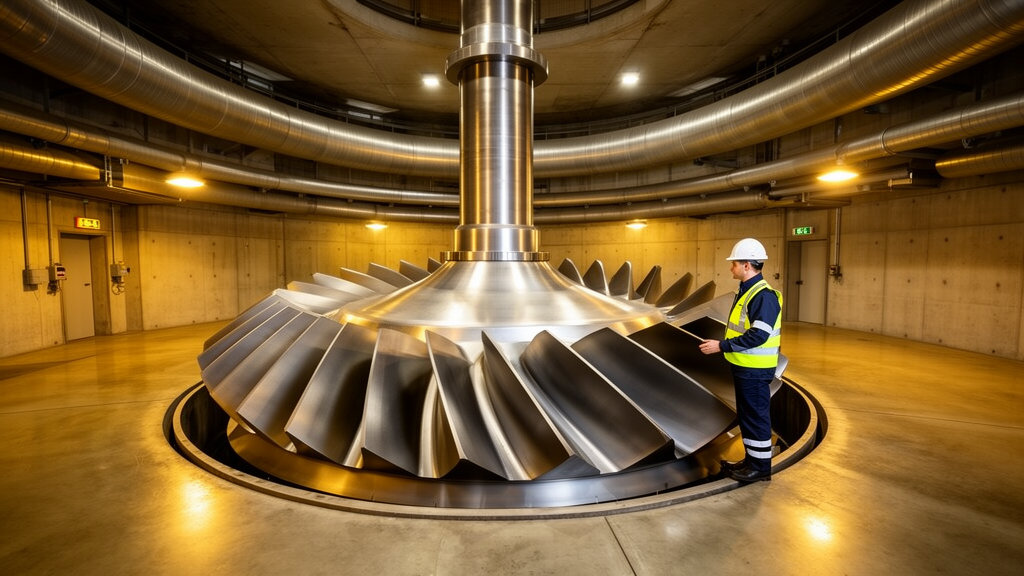
Deep inside the mountains that separate the upper and lower reservoirs of a Chinese pumped storage plant, six 350 MW reversible pump-turbines sit poised to swing from standstill to full speed in under a minute. Getting there is one of the most violent moments in the machine’s life. During start-up under turbine operating conditions, the guide vanes are barely open, the rotational speed is climbing rapidly, and the flow through the water passages is turbulent and unstable. The pressure surges generated in those seconds can shake the runner, the shaft, and the surrounding plant structure, and over years of frequent start-stop duty they can contribute to runner cracking and penstock fatigue. A new study published in Frontiers in Mechanical Engineering has now systematically compared four start-up strategies for a 710 m-head unit and identified a clear winner: a gentle, small-acceleration open-loop guide vane scheme that trims pressure pulsations by up to 25 percent while adding only about twelve seconds to the start-up sequence.
The research team, led by engineers from China Yangtze Power Co., Ltd. and the China Institute of Water Resources and Hydropower Research, chose as their case study a first-class large hydropower project equipped with six reversible mixed-flow units, each rated at 350 MW, 500 r/min, and a rated head of 710 m with a rated flow of 56.85 cubic meters per second. The water conveyance system runs roughly 2,750 meters through the mountain between the reservoirs, comprising a 2,128-meter intake system and a 637-meter tailwater system arranged in a conventional three-tunnel, six-unit layout. At heads above 700 meters, the long water column in the penstock carries enormous inertia, so any abrupt change in guide vane opening sends water hammer waves racing through the conduits. Systematic studies of start-up transients for such high-head machines have been scarce, which is precisely the gap the team set out to fill.
To capture the physics of the transition, the researchers built a one-dimensional transient flow model based on the method of characteristics, a classical technique for solving the water hammer equations that govern unsteady pipe flow. The approach transforms the motion and continuity equations into ordinary differential equations along two characteristic lines in the space-time plane, then marches a finite difference grid forward in time from a known steady state. Because the water hammer wave speed, typically on the order of 1,000 to 1,200 meters per second, vastly exceeds the flow velocity, the convective terms can be neglected, and the compatibility equations at each grid point yield the piezometric head and flow rate at every section and every time step. Boundary conditions at the upstream and downstream ends close the system, allowing the simulation to track how pressure waves propagate, reflect, and superpose throughout the entire water conveyance network during a start-up event.
Against this computational backdrop, the team compared four representative start-up modes. Method 1 is the large-acceleration open-loop scheme actually used at the plant: the guide vanes snap to a first start-up opening near the no-load limit with a control output rate of roughly 2.8 percent per second, then step down as the unit passes 95 and 96 percent of rated speed. Method 2.1 is a small-acceleration open-loop variant that opens the vanes to only about 60 percent of the no-load opening at 0.7 percent per second, dwells about six seconds, then advances through carefully staged openings as the speed climbs. Method 3 replaces the preprogrammed vane trajectory with a closed-loop acceleration controller that holds the unit’s acceleration at prescribed setpoints of 2, 1, and 0.5 Hz per second as the speed rises. Method 4 is a hybrid that opens the vanes open-loop to a starting position, then hands over to PID frequency regulation with a gentle 0.4 Hz per second frequency ramp from 40 to 50 Hz.
The simulations, run both for a single unit starting alone and for two units starting simultaneously on the same hydraulic branch, revealed a stark trade-off. Method 1 is the fastest, completing the start-up in 40.59 seconds, but it produces the harshest hydraulic environment. When Units 3 and 4 start together, the peak-to-peak pressure at the spiral case inlet of Unit 4 reaches 193.81 meters of water, with the spiral case end hitting 205.86 meters. Methods 3 and 4 tame the pulsations substantially, cutting spiral case peak-to-peak pressures by 12 to 25 percent in the dual-unit scenario, but they pay a heavy price in time: 69.38 and 72.70 seconds respectively, the latter nearly 1.8 times the baseline. Method 2.1 threads the needle. Its 52.64-second start-up is only about twelve seconds slower than Method 1, yet in the single-unit case it reduces peak-to-peak pressures at the draft tube inlet and outlet by 17.2 and 25.3 percent compared with the aggressive scheme.
The frequency content of the pressure signals tells a complementary story. In the spiral casing, the dominant pulsation frequency is 83.3 Hz, matching the runner rotational frequency and its harmonics, driven by guide vane wake interference and rotor-stator interaction. In the draft tube, the dominant frequencies range from 42 to 76.8 Hz, five to ten times the rotational frequency, signatures of the precessing vortex rope that forms in the draft tube cone during part-load operation. The largest pulsation amplitudes consistently appear during the guide vane acceleration phase, roughly 15 to 25 seconds after the start command, when the rate of change of flow velocity is at its maximum and the flow regime is most unstable. Under dual-unit start-up, Method 2.1 shows a pressure pulsation attenuation rate 18.7 percent slower than Method 1 but peak amplitudes 7.2 percent lower, indicating that the gentler opening rate gives the flow field time to adjust smoothly instead of being violently disturbed.
The physical mechanism behind these differences lies in the coupling between guide vane kinematics and hydrodynamic inertia. Method 1’s rapid opening accelerates the discharge so abruptly that severe flow separation and vortex shedding develop in the draft tube, producing the highest peak-to-peak pressures of any scheme. Method 2.1’s restrained initial acceleration lets the water column in the long penstock adjust progressively, reducing the inertial pressure head and suppressing the low-pressure zones and turbulent vortices that drive draft tube fluctuations. Method 3’s closed-loop logic keeps the relative velocity between runner blades and fluid consistent, preventing abrupt torque changes, but strict adherence to acceleration setpoints stretches the timeline. Method 4 achieves a smooth frequency capture, yet the prolonged period of large vane openings sustains high-velocity flow in the penstock and extends the hydraulic disturbance.
To verify that Method 2.1 was not merely a lucky compromise, the team generated two variants, Methods 2.2 and 2.3, by altering the guide vane opening rates and dwell times. Method 2.2 raises the initial opening rate to about 1.4 percent per second with an eight-second dwell, while Method 2.3 uses 1.6 percent per second with a five-second dwell. Both variants shortened the start-up to roughly 44 seconds, but at a steep cost: in the dual-unit scenario, draft tube peak-to-peak pressures jumped by 24.6 and 23.1 percent respectively compared with Method 2.1, and in the single-unit case the draft tube outlet pressure swings rose by 27.6 and 23.8 percent. The dwell time itself serves a deliberate physical purpose. The five-to-eight-second waits, tuned against the theoretical wave period derived from the pipeline length and wave speed, allow water hammer waves to complete a propagation-reflection cycle through the penstock so that pressures stabilize before the next opening stage, and they give the massive water column time to build flow momentum so the velocity circulation at the runner inlet can match the rotating runner.
For the final ranking, the researchers applied the entropy weight method, an objective multi-criteria technique that assigns weights to evaluation indicators based on the information entropy of the data itself, avoiding the subjectivity of expert-driven weighting. Standardizing the peak-to-peak pressures at the spiral case inlet and end and the draft tube inlet and outlet, the method scored all schemes across both operating scenarios. Method 2.1 ranked first in every case, achieving a comprehensive score of 0.5275 in the dual-unit start-up and 0.7171 in the single-unit start-up, comfortably ahead of Method 4, Method 3, and the baseline Method 1, which ranked last. Even after the guide vane parameters were adjusted, the entropy evaluation still crowned Method 2.1, confirming its robustness.
The authors argue that the practical case for the gentle scheme is compelling. The incremental cost amounts to a modest twelve-second extension of the start-up sequence, negligible in routine dispatch, plus a one-time governor software modification. In return, the 7.2 to 25.3 percent reduction in pressure pulsation amplitude helps mitigate runner cracking and penstock fatigue, extends overhaul intervals, reduces unplanned outages, and strengthens the plant’s contribution to grid frequency regulation. As renewable-heavy power systems demand ever more frequent cycling from pumped storage fleets, the study offers plant operators a quantitative basis for choosing start-up strategies, though the team notes that prototype testing remains the necessary next step before the recommendation is fully adopted in the field.
Subject of Research: Start-up transient control strategies for high-head reversible pump-turbines in pumped storage plants
Article Title: Research on start-up transition process of high-head pumped storage units
Article References: Zhang, X., Zheng, X., Hu, Y., Zhang, H., Huang, Z., Chen, X., & An, X. (2026). Research on start-up transition process of high-head pumped storage units. Frontiers in Mechanical Engineering, 12, Article 1912689. https://doi.org/10.3389/fmech.2026.1912689
Image Credits: AI Generated
DOI: 10.3389/fmech.2026.1912689
Keywords: pumped storage, pump-turbine, guide vane, water hammer, pressure pulsation, start-up strategy, hydraulic transient, method of characteristics, entropy weight method, Francis turbine, grid frequency regulation, draft tube
Cite Scienmag News
Denise Maddox. (October 17, 2026). Gentle Guide Vane Openings Emerge as Safest Way to Start High-Head Pumped Storage Turbines. Scienmag. https://scienmag.com/gentle-guide-vane-openings-emerge-as-safest-way-to-start-high-head-pumped-storage-turbines/
Denise Maddox. "Gentle Guide Vane Openings Emerge as Safest Way to Start High-Head Pumped Storage Turbines." Scienmag, 17 October 2026, https://scienmag.com/gentle-guide-vane-openings-emerge-as-safest-way-to-start-high-head-pumped-storage-turbines/. Accessed 17 October 2026.
Denise Maddox. "Gentle Guide Vane Openings Emerge as Safest Way to Start High-Head Pumped Storage Turbines." Scienmag. October 17, 2026. https://scienmag.com/gentle-guide-vane-openings-emerge-as-safest-way-to-start-high-head-pumped-storage-turbines/


