


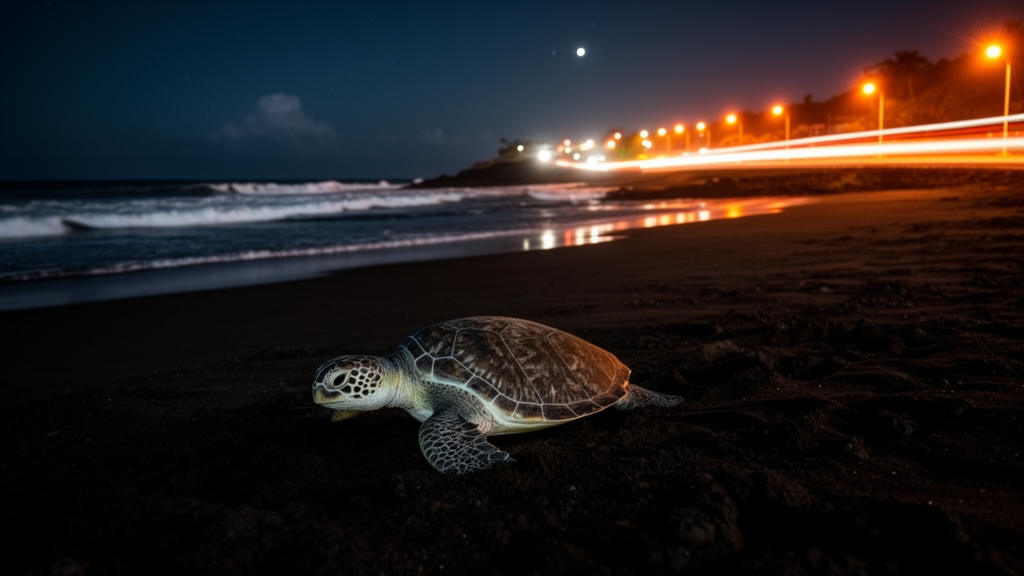
On a dark stretch of Guatemala’s Pacific coast, one of nature’s most ancient rituals is quietly being disrupted by something as modern as a porch light. New research published in the journal Geosciences reveals that olive ridley sea turtles (Lepidochelys olivacea) nest significantly less often on parts of the beach illuminated by artificial light, and that the effect intensifies on weekends, when human activity and lighting surge along the shoreline. The study, led by researchers at the University of Costa Rica and international collaborators, offers some of the clearest field evidence yet that even modest levels of coastal glow can push nesting females away from otherwise suitable habitat.
Between August and December, the peak of the olive ridley nesting season, the team surveyed a 21-kilometer stretch of beach on Guatemala’s southern coast, documenting more than 1,600 nesting events and measuring light levels at regular intervals along the sand. Using portable photometers, they recorded both skyglow and direct light sources, then compared nesting density against light intensity, day of the week, and other environmental variables such as sand temperature and beach width. The result was striking: nesting activity dropped measurably as artificial brightness increased, and the decline was steepest on Saturdays and Sundays, when beachfront hotels, homes, and visitors were most active.
The weekend pattern is particularly revealing. Because the same stretch of beach was sampled across both weekdays and weekends, factors like sand composition, slope, and vegetation remain essentially constant. What changes is the human footprint: more lights, more noise, more foot traffic, and more vehicles on the sand. The fact that turtles responded to this weekly rhythm suggests they are actively avoiding illuminated, disturbed sections of beach rather than simply being excluded by fixed habitat features. In effect, the researchers documented a behavioral response operating on a timescale of days, not years.
Olive ridleys are among the most abundant sea turtles in the world, but their populations have declined sharply over the past century due to egg harvesting, bycatch in fishing gear, and coastal development. Unlike some turtle species that nest in massive synchronized aggregations called arribadas, olive ridleys in this region nest solitarily at night, emerging from the surf to dig nests in the sand above the high-tide line. This nocturnal behavior makes them especially sensitive to light pollution, which can disorient hatchlings crawling toward the sea and deter adult females from coming ashore at all.
Artificial light at night is one of the fastest-growing forms of environmental change on the planet. Satellite imagery shows that artificially lit areas on Earth’s surface expand by roughly 2 percent each year, and coastal zones are among the most heavily affected. For sea turtles, whose nesting behavior evolved over millions of years on dark beaches, the consequences are direct and measurable. Studies elsewhere have shown that bright lights can cause hatchlings to wander inland and die from dehydration, exhaustion, or predation, while nesting females may abandon beaches they would otherwise use.
What makes the new Guatemalan study particularly valuable is its fine spatial and temporal resolution. Rather than comparing broadly different beaches, the researchers examined variation within a single coastline, isolating the effect of light from other confounding factors. They also measured light in a way that approximates what a turtle actually perceives from the beach, rather than relying solely on satellite data, which can miss low-level glow from individual homes and small businesses. This ground-truthing approach revealed that even modest illumination, well below the levels that would be obvious from orbit, was enough to suppress nesting.
The findings carry practical implications for coastal management across Central America and beyond. Guatemala’s Pacific coast has seen rapid growth in tourism and residential development in recent decades, and much of that growth has occurred with little consideration for wildlife. Simple interventions, such as shielded fixtures that direct light downward, motion-activated lighting, warm-spectrum bulbs that reduce the blue and green wavelengths turtles see most strongly, and seasonal curfews on beachfront illumination during nesting season, could substantially reduce the impact without requiring wholesale changes to coastal life.
Such measures have already proven effective elsewhere. In Florida, where loggerhead and green turtles nest on heavily developed beaches, lighting ordinances have been in place for decades, and studies show that compliant properties produce dramatically more successful hatchling emergences than non-compliant ones. Similar approaches have been adopted in parts of Australia, Oman, and the Caribbean. The Guatemalan study suggests that these lessons apply not only to large resorts but also to the small-scale, dispersed lighting that characterizes much of the developing-world coastline, which is often overlooked by both regulators and conservation programs.
The researchers also note that the weekend effect may compound other threats. If turtles are pushed away from illuminated beach sections on weekends, they may concentrate nesting in darker areas, increasing competition for space and raising the risk that nests are destroyed by later nesters digging into earlier clutches. Alternatively, females that cannot find suitable dark habitat may delay nesting or return to sea without laying, reducing overall reproductive output. Understanding these downstream consequences will require longer-term monitoring, ideally across multiple seasons and beaches with varying levels of development.
For now, the message from Guatemala’s dark beaches is clear: the glow of a single weekend can leave a measurable mark on one of the ocean’s oldest reproductive rituals. As coastal development accelerates across the tropics, the study offers both a warning and a practical template. Protecting nesting beaches from light does not require halting development; it requires designing it with the biology of the animals that share the shoreline in mind. For the olive ridleys of the eastern Pacific, that difference could determine whether future generations of hatchlings emerge into moonlight or into the glow of a beachfront bar.
Subject of Research: Effects of artificial light at night on olive ridley sea turtle nesting behavior on Guatemalan beaches
Article Title: Into the light: the adverse effects of artificial light at night on nest density of olive ridley sea turtles (Lepidochelys olivacea)
Article References: Carbonell Ellgutter, J. A., Rosell, F., Renssen, H., Hawkes, L. A., & Reinhardt, S. (2026). Into the light: the adverse effects of artificial light at night on nest density of olive ridley sea turtles (Lepidochelys olivacea). Frontiers in Marine Science, 13, Article 1746438. https://doi.org/10.3389/fmars.2026.1746438
Image Credits: AI Generated
DOI: 10.3389/fmars.2026.1746438
Keywords: olive ridley sea turtle, light pollution, sea turtle nesting, Guatemala, coastal development, weekend effect, hatchling disorientation, wildlife conservation, Central America, nocturnal behavior, tourism impact, lighting ordinances
Cite Scienmag News
Margaret Porter. (October 17, 2026). Weekend Lights Drive Sea Turtles Away: Artificial Glow Cuts Nesting on Guatemala’s Coast. Scienmag. https://scienmag.com/weekend-lights-drive-sea-turtles-away-artificial-glow-cuts-nesting-on-guatemalas-coast/
Margaret Porter. "Weekend Lights Drive Sea Turtles Away: Artificial Glow Cuts Nesting on Guatemala’s Coast." Scienmag, 17 October 2026, https://scienmag.com/weekend-lights-drive-sea-turtles-away-artificial-glow-cuts-nesting-on-guatemalas-coast/. Accessed 17 October 2026.
Margaret Porter. "Weekend Lights Drive Sea Turtles Away: Artificial Glow Cuts Nesting on Guatemala’s Coast." Scienmag. October 17, 2026. https://scienmag.com/weekend-lights-drive-sea-turtles-away-artificial-glow-cuts-nesting-on-guatemalas-coast/


