


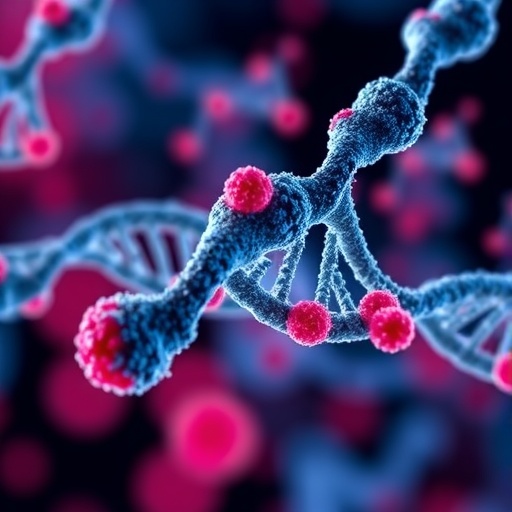
In the relentless quest to understand the origins and progression of blood cancers, a new landmark study from Washington University School of Medicine in St. Louis illuminates a crucial and previously underappreciated interaction: that between inherited genetic mutations and mutations acquired throughout a person’s life. This research marks a significant stride in cancer biology, revealing how the interplay of these distinct mutational sources shapes an individual’s risk of developing blood cancers such as acute myeloid leukemia (AML). The findings open promising avenues for early detection and intervention—potentially before cancer can take root.
As we age, our cells undergo constant division, a process that inevitably introduces errors into the DNA sequence. Most acquired mutations are benign, but a subset may confer a growth advantage to certain cells, initiating a cascade that ultimately leads to malignancy. While inherited—or germline—mutations are present from birth in every cell, acquired—or somatic—mutations accumulate gradually due to environmental exposures or biological processes. The new study provides compelling evidence that these two mutation types are not independent actors but instead engage in complex interactions that influence cancer risk dynamically over a lifetime.
The research team, led by Dr. Kelly Bolton, an assistant professor in the Division of Oncology, delved deep into genomic data derived from more than 730,000 individuals, integrating blood sample analyses with extensive genetic profiling. Their focus centered on clonal hematopoiesis, a condition marked by the expansion of blood stem cell clones harboring acquired mutations. While clonal hematopoiesis is generally considered a part of the normal aging process, it substantially increases the risk of progressing to overt blood cancer. Crucially, this study uncovered that inherited mutations in certain genes modulate the emergence and expansion of these clones, effectively shaping the landscape of clonal hematopoiesis.
Clonal hematopoiesis arises when a mutation in a hematopoietic stem cell provides a selective growth or survival advantage. These altered clones expand and can outcompete normal stem cells, creating a pre-malignant state. Yet, clonal hematopoiesis itself is not synonymous with leukemia: most individuals with this condition never develop blood cancer. The current research suggests that inherited genetic variants set the stage—literally providing the “soil” in which “undesirable seeds,” or acquired mutations, can flourish. This paradigm challenges a traditional view of cancer genesis and suggests that risk assessments based solely on acquired or inherited mutations may overlook critical combinatory effects.
By mapping specific inherited mutations and analyzing their association with patterns of newly acquired mutations, the researchers identified distinct genetic backgrounds that predispose individuals to more dangerous clonal expansions. These inherited variants affect the likelihood that clonal hematopoiesis will acquire additional driver mutations, pushing mutated clones closer to malignancy. The findings underscore that the path from normal blood cell production to leukemia is a multistep process, influenced by a dynamic interplay of germline predisposition and somatic evolution.
Environmental and lifestyle factors such as smoking, radiation, and chemotherapy exposure exacerbate the clonal evolution process, accelerating the acquisition of harmful mutations. However, many individuals develop blood cancer without notable environmental insults, highlighting the fundamental role of genetic interplay. This insight reframes our understanding of cancer’s root causes and underscores the necessity of integrating inherited and acquired mutation analyses for accurate risk prediction.
To translate these discoveries into clinical practice, the team emphasizes the potential of novel blood tests designed to detect both inherited high-risk mutations and early signs of clonal hematopoiesis before any abnormalities manifest in routine blood panels. Currently, identification relies on specialized assays not routinely performed during medical check-ups. If these obstacles are overcome, it could herald a new era of personalized cancer prevention that intervenes before disease onset.
Dr. Bolton articulates an aspirational vision: to intercept and eradicate pre-cancerous clones early, halting progression toward leukemia. This requires fine-tuned approaches that consider an individual’s inherited genetic landscape alongside acquired mutations. Such nuanced risk stratification may guide deployment of targeted therapies designed to suppress clonal expansion in high-risk individuals, transforming the natural history of blood cancers.
Prevention trials are underway, including investigations of IDH1 and IDH2 inhibitors aimed at blocking clonal expansion in patients on the brink of leukemia, as evidenced by abnormal blood counts. The promise of these targeted treatments is substantial, yet current trials operate downstream in the disease process. Unlocking the ability to identify at-risk people earlier, before blood count abnormalities develop, remains a critical challenge that will require both technological and biological innovation.
The study’s lead author, Jie Liu, highlights the significance of the integrated genomic approach, describing how comprehensive datasets enable quantification of the interplay between germline and somatic mutations. These quantitative insights bring granularity to risk models and emphasize that cancer risk cannot be fully understood by studying mutations in isolation. This nuanced perspective is pivotal for the future of precision oncology.
Blood cancers like AML are notoriously difficult to treat, with survival rates notoriously low once the disease advances. The current research thus carries profound clinical implications: by pushing forward the timeline of detection and enabling preemptive strikes against clonal hematopoiesis, there is hope to reduce the incidence and mortality of these formidable diseases significantly.
Fundamentally, this investigation redefines the genetic architecture of cancer predisposition, emphasizing that inherited and acquired mutations intertwine intricately within the hematopoietic system. The study calls for expanding the focus on genetic risk from the germline-only viewpoint to one that embraces the dynamic nature of somatic evolution shaped by inherited biology. This integrative vision will shape future research, diagnostics, and therapeutics in hematologic malignancies.
Washington University School of Medicine’s commitment to leveraging large-scale genomic resources such as the U.K. Biobank and the NIH’s All of Us Research Program has been instrumental in powering these revelations. The collaboration across disciplines and data sources embodies the modern era of biomedical discovery, where massive datasets enable explorations of human disease complexity at unprecedented depth.
This groundbreaking study not only advances our scientific understanding but also lights a path toward precision preventive medicine, where inherited and acquired genetic information coalesce into actionable knowledge. It marks a pivotal moment in the fight against blood cancers, a disease group that will benefit immensely from such strategic foresight.
News Publication Date: July 15, 2025
Web References:
https://www.nature.com/articles/s41588-025-02250-x
References:
Liu J, Tran D, Xue L, Wiley BJ, Vlasschaert C, Watson CJ, MacGregor HAJ, Zong X, Chan ICC, Das I, Uddin MM, Niroula A, Griffin G, Ebert BL, Mack T, Pershad Y, Sharber B, Berger M, Sehir A, Ptashkin R, Levine RL, Papaemmanuil E, Joseph V, Gao T, Kemel Y, Mandelker D, Stopsack KH, Pharoah PDP, Mukherjee S, Ding L, Cao Y, Walter MJ, Blundell JR, Chatterjee N, Offit K, Godley LA, Link DC, Stadler ZK, Bick AG, Natarajan P, Bolton KL. Germline genetic variation impacts clonal hematopoiesis landscape and progression to malignancy. Nature Genetics. July 15, 2025.
Cite Scienmag News
Nathaniel Bowman. (August 22, 2025). Genetic Research Uncovers New Methods for Early Detection of Blood Cancer. Scienmag. https://scienmag.com/genetic-research-uncovers-new-methods-for-early-detection-of-blood-cancer/
Nathaniel Bowman. "Genetic Research Uncovers New Methods for Early Detection of Blood Cancer." Scienmag, 22 August 2025, https://scienmag.com/genetic-research-uncovers-new-methods-for-early-detection-of-blood-cancer/. Accessed 9 September 2026.
Nathaniel Bowman. "Genetic Research Uncovers New Methods for Early Detection of Blood Cancer." Scienmag. August 22, 2025. https://scienmag.com/genetic-research-uncovers-new-methods-for-early-detection-of-blood-cancer/


