


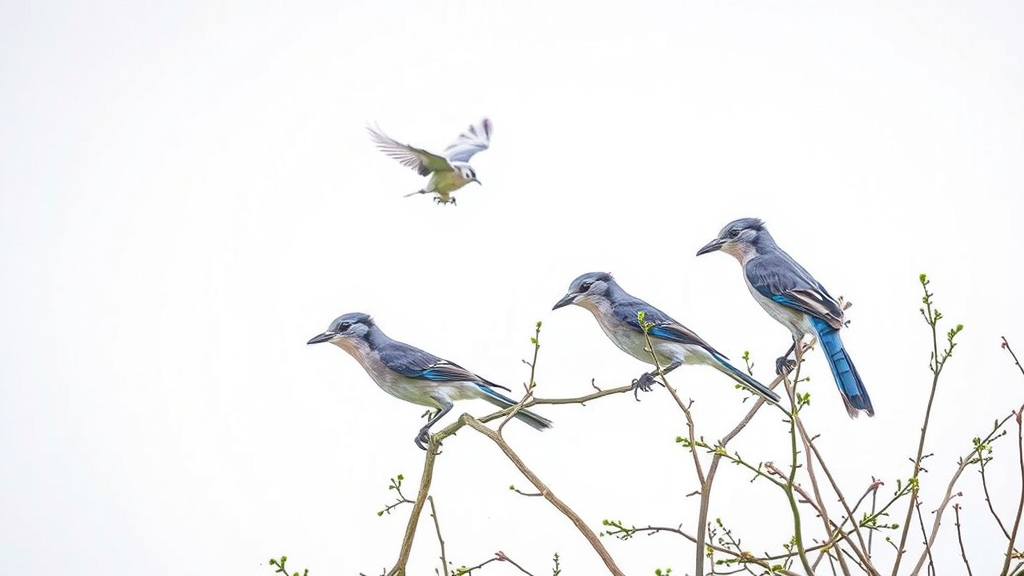
In one of the most ambitious experiments ever attempted with an imperiled North American bird, a team of conservation scientists has moved dozens of Florida scrub-jays to a new home in a single season, betting that a surge of fresh genes can pull a struggling population back from the edge. At the center of the effort is Lauren Deaner, a doctoral researcher in the integrative biology program at the University of Central Florida, who has spent nearly two decades working hands-on with this charismatic, cooperative species. Her dissertation project, a first-of-its-kind translocation initiative, is designed to answer one of conservation biology’s most pressing questions: can genetic rescue, the deliberate introduction of individuals from other populations to boost genetic diversity, reliably restore the health and long-term viability of a depleted wild population?
The Florida scrub-jay, the only bird species endemic to Florida, has become an icon of the state’s vanishing oak scrub habitats. Decades of habitat loss and fragmentation have left remaining populations isolated in small patches, where inbreeding and lost genetic variation can erode fertility, survival and resilience to disease. Deaner’s project builds on regional recovery efforts that began in the late 1990s through mitigation work led by the Mosaic Company, with early guidance from the late Reed Bowman, a prominent Florida avian biologist. Today, Raoul Boughton, senior manager of ecology and wildlife at the Mosaic Company, leads the recovery effort, with Deaner and Sahas Barve, program director of avian ecology at Archbold Biological Station, serving as co-principal investigators. Their collaboration spans wildlife managers, academic geneticists and field ecologists, reflecting the interdisciplinary scope that modern species recovery demands.
The scale of this translocation sets it apart. Previous scrub-jay relocations typically involved moving small numbers of birds over several years, producing gradual, hard-to-interpret changes. This time, researchers translocated 48 Florida scrub-jays to a new recipient site in one coordinated effort, enough birds to fill the site to its estimated carrying capacity. Every one of the 48 birds hatched in 2025, a deliberate design choice that eliminated age-related competitive advantages and allowed the team to observe how a cohort of young birds establishes itself from a level starting point. The result is essentially a controlled experiment in population establishment, replicated at a landscape scale that no previous scrub-jay study has attempted.
What happened next surprised even the researchers. Florida scrub-jays typically delay breeding, usually not becoming breeders until they are 2 or 3 years old, and younger birds instead remain on their parents’ territories as helpers, feeding nestlings and defending the family group. Across six decades of monitoring at Archbold Biological Station and two decades of data from the local population, fewer than 0.25 percent of recorded nesting attempts involved pairs of one-year-old birds. Yet at the recipient site, just six months after the translocation, four of the 10 newly formed pairs of one-year-old birds attempted to nest, a rate of 40 percent. The team had expected roughly half of the groups to include young birds serving as helpers; instead, most of the translocated jays sought their own breeding territories almost immediately.
That precocious breeding behavior matters far beyond its novelty. Genetic rescue ultimately works only if translocated individuals survive, find mates, reproduce and pass their genetic variation into the recipient population. The nesting attempts signal that the founding birds are not merely persisting but actively claiming territories and pairing up, giving researchers an early window into whether and how genetic integration will occur. While it remains too soon to measure the translocation’s long-term effects, the speed of establishment suggests the young birds detected something unusual about their circumstances, whether the absence of older competitors, the availability of vacant habitat, or some combination of social and ecological cues, and responded by accelerating their life histories.
The scientific machinery behind the project combines two powerful data streams. Genomic sequencing allows the team to examine patterns of genetic variation among source populations, identifying how different lineages have diverged and which combinations of breeding might maximize heterozygosity and minimize inbreeding in the next generation. Meanwhile, long-term field monitoring, the kind of painstaking, bird-by-bird observation that Deaner and her colleagues have honed over decades, provides the demographic reality check: survival rates, reproductive output, territory establishment, dispersal distances and population growth. The team integrates both streams using Vortex, a population viability analysis software that models how genetic, environmental and demographic factors interact to affect a species’ probability of persistence. By running scenarios with and without genetic rescue, the researchers can quantify how much a single large translocation might shift the population’s trajectory decades into the future.
Innovative tracking technology adds another layer of precision. Each translocated jay carries an RFID tag, and the team established feeding stations where a bird must stand on an antenna to access peanuts. Every visit is automatically recorded, giving Deaner a continuous, individual-level log of presence and social feeding behavior. Those visitation patterns do more than confirm survival; they may reveal the subtle early signatures of pair formation, as two birds begin appearing at the same stations at overlapping times. Identifying emerging pairs quickly allows the researchers to target those birds for intensive reproductive monitoring, locating nests, confirming clutch sizes and, eventually, sampling chicks for genetic analysis to confirm which parents contributed which alleles to the next generation.
Deaner’s path to this project runs directly through the species itself. Between earning her undergraduate degree at the University of Delaware and her master’s degree at Georgia Southern University, she spent six years conducting early translocations involving the very same Florida scrub-jay population she studies today. Collecting those field data, she says, and knowing that so many answers lie just beneath the surface of each spreadsheet, is what first inspired her to pursue graduate school. After completing her master’s degree, she returned to the scrub-jay recovery project, where the experience reinforced her conviction that genetic recovery is essential to the population’s long-term persistence. At UCF, she found an academic home that could match her field experience with analytical firepower. She conducts her research in the Conservation Genomics Lab of Eric Hoffman, chair and professor in the UCF Department of Biology, working alongside students tackling parallel conservation questions. Her dissertation weaves together conservation genomics, population ecology, behavioral ecology, spatial analysis and population modeling, an integration she credits to the university’s collaborative and interdisciplinary approach to biology.
The implications of the work extend well beyond a single species. If the scrub-jay translocation demonstrates that a one-time, carrying-capacity introduction of young, genetically diverse individuals can jump-start population recovery, it could reshape how managers design rescue programs for other imperiled species, potentially achieving results faster and with fewer resources than incremental translocations spread over many years. Deaner hopes the research will ultimately help conservationists recover imperiled species more quickly and more efficiently, turning genetics from a diagnostic tool into an active lever for restoration. In September, she will present preliminary findings at the International Conservation Translocation Conference in Edinburgh, Scotland, sharing early results with a global community of translocation practitioners.
For Deaner, the project is also a testament to a philosophy of curiosity-driven science. It is not the taxon that matters, she says, but the questions; as long as the questions are the ones that trigger your curiosity, you are heading in the right direction. With 48 young jays establishing territories, pairing up and attempting nests in habitat where their genes have never flowed before, the questions she has pursued for nearly twenty years are finally being answered in real time, one banded bird and one RFID log entry at a time, in the scrublands of central Florida.
Subject of Research: Conservation genomics of genetic rescue in the Florida scrub-jay
Article Title: UCF researcher uses conservation genomics to advance Florida scrub-jay recovery
Article References: UCF researcher uses conservation genomics to advance Florida scrub-jay recovery. (n.d.). Original publication
Image Credits: AI Generated
DOI: Not provided
Keywords: Florida scrub-jay, conservation genomics, genetic rescue, translocation, population viability, RFID tracking, mate choice, University of Central Florida, Archbold Biological Station, endangered species recovery, population genetics, wildlife conservation
Cite Scienmag News
Juliet Wilcox. (September 20, 2026). Genetic Rescue Trial Moves 48 Florida Scrub-Jays to Speed Recovery. Scienmag. https://scienmag.com/genetic-rescue-trial-moves-48-florida-scrub-jays-to-speed-recovery/
Juliet Wilcox. "Genetic Rescue Trial Moves 48 Florida Scrub-Jays to Speed Recovery." Scienmag, 20 September 2026, https://scienmag.com/genetic-rescue-trial-moves-48-florida-scrub-jays-to-speed-recovery/. Accessed 4 October 2026.
Juliet Wilcox. "Genetic Rescue Trial Moves 48 Florida Scrub-Jays to Speed Recovery." Scienmag. September 20, 2026. https://scienmag.com/genetic-rescue-trial-moves-48-florida-scrub-jays-to-speed-recovery/


