


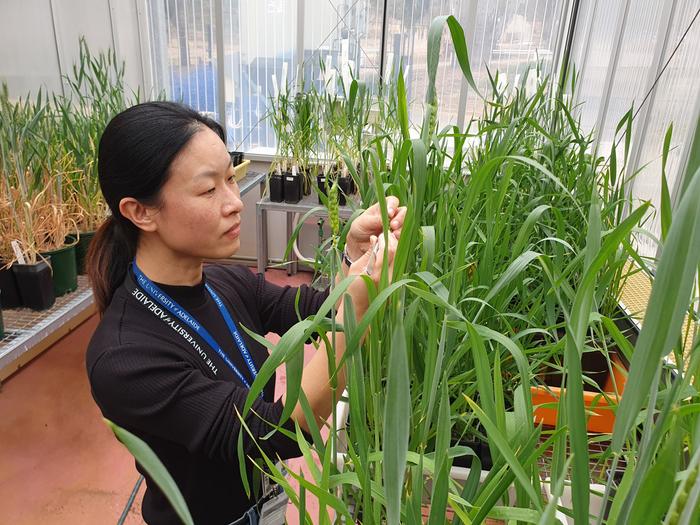
Fungal disease Fusarium head blight (FHB) is on the rise due to increasingly humid conditions induced by climate change during the wheat growing season, but a fundamental discovery by University of Adelaide researchers could help reduce its economic harm.

Credit: University of Adelaide
Fungal disease Fusarium head blight (FHB) is on the rise due to increasingly humid conditions induced by climate change during the wheat growing season, but a fundamental discovery by University of Adelaide researchers could help reduce its economic harm.
While some types of wheat are resistant to FHB thanks to the action of the TaHRC gene at the Fhb1 locus, how this gene functions in wheat cells was unknown until now.
Collaborating with Nanjing Agriculture University, the University of Adelaide research team has shown TaHRC works in the nucleus of wheat cells, and it can either increase or decrease a plant’s susceptibility to FHB.
“There are two variants of TaHRC that have opposing effects on the condensation of a specific protein complex within the nucleus,” says Dr Xiujuan Yang, from the University’s School of Agriculture, Food and Wine.
“When condensed, the complex leads to susceptibility to FHB, whereas when diffused, it provides resistance against FHB.
“We are the first to reveal the function of protein complex condensation in response to a major crop fungal disease, providing insight into the mode of action of protein complexes in cereal defence responses.”
FHB has caused significant harm to Australia’s wheat industry in recent years, with crops in the 2022 season suffering up to 100 per cent yield losses.
The disease has been on the rise globally since the 1970s, but climate change has increased its prevalence.
“Australia’s reputation for producing high-quality wheat has been built on fortuitous climate conditions during flowering and grain fill, typically coinciding with the dry season, which helps avoid many fungus-caused diseases that thrive in humid weather,” says Dr Yang.
“However, in the background of climate change, a wet spring in 2022 led to Fusarium head blight becoming widespread across eastern Australia.”
Australian durum wheat varieties are all highly susceptible to FHB, but it is unclear what level of resistance exists in bread-wheat varieties.
Dr Yang hopes this fundamental discovery, published in Cell Host & Microbe, will counteract the growing prevalence of FHB and provide assurance to Australian growers.
“Our findings offer exciting prospects for developing new and enhanced forms of Fusarium head blight resistance,” Dr Yang says.
“By understanding the underlying mechanisms beyond Fhb1, we can innovate breeding strategies to diversify resistance sources.
“Our research opens the door to the development of more resilient and sustainable wheat varieties for future agriculture, and might shed light onto other Fusarium-caused diseases, such as crown rot.”
Journal
Cell Host & Microbe
Method of Research
Data/statistical analysis
Subject of Research
Cells
Article Title
A phase-separated protein hub modulates resistance to Fusarium head blight in wheat
Article Publication Date
23-Apr-2024
COI Statement
The authors declare no competing interests.
Cite Scienmag News
Alan Morgan. (April 26, 2024). Genetic hope in fight against devastating wheat disease. Scienmag. https://scienmag.com/genetic-hope-in-fight-against-devastating-wheat-disease/
Alan Morgan. "Genetic hope in fight against devastating wheat disease." Scienmag, 26 April 2024, https://scienmag.com/genetic-hope-in-fight-against-devastating-wheat-disease/. Accessed 6 September 2026.
Alan Morgan. "Genetic hope in fight against devastating wheat disease." Scienmag. April 26, 2024. https://scienmag.com/genetic-hope-in-fight-against-devastating-wheat-disease/

