


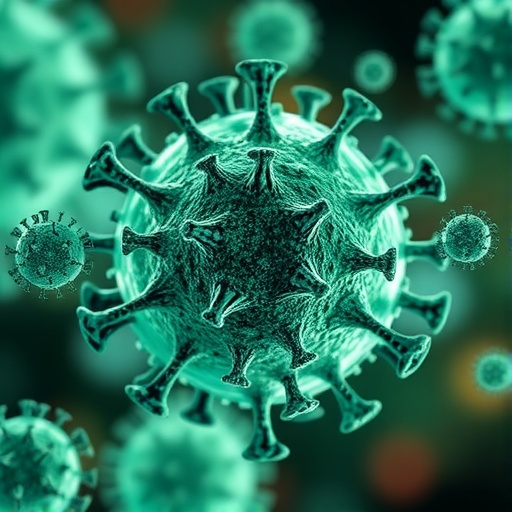
Since the outset of the COVID-19 pandemic, the SARS-CoV-2 virus has exhibited a remarkable capacity for evolution, adapting swiftly to human hosts and giving rise to myriad variants with diverse properties. However, a groundbreaking study published in the prestigious journal Genome Biology and Evolution challenges prevalent assumptions about the virus’s mutational freedom. Conducted by researchers at the University of Glasgow’s Centre for Virus Research, this new paper illuminates how the evolutionary trajectory of the virus, particularly its spike protein, has been fundamentally constrained by structural limitations, confining the virus within a narrow genetic landscape despite rapid mutation.
When SARS-CoV-2 first emerged in late 2019, its evolutionary journey was marked by significant shifts across the viral genome, most notably in the spike glycoprotein that decorates its surface. The spike protein serves as the key facilitator of viral entry into host cells by binding to the ACE2 receptor and is, therefore, a prime target for both the immune system and therapeutic interventions. Initial scientific intuition suspected that the virus could expand its mutational routes by radically altering the spike’s structural conformation, possibly creating new avenues for enhanced transmissibility or immune evasion. Yet, the data unveiled by this recent research contradicts this hypothesis, showing that structural constraints of the spike protein have remained steadfast throughout the pandemic.
The study leveraged an unprecedentedly rich array of global SARS-CoV-2 genomic sequences, coupled with advanced computational analyses focusing on protein structural modeling and constraint prediction. This multifaceted approach allowed the scientists to discern phases of the virus’s evolution post-spillover into humans and quantify the degree to which protein stability dictated the viability of emerging mutations. Computational predictors were applied to various spike protein structural contexts, revealing that while mutations accrued rapidly, they did so within a fixed fitness landscape shaped by stringent biophysical limits.
Early in the pandemic, SARS-CoV-2 exhibited what is described as neutral diversification, a phase characterized by the accumulation of genetic changes without dramatic effects on viral fitness or phenotype. However, by late 2020, this gave way to the rise of multi-mutant variants distinguished by combinations of mutations rather than singular dramatic changes. The World Health Organization classified these as variants of concern—variants possessing traits like heightened transmissibility or partial immune escape. Despite their epidemiological importance, the investigation found no evidence that these phenotypic changes arose from a relaxation of spike protein structural constraints.
The findings underscore a nuanced but critical insight: rather than the virus discovering new evolutionary pathways via structural protein alterations, variant emergence appears driven by novel mutation combinations where functional interactions—epistasis—play a dominant role. In other words, SARS-CoV-2 adapts by reshuffling existing mutations, exploiting synergistic effects rather than expanding the scope of possible structural mutations. This suggests a remarkably constrained viral adaptability fingerprinted in the protein’s stability and folding dynamics.
This revelation holds profound implications in the broader field of coronavirus evolution. The spike protein’s steadfast structural constraints likely represent a fundamental evolutionary bottleneck, limiting the virus’s capacity to explore radically new phenotypic territories without compromising essential functions. Such constrained mutational space could explain why, despite billions of infections and rampant mutation, SARS-CoV-2 variants have not dramatically altered the basic mechanisms of host cell entry or immune system recognition beyond known mutations.
From a clinical and public health perspective, understanding these constraints furnishes valuable guidance for vaccine design and antiviral drug development. Vaccines targeting conserved regions of the spike protein that cannot easily mutate without destabilizing the virus might maintain long-term efficacy. Similarly, antiviral strategies can be optimized by focusing on structural “Achilles’ heels” identified through computational constraint mapping, anticipating the virus’s limited mutational options to escape therapeutics.
Lead author James Herzig emphasized the broader scientific impact of these revelations, noting that “this research describes the evolutionary pressures acting to contain the virus’s spike protein mutations without relaxation, illuminating important dynamics that will inform our approach to future coronavirus zoonoses and therapeutic countermeasures.” Insights gleaned from SARS-CoV-2 serve as a paradigm for anticipating how other coronaviruses might behave upon species jumps and evolve under selective pressure.
Technologically, the availability of massive sequencing datasets coupled with structural biology tools has revolutionized our capacity to monitor viral evolution in near real-time. This study exemplifies how interdisciplinary computational biology approaches can dissect viral adaptation with granularity previously unattainable, illustrating the power of combining protein structural analysis with population-scale genomic data to uncover hidden patterns governing viral fitness landscapes.
The persistence of structural constraints amidst rapid viral evolution epitomizes the interplay of biophysics and evolutionary biology: while mutation rates may be high and selective pressures intense, the fundamental laws governing protein folding and stability impose critical limits on evolutionary innovation. This interplay ensures that even a pandemic virus must navigate a tightly bounded mutational arena, reconciling adaptability with viability.
In summary, the research dismantles the narrative that SARS-CoV-2 dramatically expanded its mutational repertoire post-human transmission. Instead, it evolved rapidly within well-defined structural boundaries, fashioning new variants by recombining existing mutations rather than breaching ancient biophysical constraints. This discovery reshapes our understanding of viral evolution during the pandemic and sets a conceptual framework for anticipating future viral threats.
For those aimed at integrating these scientific insights into practical application, the study’s comprehensive methodology and conclusions offer a roadmap toward more robust vaccine platforms and durable antiviral agents. Maintaining vigilance over the structural stability of viral proteins may well be our strongest ally in containing and mitigating not only COVID-19 but future pandemics caused by coronaviruses and other pathogens subject to similar evolutionary pressures.
In the continuum of evolutionary biology and pandemic preparedness, this research symbolizes a crystalline moment where deep mechanistic understanding can be translated into tangible benefits for global health, confirming that despite the virus’s rapid evolution, nature’s structural boundaries have not been substantially crossed.
News Publication Date: 25-Mar-2026
Web References:
https://academic.oup.com/gbe/article-lookup/doi/10.1093/gbe/evag049
http://dx.doi.org/10.1093/gbe/evag049
Cite Scienmag News
Kristina Jarvis. (March 25, 2026). Genetic Discovery Reveals Evolutionary Boundaries of the COVID-19 Virus. Scienmag. https://scienmag.com/genetic-discovery-reveals-evolutionary-boundaries-of-the-covid-19-virus/
Kristina Jarvis. "Genetic Discovery Reveals Evolutionary Boundaries of the COVID-19 Virus." Scienmag, 25 March 2026, https://scienmag.com/genetic-discovery-reveals-evolutionary-boundaries-of-the-covid-19-virus/. Accessed 3 September 2026.
Kristina Jarvis. "Genetic Discovery Reveals Evolutionary Boundaries of the COVID-19 Virus." Scienmag. March 25, 2026. https://scienmag.com/genetic-discovery-reveals-evolutionary-boundaries-of-the-covid-19-virus/


