


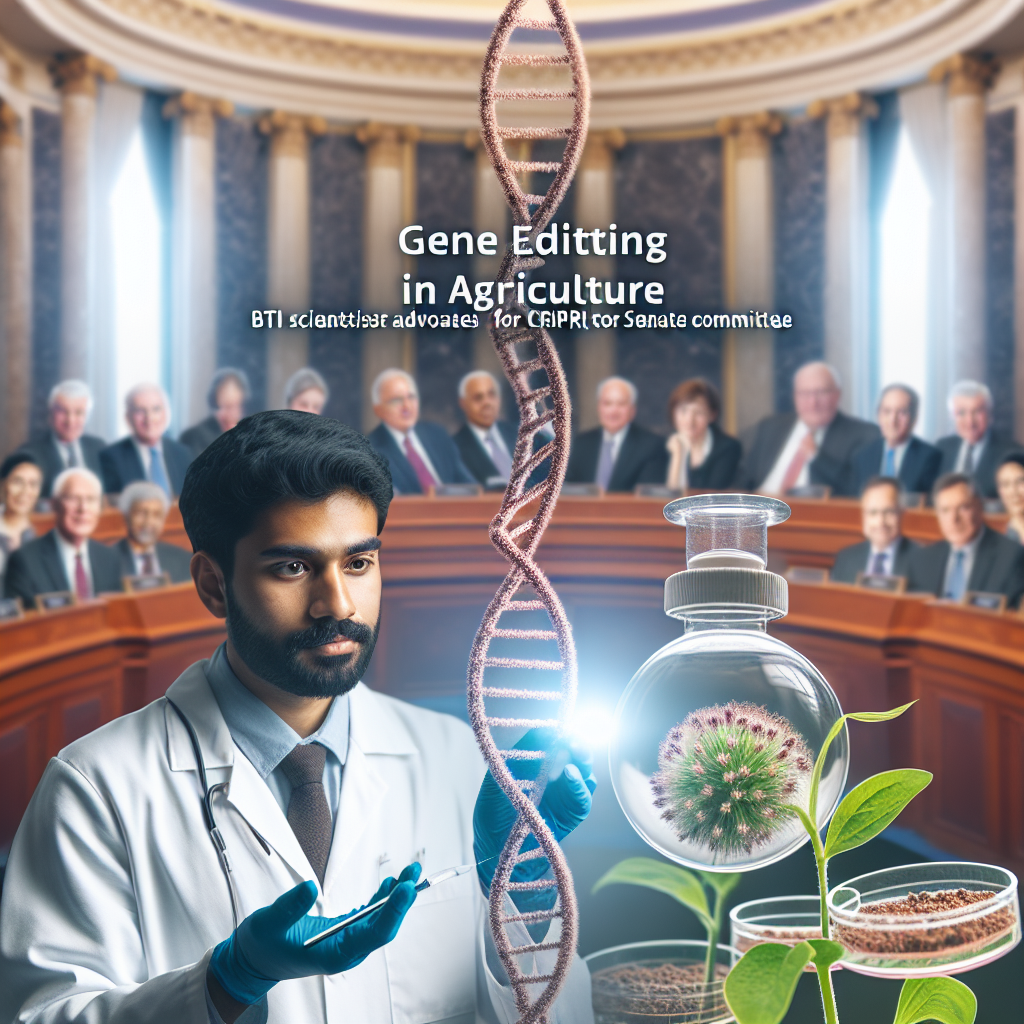
On April 23rd, Georg Jander, a professor from the Boyce Thompson Institute, addressed an audience in the offices of the U.S. Senate Committee on Agriculture, Nutrition, and Forestry. In a compelling presentation titled “The Next Agricultural Revolution: Targeted Gene Editing Using CRISPR,” Jander outlined the transformative potential of CRISPR technologies in agriculture. Two other speakers in this Congressional Lunch-and-Learn session, Dan Jenkins from Pairwise and Emily Negrin from Inari, described how their companies use CRISPR-mediated gene editing for crop improvement.
On April 23rd, Georg Jander, a professor from the Boyce Thompson Institute, addressed an audience in the offices of the U.S. Senate Committee on Agriculture, Nutrition, and Forestry. In a compelling presentation titled “The Next Agricultural Revolution: Targeted Gene Editing Using CRISPR,” Jander outlined the transformative potential of CRISPR technologies in agriculture. Two other speakers in this Congressional Lunch-and-Learn session, Dan Jenkins from Pairwise and Emily Negrin from Inari, described how their companies use CRISPR-mediated gene editing for crop improvement.
“CRISPR is driving a new green revolution,” explained Jander. “It allows us to precisely edit plant genes in a way that was never before possible. We can now optimize crops for desirable traits like disease resistance, higher nutritional value, and improved yields more efficiently than traditional breeding methods.”
CRISPR, which stands for Clustered Regularly Interspaced Short Palindromic Repeats, is a gene editing technology that enables scientists to modify an organism’s DNA with unprecedented precision. Borrowed from a natural defense mechanism in bacteria, CRISPR uses a programmable guide molecule to direct a DNA-cutting enzyme to a specific target sequence in the genome. Once cut, that targeted portion of DNA can be removed, added, or altered.
During his presentation, Jander emphasized how CRISPR could be pivotal in addressing some of the most pressing challenges of modern agriculture. “With CRISPR, we can enhance crops by turning on beneficial genes, turning off undesirable ones, or even introducing new traits from other species. The possibilities for improving food security, agricultural sustainability, and crop resilience are vast.”
Following his presentation, Jander engaged in strategic discussions with Senate and House staffers, emphasizing the importance of continued federal funding for agricultural research. These interactions highlighted the role of scientific innovation in bolstering the economy and sustainability of Upstate New York—a region profoundly dependent on agriculture.
The session, organized by the National Coalition for Food and Agricultural Research, the American Society of Plant Biologists, and Lewis-Burke Associates, was not just an exposition of scientific expertise but a call to action. It underscored the necessity for policymakers to support and fund the technologies that will define the future of agriculture.
The Boyce Thompson Institute, where Jander conducts his research, has been at the forefront of integrating plant science with sustainable agricultural practices. With CRISPR technology, researchers like him are not only decoding the complexities of plant biology but are also setting the stage for transformative leaps in sustainable agriculture. The ongoing support from legislative bodies and funding agencies will be crucial in moving these innovations from the lab to the field, where they can have a significant impact.
About the Boyce Thompson Institute
Founded in 1924 and located in Ithaca, New York, BTI is at the forefront of plant science research. Our mission is to advance, communicate, and leverage pioneering discoveries in plant sciences to develop sustainable and resilient agriculture, improve food security, protect the environment, and enhance human health. As an independent nonprofit research institute affiliated with Cornell University, we are committed to inspiring and training the next generation of scientific leaders. Learn more at BTIscience.org.
Cite Scienmag News
Juliet Wilcox. (May 1, 2024). Gene editing in agriculture: BTI scientist advocates for CRISPR innovations to senate committee. Scienmag. https://scienmag.com/gene-editing-in-agriculture-bti-scientist-advocates-for-crispr-innovations-to-senate-committee/
Juliet Wilcox. "Gene editing in agriculture: BTI scientist advocates for CRISPR innovations to senate committee." Scienmag, 1 May 2024, https://scienmag.com/gene-editing-in-agriculture-bti-scientist-advocates-for-crispr-innovations-to-senate-committee/. Accessed 6 September 2026.
Juliet Wilcox. "Gene editing in agriculture: BTI scientist advocates for CRISPR innovations to senate committee." Scienmag. May 1, 2024. https://scienmag.com/gene-editing-in-agriculture-bti-scientist-advocates-for-crispr-innovations-to-senate-committee/


