


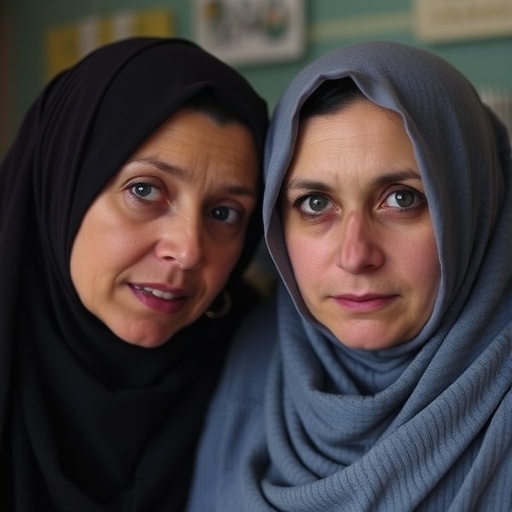
Nearly every displaced woman in Gaza surveyed in a new study screened positive for severe post-traumatic stress symptoms, a finding researchers describe as an unprecedented psychological toll linked directly to hunger, overcrowded displacement, and the collapse of everyday life under war.
The study, published in the International Journal for Equity in Health, assessed 503 displaced women in the Gaza Strip during the 2023–2025 war using a mixed-methods design that combined a structured quantitative survey with in-depth qualitative interviews. The average participant was 29.4 years old, with a standard deviation of 7.3 years, and the majority were married, unemployed, and living below the deep poverty line. Most had been displaced for nearly a year, and the overwhelming majority were sheltering in tents under conditions of severe overcrowding and acute food shortage.
When researchers measured post-traumatic stress symptoms using the Impact of Event Scale–Revised, a widely used screening instrument that evaluates intrusion, avoidance, and hyperarousal symptoms following traumatic exposure, they found that 98.2 percent of participants scored in the severe range. The mean IES-R score across the sample was 61.5, with a standard deviation of 9.5 — a figure far above the thresholds typically used to flag clinically significant trauma-related distress. The authors are careful to note that because symptoms were assessed with a screening tool rather than a formal diagnostic clinical interview, the results should be interpreted as reflecting an extremely high burden of trauma-related distress within the study sample rather than confirmed clinical diagnoses. Even with that caveat, the near-universality of severe scores stands out even against the backdrop of other conflict-affected populations, where severe symptom prevalence rarely approaches such levels.
Food emerged as one of the strongest statistical correlates of psychological suffering. Severe food insecurity, measured with the Food Insecurity Experience Scale developed by the Food and Agriculture Organization, affected approximately 71 percent of participants. Women experiencing severe food insecurity had significantly higher PTSD symptom severity scores, an association that held at a p-value below 0.001. The researchers also identified a cluster of socioeconomic and living-condition factors associated with worse outcomes: being divorced or widowed, living in an extended-family household, sheltering in a tent or collective shelter during displacement, and reporting that food was simply unavailable were all significantly linked to elevated symptom scores.
These quantitative patterns were given texture and depth by the qualitative arm of the study, in which trained researchers conducted semi-structured, face-to-face interviews in Arabic with 34 of the women. Analysis of the transcripts revealed five overarching themes: poverty and inequity; food as a luxury; wounds you cannot see; on the move, nowhere to belong; and small acts of resilience. Together, the themes trace an arc from material deprivation to psychological injury and, ultimately, to the fragile coping strategies women deployed to keep themselves and their families functioning.
The theme of food as a luxury captured how a basic biological need had been transformed into an object of obsession and grief. Women described rationing scraps, skipping meals so children could eat, and the humiliating experience of standing in lines for aid that never arrived. The researchers note that this chronic preoccupation with food security operated on two fronts — it was simultaneously a source of traumatic stress in its own right and an amplifier of existing war trauma, since hunger stripped away one of the last remaining domains in which mothers could still protect their children.
The “wounds you cannot see” theme speaks directly to the invisible nature of psychological injury in wartime. Women recounted nightmares, intrusive memories of bombings and the deaths of relatives, hypervigilance, emotional numbness, and an inability to feel safe even in moments of quiet. Several described the stigma of admitting psychological suffering, or the sense that mental distress was a luxury they could not afford to acknowledge while survival demanded constant action. The researchers interpret these accounts as illustrating how trauma in this context is not a discrete event but a continuous condition, woven into the fabric of daily life.
Displacement itself — the theme of being “on the move, nowhere to belong” — emerged as a distinct psychological stressor. Women described repeated forced evacuations, the loss of homes that anchored family identity and memory, and the corrosive instability of living in tents that leaked in rain, baked in heat, and offered no privacy for grieving or for motherhood. The loss of place, the authors suggest, compounds the loss of people, producing a grief that has nowhere to settle.
Yet the final theme, small acts of resilience, complicates a narrative of pure victimhood. Women described prayer, mutual aid among neighbors, storytelling with children, and small rituals of domesticity — making tea, arranging a tent, celebrating a birthday with almost nothing — as deliberate acts of psychological resistance. The researchers frame these behaviors as adaptive coping mechanisms that, while insufficient to protect against severe trauma symptoms, sustained a sense of agency and dignity under conditions designed to strip both away.
Methodologically, the study relied on a convenience sample recruited through structured surveys administered via Google Forms, a pragmatic choice given the destruction of infrastructure and the impossibility of random sampling in an active war zone. The authors acknowledge this limitation, along with the screening-based measurement of PTSD and the absence of consistent formal referral pathways for psychological care during data collection, which meant that women who became distressed during interviews could not always be directed to clinical services. Interviews followed strict ethical protocols approved by the Institutional Review Board at An-Najah National University, with verbal informed consent, anonymization, and trained interviewers instructed to pause or terminate any conversation that caused visible distress.
The demographic profile of the sample underscores the socioeconomic dimension of psychological vulnerability. That most participants were unemployed and living below the deep poverty line before and during the war reflects broader patterns in which economic deprivation and mental health outcomes are tightly intertwined in conflict settings. Divorced and widowed women — those without a partner’s social and economic support — fared significantly worse, as did women in extended-family households, possibly reflecting crowded conditions and multiplied caregiving burdens.
The study carries a sobering human footnote. The acknowledgments honor the memory of co-author Ayman S. Abutair, a clinical nutrition researcher at Al-Azhar University-Gaza, who lost his life during the war before the paper’s publication. His death stands as a stark reminder that the researchers documenting these invisible wounds were themselves living within the same catastrophe.
The authors argue that their findings demonstrate an urgent and unmet need for comprehensive humanitarian and psychosocial support tailored to displaced women — support that integrates mental health care with food assistance, shelter improvement, and protection for female-headed households. They emphasize that because caregiving responsibilities fall disproportionately on women during war and displacement, their psychological deterioration radiates outward to children and entire family systems, making women’s mental health a strategic priority for any humanitarian response rather than an afterthought.
What the study ultimately documents is the entanglement of hunger and trauma at a scale rarely captured in research. Where most studies of conflict-related PTSD examine populations after violence has subsided, this research measured psychological injury while bombs were still falling, while displacement was ongoing, and while food systems had collapsed. The result is a portrait of a population in which severe trauma symptoms are not an unfortunate consequence of war but, in effect, a near-universal condition — visible not in wounds, but in sleepless nights, interrupted meals, and the quiet endurance of half a million women carrying burdens that remain, for now, largely untreated.
Cite Scienmag News
Courtney Benton. (September 9, 2026). Gaza women bear invisible psychological scars of war, study finds. Scienmag. https://scienmag.com/gaza-women-bear-invisible-psychological-scars-of-war-study-finds/
Courtney Benton. "Gaza women bear invisible psychological scars of war, study finds." Scienmag, 9 September 2026, https://scienmag.com/gaza-women-bear-invisible-psychological-scars-of-war-study-finds/. Accessed 9 September 2026.
Courtney Benton. "Gaza women bear invisible psychological scars of war, study finds." Scienmag. September 9, 2026. https://scienmag.com/gaza-women-bear-invisible-psychological-scars-of-war-study-finds/


