


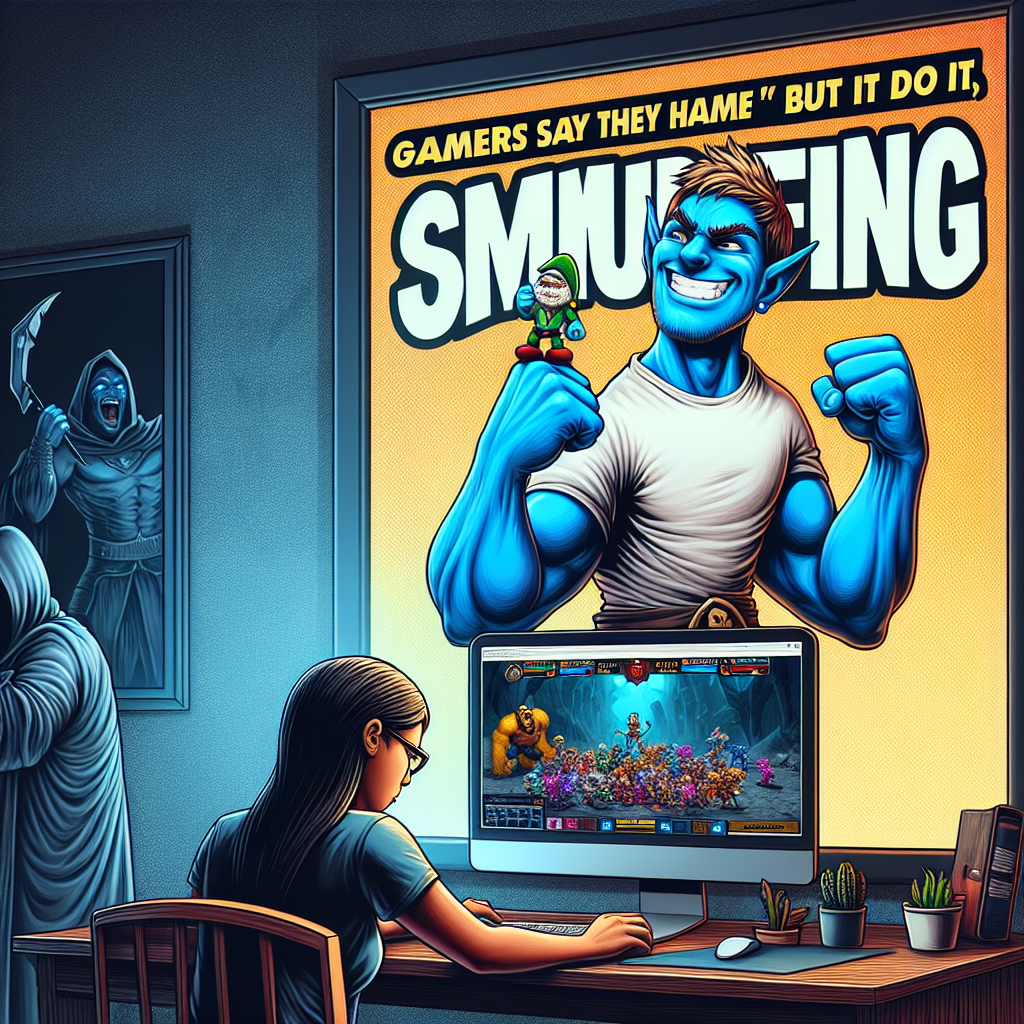
COLUMBUS, Ohio – Online video game players believe the behavior known as “smurfing” is generally wrong and toxic to the gaming community – but most admit to doing it and say some reasons make the behavior less blameworthy, new research finds.
COLUMBUS, Ohio – Online video game players believe the behavior known as “smurfing” is generally wrong and toxic to the gaming community – but most admit to doing it and say some reasons make the behavior less blameworthy, new research finds.
The new study suggests that debates about toxicity in gaming may sometimes be more complex and nuanced than is often acknowledged, according to the researchers.
Online video games use what are called “matchmaking systems” to pair players based on skill. “Smurfing” is when players cheat these systems by creating new accounts so that they can play against people lower in skill.
The practice has become controversial in the gaming community, with some people defending it while others say it ruins the game.
This study suggests the practice is common, even though many players claim to hate it, said Charles Monge, lead author of the study and a doctoral student in communication at The Ohio State University.
“Gamers say they really don’t like smurfing. They also say they do it, but they’re not ruining games and they only do it for valid reasons,” Monge said.
Monge conducted the study with Nicholas Matthews, assistant professor of communication at Ohio State. The research was published recently in the journal New Media & Society.
“Gamers put smurfing in the bad category, but bad has nuance,” Matthews said. “It was really quite interesting to see people say they were being ‘bad’ by smurfing, but only a little – unlike others whose behavior was much worse.”
The research started with a baseline study of 328 people from gaming-specific subreddits on the social media site reddit and a gaming club at Ohio State. Participants reported playing video games slightly more than 24 hours a week on average.
Results showed that participants perceived smurfs as more likely than other players to be toxic – such as trolling and flaming the weaker players that they dominated.
But 69% reported that they smurfed at least sometimes, and 94% thought other people smurf sometimes. Still, relative to themselves, participants thought that other gamers were more likely to be toxic when they smurfed.
But the researchers were surprised by the responses they received when they asked participants at the end of the study if they had any comments.
“There was this outpouring of comments saying basically, ‘Hey, I do smurf sometimes, but really it is not bad all the time,’” Monge said.
“It got us interested in trying to figure out more about what made smurfing OK in their minds and in what circumstances.”
In a second study, the researchers aimed to explore how gamers determined blame for smurfers. They had 235 participants from reddit who were heavy gamers complete an online experiment where they evaluated smurfing in competitive team-based video games.
Participants were given various reasons for smurfing to evaluate. Some reasons were less blameworthy – such as wanting to play with friends who were less experienced at the game. Other reasons were more blameworthy – such as just wanting to “crush a bunch of [lesser skilled players].”
In some cases, the researchers tried to bias the judgments of participants by suggesting scenarios in which the reasons players gave for smurfing might be ignored.
In general, the study found that participants fairly evaluated people who smurfed based on the reasons they gave – and did not show strong evidence of bias in any scenario.
The response by participants in this study is in line with what scientists call the “socially regulated” perspective on blame, which suggests there can be some nuance, that there are reasons that can make an action more or less blameworthy.
That’s not what the researchers thought would happen.
Based on what most online research predicts, the response the researchers expected is called a “motivated-blame perspective,” and it considers what is blameworthy to be black and white, Matthews said.
“This perspective says if something is wrong, it doesn’t matter your reason for doing it, it is always wrong.”
Monge added: “The idea is that it shouldn’t matter if you were just smurfing so you can play with your friends, you made me lose this game and now I am mad.”
A third study involved a group of non-gamers, to see if they would have the same perspectives on blame even though they were not so invested in the importance of the games. It turns out they did – they also used the socially regulated perspective.
The issue of smurfing in the gaming community has only grown recently, the researchers said. Valve, the company behind the gaming platform Steam, banned 90,000 smurf accounts in their game DOTA2, publicly declaring that “smurfing is not welcome.”
But this study makes it clear that many gamers may have a more complex relationship to smurfing and that saying it is not welcome may be an oversimplification for them, the researchers said.
The issues explored in this study may have broader applicability beyond gaming, the researchers explained.
“Games may offer a really potent tool to test things that are not about games,” Monge said. “How we attribute blame in an online context may allow us to understand how people place blame more broadly.”
Matthews added: “Social scientists can use virtual game environments to test human interactions at mass scale. We can understand people in these social contexts when usually the mind is a black box.”
Journal
New Media & Society
Method of Research
Experimental study
Subject of Research
People
Article Title
Blaming the smurf: Using a novel social deception behavior in online games to test attribution theories
Article Publication Date
12-Mar-2024
Cite Scienmag News
Courtney Benton. (May 21, 2024). Gamers say they hate ‘smurfing,’ but admit they do it. Scienmag. https://scienmag.com/gamers-say-they-hate-smurfing-but-admit-they-do-it/
Courtney Benton. "Gamers say they hate ‘smurfing,’ but admit they do it." Scienmag, 21 May 2024, https://scienmag.com/gamers-say-they-hate-smurfing-but-admit-they-do-it/. Accessed 3 September 2026.
Courtney Benton. "Gamers say they hate ‘smurfing,’ but admit they do it." Scienmag. May 21, 2024. https://scienmag.com/gamers-say-they-hate-smurfing-but-admit-they-do-it/


