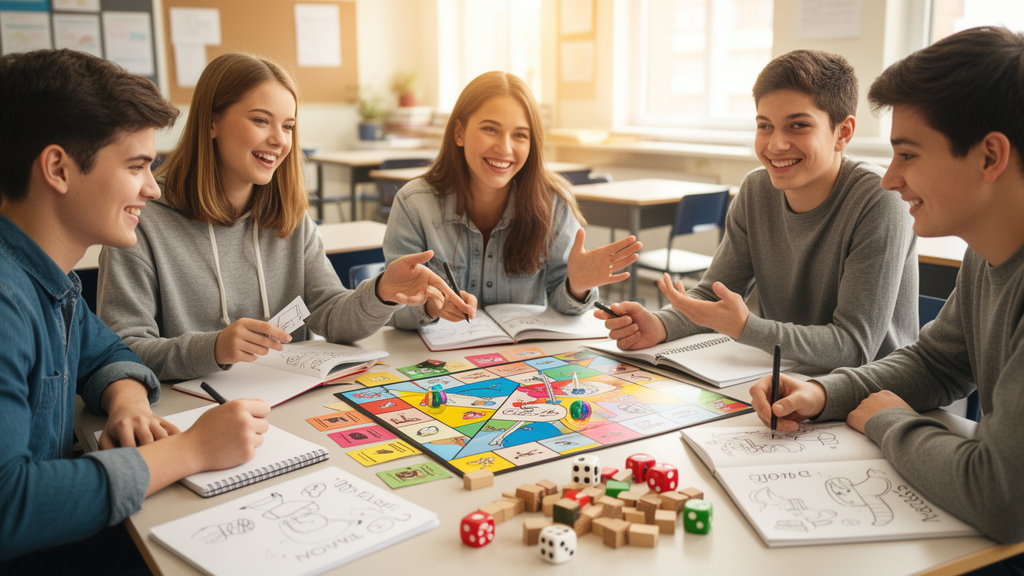
A 12-week game-based instructional module embedded in a standard pedagogy course improved several measures of creative competence among undergraduate pre-service teachers, according to a brief research report published in Frontiers in Education. The study, conducted with two intact cohorts totaling 118 students, compared a game-based condition called the “Creative Pedagogy Lab” with a conventional seminar covering the same syllabus, and found significant advantages for the game-based group across multiple outcomes.
The researchers used a quasi-experimental, nonequivalent-groups pre-test/post-test design. One cohort of 61 pre-service teachers completed the game-based module, while a second cohort of 57 completed the conventional seminar. Outcomes included creative self-efficacy and creative personal identity, measured with the Short Scale of Creative Self; teaching-for-creativity competence; divergent thinking assessed through the Alternative Uses Task; and blind consensual ratings of an authentic lesson-design product. Reflective journals and focus groups captured participants’ experiences throughout the module.
After adjusting for covariates, the game-based condition showed significant advantages in creative self-efficacy, with an effect size of ηp² = .10, and in teaching-for-creativity competence, with ηp² = .12. Blind raters judged the lesson designs produced by the game-based group as more creative, with a Cohen’s d of 0.82, and the module also improved the originality of ideas generated on the divergent thinking task, with ηp² = .06. Not every measure favored the game-based approach: no significant effect emerged for ideational fluency, and the effect on creative personal identity was small and did not survive correction for multiple comparisons.
Qualitative data from reflective journals and focus groups offered contextual insight into these patterns, though the authors note that such findings do not constitute independent evidence of a causal mechanism. Participants described the games as low-stakes “safe-fail” spaces that granted permission to experiment, an experience that may help explain the gains in creative self-efficacy and the creativity of lesson designs. At the same time, participants reported that time pressure and anxiety about covering required content constrained their engagement with the playful activities.
The report frames creative competence as the knowledge, skills, and dispositions required both to act creatively and to cultivate creativity in learners, a capability increasingly positioned as core to teachers’ professional work. Yet the authors observe that initial teacher education rarely addresses this competence systematically, which motivated the test of whether a game-based module could strengthen it within an existing course rather than as a separate offering.
The findings suggest that game-based approaches can be integrated into professional preparation without displacing core content, since the experimental and comparison groups covered the same syllabus. The authors also point to organizational conditions needed to sustain such approaches in teacher-education settings, including curricular space, facilitator development, and assessment alignment.
The study’s authors caution that the results are preliminary. As a single-institution study with a predominantly female, elementary-track sample, the findings may not generalize to other subject areas, other institutions, or more gender-balanced cohorts. The quasi-experimental design, which used intact cohorts rather than random assignment, further limits the strength of causal conclusions.
The article was received on 22 July 2026 and accepted on 29 September 2026, and is classified as a brief research report in the journal’s Teacher Education section. The work was authored by researchers affiliated with Bukhara State Pedagogical Institute, Bukhara State University, and Asia International University in Bukhara, Uzbekistan, with correspondence to Nafisa Musayeva.
Subject of Research: Effects of a game-based instructional module on creative competence in pre-service teacher education
Article Title: Unlocking teacher creativity: how organizational support sparks innovative work behavior
Article References: Musayeva, N., Musaeva, N., Olimov, T., Elibaeva, L., Khodjieva, D., Roziqova, R., & Boltayeva, S. (2026). Unlocking teacher creativity: how organizational support sparks innovative work behavior. Frontiers in Education, 11, 1945784. https://doi.org/10.3389/feduc.2026.1945784
Image Credits: AI Generated
DOI: 10.3389/feduc.2026.1945784
Keywords: creative competence, creative self-efficacy, game-based learning, pre-service teachers, teacher education, divergent thinking, quasi-experimental study, pedagogy, professional preparation, playful learning, Unlocking, teacher
Cite Scienmag News
Courtney Benton. (October 28, 2026). Game-Based Module Boosts Pre-Service Teachers’ Creative Competence, Study Finds. Scienmag. https://scienmag.com/game-based-module-boosts-pre-service-teachers-creative-competence-study-finds/
Courtney Benton. "Game-Based Module Boosts Pre-Service Teachers’ Creative Competence, Study Finds." Scienmag, 28 October 2026, https://scienmag.com/game-based-module-boosts-pre-service-teachers-creative-competence-study-finds/. Accessed 2 November 2026.
Courtney Benton. "Game-Based Module Boosts Pre-Service Teachers’ Creative Competence, Study Finds." Scienmag. October 28, 2026. https://scienmag.com/game-based-module-boosts-pre-service-teachers-creative-competence-study-finds/