


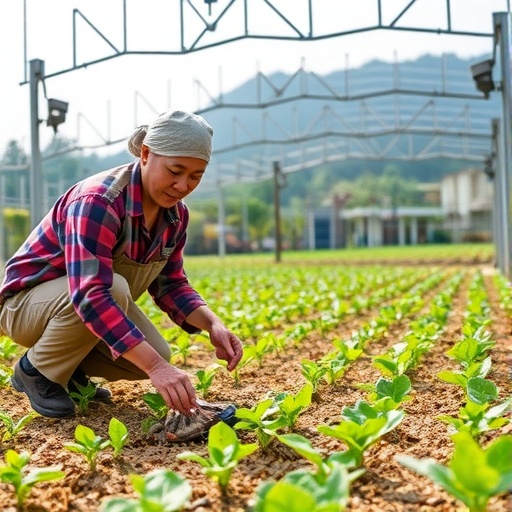
As societies worldwide grapple with the challenges of feeding a growing population, conventional wisdom has long focused on the availability of farmland and the impacts of climate change on food production. Yet, groundbreaking research from the Korea Advanced Institute of Science and Technology (KAIST) reveals a pressing, often overlooked factor threatening global food security: the dwindling agricultural workforce. This pioneering study shifts the paradigm from merely questioning the quantity of cultivable land to critically examining the sufficiency of human labor necessary to harness it effectively.
In recent decades, a marked demographic transformation characterized by low birth rates and the migration of rural populations to urban areas has reshaped the agricultural landscape. The decline in agricultural labor force is not just a phenomenon confined to a few regions but is becoming a global challenge. KAIST’s interdisciplinary research team, headed by Professor Hyungjun Kim with collaborations including experts from the University of Tokyo, integrated these socio-economic shifts into advanced predictive models. Their analysis utilizes combined frameworks of Shared Socioeconomic Pathways (SSPs) and Representative Concentration Pathways (RCPs), tools that are central to climate and socio-economic future forecasting.
The crux of their approach diverges from traditional models that primarily consider land availability, soil quality, and climate change projections. Instead, they incorporated the variable of agricultural labor availability into food production forecasting, a novel angle revealing that even with ample suitable farmland, food production capabilities could be severely constrained if the human workforce is insufficient. The results are striking, exposing potential ‘labor bottlenecks’ where limited person-power, rather than land or climate limitations, would serve as the primary impediment to agricultural expansion.
Their research anticipates that by the mid-21st century and beyond, many regions will confront significant mismatches between the potential cropland supply and the actual labor available to farm it. Notably, projections indicate that large parts of Northern Africa, Southern Europe, and Eastern Europe will suffer persistent cropland supply deficits not attributable to environmental constraints but directly linked to labor shortages. These findings challenge long-held assumptions, foregrounding demographic trends as a crucial factor in the future food security equation.
Furthermore, while some regions like Western Europe and Russia may experience temporary deficits in agricultural labor, these areas possess strong adaptive capacities. Technological advances, mechanization, and improved agricultural efficiency are expected to partially offset human resource shortfalls. However, the research team cautions that technological progress alone cannot fully compensate for declining agricultural workforce numbers because socioeconomic changes increasingly draw populations away from farming.
One particularly insightful aspect of the analysis highlights the role of migration policies on global food systems. The study finds that restricting international migration exacerbates labor shortages in developed countries, where aging populations and rural depopulation reduce agricultural labor pools. Conversely, in certain low-income countries, the agricultural workforce might expand excessively due to internal demographic trends, potentially leading to inefficiencies and underemployment. This dynamic underscores the critical link between labor mobility and food security resilience.
The implications of this study resonate profoundly for policymakers and stakeholders engaged in sustainable development and climate adaptation strategies. By integrating labor availability into agricultural planning, decision-makers can better forecast vulnerabilities and enact policies promoting rural revitalization, technological integration that truly augments human capacities, and adaptive migration frameworks. The findings underscore a pressing need for holistic approaches that marry demographic, social, and environmental perspectives to safeguard future food supplies.
Despite the stark challenges, the researchers emphasize the potential pathways to mitigate labor shortages. Innovation in agricultural robotics, precision farming, and artificial intelligence can increase productivity per worker, yet the social dynamics shaping labor distribution and economic sectors must be addressed in tandem. Economic incentives, education, and community development may help stabilize rural populations, ensuring enough hands remain on the land.
Published in Nature Sustainability, this study stands out by moving beyond the traditional narrative of climate limits and farmland availability. Instead, it confronts the critical human dimension, asking a fundamental yet often ignored question: “What if there is farmland, but no one to farm it?” Their model reveals that food production is a socio-technical system where humans play a fundamental and irreplaceable role, especially in face of accelerating climate change and demographic shifts.
The research project demonstrates the power of interdisciplinary cooperation, drawing from artificial intelligence, environmental science, socioeconomics, and policy analysis. Lead authorship by Ph.D. student Hongtak Lee, in conjunction with Professors Kim, Chon, Forsell, and Oki, exemplifies the cross-border academic commitment to addressing global challenges. The research received support from Korea’s National Research Foundation under programs focusing on AI-driven climate technologies and sustainable futures.
In the broader scientific discourse, this study has sparked significant commentary and attention, evidenced by a dedicated “News & Views” editorial in Nature Sustainability. The commentary hails the work as a critical step that shifts the focus from mere land availability to interrogate whether there will be enough people—and productivity per worker—to cultivate that land effectively. This fresh perspective has the potential to recalibrate research agendas and inform future global agricultural policies profoundly.
As we advance further into the 21st century, this research invites us to rethink the assumptions underpinning food security. The emerging narrative cautions that no matter how much potential land exists or how favorable future climate conditions might be, human capital remains the ultimate binding constraint. In this light, securing sufficient agricultural labor availability becomes not only a matter of economic planning but also a critical component of global resilience against hunger and environmental degradation.
This groundbreaking insight amplifies the call for sustainable development models that reconcile technological innovation with social realities. Addressing declining agricultural labor forces involves multifaceted solutions—from incentivizing rural livelihoods, enhancing labor productivity, to formulating inclusive migration policies. The future of global food security, it appears, hinges as much on human workforce trajectories as on environmental and technological factors alone.
News Publication Date: June 12, 2026
Web References:
https://doi.org/10.1038/s41893-026-01824-9
https://doi.org/10.1038/s41893-026-01841-8 (Commentary “Farming needs more hands”)
References:
Lee, H., Forsell, N., Oki, T., Chon, H., & Kim, H. (2026). Agricultural Workforce as a Potential Bottleneck of Future Cropland Availability. Nature Sustainability. DOI: 10.1038/s41893-026-01824-9
Cite Scienmag News
Courtney Benton. (June 12, 2026). Future Food Security Threatened: KAIST Uncovers a Critical Risk of Farming Labor Shortages. Scienmag. https://scienmag.com/future-food-security-threatened-kaist-uncovers-a-critical-risk-of-farming-labor-shortages/
Courtney Benton. "Future Food Security Threatened: KAIST Uncovers a Critical Risk of Farming Labor Shortages." Scienmag, 12 June 2026, https://scienmag.com/future-food-security-threatened-kaist-uncovers-a-critical-risk-of-farming-labor-shortages/. Accessed 4 September 2026.
Courtney Benton. "Future Food Security Threatened: KAIST Uncovers a Critical Risk of Farming Labor Shortages." Scienmag. June 12, 2026. https://scienmag.com/future-food-security-threatened-kaist-uncovers-a-critical-risk-of-farming-labor-shortages/


