


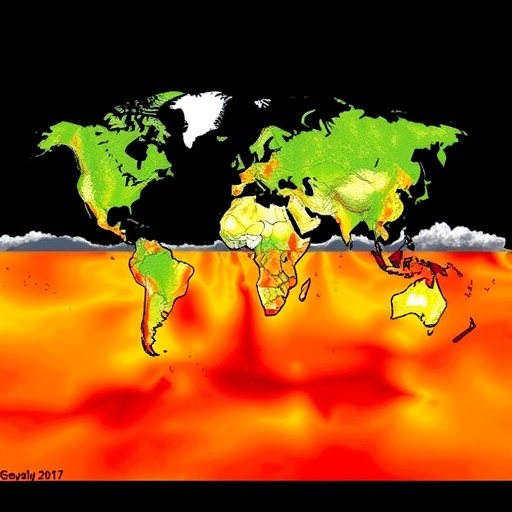
As the planet grapples with the mounting consequences of climate change, one of the most pressing concerns lies in the future trajectory of sea-level rise and the factors dictating its variability. New research has shed light on the intricate interplay between anthropogenic carbon dioxide emissions and the Earth’s geophysical responses, offering unprecedented clarity into how these elements jointly influence projections of rising seas. The findings not only deepen our understanding of how future emissions pathways dominate near-term sea-level scenarios but also highlight critical tipping points within polar ice dynamics that could amplify risks over longer timescales.
At the heart of this investigation is the complex relationship between carbon emissions and the climate system’s resulting temperature changes that ultimately drive sea-level fluctuations. By leveraging an ensemble of meticulously calibrated carbon cycle–climate–sea-level models, researchers have dissected how different emission scenarios propagate through the Earth system to shape sea-level rise trajectories. This modeling approach integrates both human-induced factors — mainly the timing and magnitude of CO2 emissions — and intrinsic Earth system uncertainties, such as the potential thresholds in the Antarctic Ice Sheet’s response to warming temperatures.
One of the most compelling revelations from this work is the primacy of emissions scenarios in dictating sea-level variability in the near future, specifically the mid-21st century window between 2065 and 2075. During this period, the pathway of CO2 emissions — and critically, when society manages to clamp down on these emissions — emerges as the dominant factor driving differences in predicted sea-level rise. This finding underscores the power and immediacy of human agency, where decisions made today about decarbonization timelines will profoundly shape coastal futures.
The study also elevates the role of the Antarctic Ice Sheet (AIS), a colossal reservoir of ice whose stability remains a subject of intense scientific scrutiny and uncertainty. Particularly, the researchers highlight that accelerated melting of the AIS could significantly amplify global sea-level sensitivity to both the average temperature over time and the total cumulative warming experienced by the planet. What this means in practice is that if certain critical thresholds within the AIS are surpassed, the rate and magnitude of sea-level rise could escalate beyond what would be expected solely from thermal expansion and melt from other ice masses.
Central to the nuances of this research is the concept of geophysical tipping points—nonlinear thresholds beyond which the ice sheet’s response to warming accelerates irreversibly. Identifying these tipping points and understanding their probabilities is pivotal for accurately assessing the risk that sea levels will surpass certain critical benchmarks, threatening millions of coastal inhabitants and ecosystems. The study emphasizes that among these uncertainties, pinpointing the AIS tipping threshold and refining estimates of equilibrium climate sensitivity remain paramount.
Equilibrium climate sensitivity, a measure of how much the Earth’s temperature will ultimately rise in response to a doubling of atmospheric CO2, remains one of the most debated parameters in climate science. Its value heavily influences the projected temperature scenarios fed into sea-level rise projections. The range of uncertainty around this sensitivity directly translates to variability in how researchers estimate future sea-level change, reinforcing that a better grasp of climate sensitivity is crucial to reducing predictive ambiguities.
This research conveys a sobering reality: the future trajectory of sea-level rise is not solely a function of emissions quantity but is deeply intertwined with the timing of emission reductions. Delaying significant emission cuts even by a decade or two could lock in a higher range of sea-level rise scenarios by mid-century. This temporal sensitivity elevates the urgency for near-term policy decisions focused on rapid decarbonization efforts.
At the same time, the study cautions against complacency in adaptation strategies. Given the geophysical uncertainties, especially concerning accelerated AIS melting and its nonlinear impact, coastal communities must brace for a wide range of possible futures. Preparing for higher-end sea-level scenarios without certainty about tipping points requires flexible and robust planning that can incorporate new scientific knowledge as it emerges.
Tools that propagate emissions uncertainties through the entire carbon cycle, climate response, and sea-level rise continuum represent a significant advance in climate risk assessment. By constructing an integrated ensemble that encompasses multiple interacting processes, the researchers provide risk managers and policymakers with more holistic and probabilistic projections rather than deterministic predictions. This approach fosters a richer dialogue about managing risk under deep uncertainties.
Negative emissions technologies, which aim to remove CO2 from the atmosphere, were notably excluded from this modeling framework. This decision was intentional, as the absence of negative emissions illustrates the full impact of the emission trajectory itself without technological offsets. While such innovations hold promise, their real-world scalability and effectiveness remain contested, reinforcing that immediate emission reductions remain the surest lever.
In dissecting the relative roles of human and geophysical drivers, the research effectively disentangles a longstanding knot in climate projection science. Variability in emissions dominates near-term uncertainty, but as the century unfolds, Earth system dynamics, particularly ice sheet instability, can take over as the principal determinants of sea-level rise magnitude. This temporal shift in the hierarchy of influences refines how scientists and decision-makers should prioritize actions and research.
Employing advanced carbon-climate-sea-level model chains also permits a clearer identification of key knowledge gaps. For example, the precise mechanisms and temperatures at which AIS melting accelerates are still poorly constrained, highlighting an area where observational and theoretical work is critically needed. Similarly, efforts to hone in on equilibrium climate sensitivity through paleoclimate reconstructions and emerging climate models remain essential to narrowing predictive spreads.
The study’s insights bear significant implications beyond academia. Coastal cities around the world—from megacities to small island nations—stand on the frontline of sea-level rise impact. Understanding when and how much the seas might rise informs not only infrastructure investments and disaster preparedness but also economic policies, insurance schemes, and migration planning. The intertwined uncertainties of emissions and geophysical processes translate directly into real-world stakes for billions of lives.
Ultimately, this new research encapsulates a clarion call for dual-track climate action: accelerating decarbonization at unprecedented speed to minimize near-term uncertainties, while simultaneously advancing geophysical science to anticipate and mitigate longer-term risks. In this dual approach lies the best hope for managing the existential challenges posed by rising seas.
The synthesis of emission pathways and ice dynamics highlights the necessity for international cooperation. Global emissions trajectories hinge on collective political will, while understanding ice sheet behavior benefits from coordinated observational networks and open scientific collaboration. Facing sea-level rise requires an integrated response, weaving together scientific insight, policy action, and community resilience.
Emerging from this body of work is not only a better scientific understanding but a roadmap for balancing mitigation with adaptation. The coastal futures illuminated by these models are not predestined but contingent on humanity’s choices made today and over coming decades. This research thus provides both a warning and a guidepost, underscoring that managing sea-level rise risk demands swift emissions action coupled with vigilant attention to the Earth’s changing geophysical systems.
In conclusion, the interplay of future CO2 emissions pathways and Earth system uncertainties creates a complex but decipherable narrative of sea-level rise risk. The dominant hand of emissions in shaping near-term variability makes rapid decarbonization an imperative, while the lurking potential of Antarctic tipping points urges continued vigilance and enhanced scientific understanding. By navigating this nexus thoughtfully, society can better chart a resilient course amidst the rising tide.
Cite Scienmag News
Thomas Green. (October 10, 2025). Future Emissions and Uncertainty Shape Sea-Level Rise. Scienmag. https://scienmag.com/future-emissions-and-uncertainty-shape-sea-level-rise/
Thomas Green. "Future Emissions and Uncertainty Shape Sea-Level Rise." Scienmag, 10 October 2025, https://scienmag.com/future-emissions-and-uncertainty-shape-sea-level-rise/. Accessed 4 September 2026.
Thomas Green. "Future Emissions and Uncertainty Shape Sea-Level Rise." Scienmag. October 10, 2025. https://scienmag.com/future-emissions-and-uncertainty-shape-sea-level-rise/


