


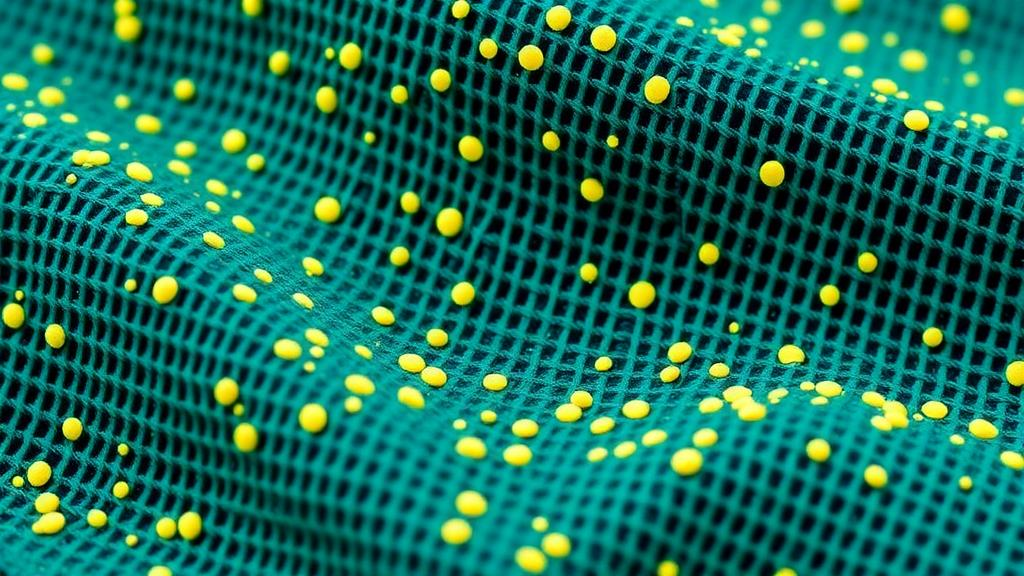
In a development that reads like science fiction but is grounded firmly in polymer chemistry and biomimetics, researchers at Northwestern University have created a nanoparticle-based compound that can be mixed into clothing dyes to neutralize some of the most dangerous chemicals humans encounter: organophosphorus compounds, the family of toxins that includes pesticides, insecticides, and lethal nerve agents. The material, described in a study published on August 25 in the journal ACS Nano, draws its inspiration from melanin, the same class of pigments that colors skin, hair, plants, and fungi. Within just ten minutes of activation, the researchers report, the amount of a toxic chemical byproduct is cut in half, and the detoxification continues with additional material and exposure to sunlight.
The team behind the work was led by two corresponding authors from Northwestern’s Weinberg College of Arts and Sciences and the McCormick School of Engineering: Nathan Gianneschi, the Jacob & Rosaline Cohn Professor of Chemistry and a professor of materials science and engineering and biomedical engineering, and Omar Farha, the Charles E. and Emma H. Morrison Professor of Chemistry and chair of the Department of Chemistry. Their collaboration unites two research traditions that rarely intersect so directly: Gianneschi’s long-running work on synthetic melanin-like polymers and Farha’s celebrated expertise in catalytic metal-organic frameworks, porous crystalline materials that have proven exceptionally effective at capturing and destroying chemical warfare agents. By fusing these approaches, the group produced something neither could achieve alone.
To understand why the new material matters, it helps to understand the threat. Organophosphorus compounds work by sabotaging the nervous system. When one of these chemicals breaks down in the body, it releases two products. One, dimethyl phosphate, is essentially harmless. The other, a methyl nitrophenyl compound, is far more sinister: it inhibits the enzymes in blood responsible for breaking down acetylcholine, a critical neurotransmitter. When those enzymes are blocked, acetylcholine accumulates in the nervous system, overstimulating it and preventing the brain from communicating with the rest of the body. The consequences can be paralysis and death, which is precisely why nerve agents have been weaponized and why pesticide exposure remains a serious occupational hazard for agricultural workers worldwide.
Nature, it turns out, has its own strategies for coping with such substances, and the Northwestern team looked to one of the most versatile biological materials for a template. They focused on allomelanin, a renewable and biodegradable pigment that deepens the color of plants and fungi. Unlike the melanin in human skin, allomelanin is naturally porous, riddled with a network of tiny micropores that can grab and capture small harmful molecules. That intrinsic microporosity, the researchers emphasize, is not a luxury but a requirement. Sofia Aman, a graduate student in Gianneschi’s laboratory and the study’s co-first author, noted that when the team tested other melanin-like materials lacking this porosity, they did not perform as well, making allomelanin a uniquely effective substrate for the task.
Porous absorption alone, however, only traps a toxin; it does not destroy it. The second act of the design comes from chemistry. The researchers decorated their synthetic allomelanin nanoparticles with a zirconium cluster, a metal-based unit capable of catalyzing chemical reactions. Working in concert, the two components form a division of labor: the allomelanin sponge soaks up organophosphorus molecules from the surroundings, while the zirconium catalyst dismantles them. Crucially, the system shows selectivity. The allomelanin grabbed hold of the toxic chemical and broke it down while leaving the nontoxic dimethyl phosphate untouched, reducing both the quantity of the dangerous substance and its potency.
One of the most elegant engineering choices in the study addresses a practical constraint. For the catalytic reaction to proceed, the environment must be entirely basic, reaching a pH of 10 or higher. Rather than requiring users to apply an external basic compound, an impractical step in a field setting, the researchers built basic chemical groups directly onto the surface of the nanoparticles. Water then serves as the activation trigger: when the particles are wetted, the built-in basic groups create the conditions needed for the zirconium catalyst to break down the harmful chemicals. This means that in an emergency, a person exposed to a toxic organophosphorus compound could theoretically spray their clothing with water mixed with the compound, deactivating the chemical before its damaging effects take hold.
The applications extend well beyond emergency response. Because the team has previously demonstrated that their bioinspired melanins can be used to dye synthetic fabrics, the nanoparticles could be incorporated during the textile dying process itself. Gianneschi described the materials as non-toxic and suitable as an additive in clothing, facemasks, and beyond, envisioning protective clothing or breathing equipment for workers who manufacture or handle these hazardous chemicals. The populations who stand to benefit most are those with daily, unavoidable exposure: farmers who wear masks and gloves while applying pesticides, and soldiers whose uniforms and tactical gear could gain a passive layer of chemical defense woven directly into the fibers.
The material even harvests energy from its environment to work faster. Melanin reacts with sunlight and absorbs heat, and the researchers found that exposing the allomelanin to sunlight accelerates the detoxification process. In practical terms, a treated garment worn outdoors would not merely sit idle after absorbing a toxin; it would actively speed up its own decontamination under ordinary daylight. Within ten minutes, the toxic byproduct in the study decreased by fifty percent, and the reduction continued to deepen with more melanin and with sun exposure, a self-reinforcing performance profile that few synthetic protective materials can match.
Farha framed the advance as a transfer of hard-won knowledge from one class of materials to another. His group previously developed catalytic metal-organic frameworks, which he described as exceptionally powerful in the absorption and processing of chemical warfare agents. The new work takes those learnings and advances them toward melanin-inspired materials that are inherently adhesive and act as dyes for various fibers and fabrics. Melanin, he noted, is nature’s pigment as well as an efficient absorbent of small molecules and heavy metal ions in biological organisms, and the study couples those natural functions with catalysis through a combination of synthetic inorganic chemistry and biomimetic polymer science.
For Gianneschi, who has studied melanin for more than twelve years in an effort to understand its myriad functions in nature and to engineer mimetic materials for scalable, translational applications, the study represents a proof of concept for a new direction in how scientists think about protective materials and coatings design. He characterized the accumulated knowledge as a treasure trove of approaches and materials to optimize for applications like this one. The research, titled Catalytic Porous Metallized Melanin for the Remediation of Organophosphorus Agents, was supported by the Air Force Office of Scientific Research, the Army Synthetic Biology Centre for Predictive Materials Design, and the Catalyst Design for Decarbonization Center. If the concept matures from laboratory demonstration to manufactured product, the humble pigment that darkens fungi could become an invisible guardian stitched into the clothing of the people who face these poisons every day.
Subject of Research: Catalytic porous metallized melanin nanoparticles for detoxifying organophosphorus nerve agents and pesticides in protective fabrics
Article Title: Wearable nanotech could combat nerve agents
Article References: Wearable nanotech could combat nerve agents. (n.d.). Original publication
Image Credits: AI Generated
DOI: Not provided
Keywords: nanoparticles, melanin, allomelanin, nerve agents, organophosphorus, pesticides, protective clothing, zirconium catalyst, Northwestern University, ACS Nano, biomimetic materials, detoxification
Cite Scienmag News
Bethany Barker. (October 11, 2026). Fungal-inspired nanoparticles woven into fabric could neutralize deadly nerve agents. Scienmag. https://scienmag.com/fungal-inspired-nanoparticles-woven-into-fabric-could-neutralize-deadly-nerve-agents/
Bethany Barker. "Fungal-inspired nanoparticles woven into fabric could neutralize deadly nerve agents." Scienmag, 11 October 2026, https://scienmag.com/fungal-inspired-nanoparticles-woven-into-fabric-could-neutralize-deadly-nerve-agents/. Accessed 11 October 2026.
Bethany Barker. "Fungal-inspired nanoparticles woven into fabric could neutralize deadly nerve agents." Scienmag. October 11, 2026. https://scienmag.com/fungal-inspired-nanoparticles-woven-into-fabric-could-neutralize-deadly-nerve-agents/


