


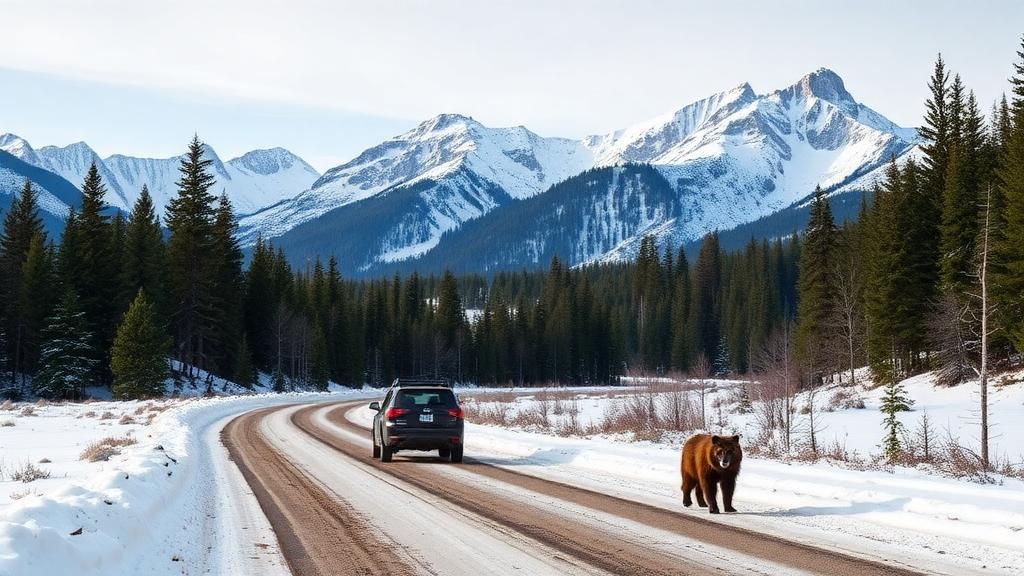
One of the rarest and most elusive carnivores in North America is quietly losing ground to a threat that most people would never suspect: the simple act of going outside to play. A new study led by researchers at the University of Calgary has found that both outdoor recreation and road density are strongly linked to lower wolverine population densities across a vast sweep of the Canadian Rockies, a finding that researchers believe is the first landscape-scale evidence that recreation alone can depress the density of a large carnivore. The research, published on September 29 in the peer-reviewed journal Biological Conservation, covers one of the largest areas ever examined for wolverines and offers a sobering numerical portrait of a species that most backcountry users will never see, even as their skis and boots crisscross its snowy habitat.
The study, led by Dr. Mirjam Barrueto as part of her doctoral research at the University of Calgary, spanned western Alberta and eastern British Columbia, encompassing the Rocky Mountains and the Columbia Mountains. Co-authors include her supervisor, Dr. Marco Musiani, an adjunct professor in the Faculty of Science, along with scientists from Parks Canada, the Nature Conservancy of Canada and Montana State University. Together, the team set out to answer a deceptively simple question: how is the wolverine population actually doing, and what kinds of human pressures are shaping its numbers? The answer, drawn from one of the most extensive wolverine surveys ever conducted, is that the animals are far scarcer than the seemingly wild landscape would suggest, and that two distinct forms of human disturbance are leaving measurable fingerprints on the population.
The headline numbers are stark. Across 81,800 square kilometres of mountain terrain, the researchers estimate that fewer than 300 wolverines currently make their home. That figure, low as it is, may actually understate the loss: according to Barrueto, the population could be roughly 30 per cent higher if current levels of recreation and road development were absent. In other words, in the absence of the trails, ski operations, highways and resource roads that now thread through these mountains, the region could plausibly support dozens more of these solitary predators. The finding is particularly striking because it emerges at the scale of entire landscapes rather than individual sites, meaning the effect is not simply that wolverines shift their movements to avoid a busy trailhead or a noisy road corridor on a given day.
That distinction matters enormously for how the results should be interpreted. As Barrueto explains, the analysis shows that in areas with more disturbance, whether from road density or recreation, there were simply fewer individual wolverines living there than in areas with less disturbance. The animals are not merely redistributing themselves within the landscape, crowding into quiet corners while the overall total stays the same. Instead, disturbed areas support genuinely smaller populations, a pattern that suggests the disturbance is functionally removing habitat or imposing costs, such as stress, energetic expense or reduced reproductive success, that translate into fewer animals able to persist. On a population scale, that is a fundamentally different and more consequential outcome than localized avoidance behavior.
Measuring recreation across such an enormous and remote area presented a methodological challenge, and the research team turned to an increasingly common tool in wildlife science: publicly available heat maps generated by recreational apps. These digital traces capture the intensity of human activity in the backcountry, including backcountry skiing, heliskiing and cat skiing, cross-country skiing and hiking in both winter and summer. Notably, the recreation data does not include snowmobiling, but Barrueto points out that snowmobile activity is likely captured indirectly in the road density variable, since snowmobiles depend on roads and trails for access. The approach demonstrates how crowdsourced recreational data, originally designed to help people navigate and share their outings, can be repurposed to quantify one of the most diffuse and hard-to-measure pressures on wildlife across entire mountain ranges.
While the recreation finding came as a surprise even to the researchers, the role of roads was more expected. Barrueto notes that road density emerged as the other main predictor of wolverine population density, and that it was also a key predictor for females specifically, a result consistent with previous studies. Roads have long been recognized as a powerful driver of ecological change, fragmenting habitat, facilitating human access into remote areas, and increasing mortality risk. What the new study adds is a clearer picture of how these two disturbance types, one ancient in origin and one distinctly modern, combine to shape the distribution and abundance of a carnivore that evolved in landscapes without either.
One of the most important new insights from the research is that the impacts of disturbance are sex specific. Road density, in particular, affects female wolverines the most, and that matters far beyond simple demographics. Females are the engine of population recovery, and wolverines are among the slowest-reproducing carnivores in North America: females give birth to only one to three kits every few years, meaning that any reduction in female survival or occupancy ripples through the population over long time horizons. A landscape that loses its females is a landscape that loses its capacity to rebound, even if males continue to move through the area. For wildlife managers, this makes the protection of low-disturbance habitat for females a particularly high-leverage conservation strategy.
The biological realities of the species compound the concern. Wolverines are, as Barrueto describes them, pretty small carnivores, and it generally seems stressful for most of these animals to interact with humans. They are built for remoteness: solitary, wide-ranging, dependent on deep snow and cold conditions, and naturally occurring at low densities even in pristine habitat. That combination makes them inherently vulnerable to cumulative human pressure. An animal that reproduces slowly, occupies enormous home ranges and avoids areas of human activity has little capacity to absorb additional disturbance without its population density declining. The study’s findings suggest that the wolverines of the Canadian Rockies are already living close to that edge, with the Upper Columbia region of southeastern British Columbia standing out as an area with very few animals.
The research does not stop at diagnosis. It makes five recommendations aimed at giving managers and planners concrete tools, including maintaining roadless areas and areas of low road density, protecting low-disturbance, high-quality wolverine habitat, and limiting recreation in reproductive areas. Barrueto frames the work as a call to awareness for anyone who works or plays in wolverine habitat, herself included, and poses the question at the heart of the matter: do we want a landscape with just deer and coyotes, or do we want a landscape that has space for wild things? Now that the impacts are understood, she argues, management and planning decisions can be made deliberately so that wolverines can thrive in the places people love.
That actionable quality is what resonates most with co-author Dr. Aerin Jacob, director of science and research and Weston Family senior scientist at the Nature Conservancy of Canada. Describing the findings as stark, Jacob emphasizes that the study provides something concrete to act on at every level, whether that means decisions about building trails, protecting and restoring habitat, or working to prevent and reduce impacts. In her view, that kind of collaboration among scientists, land managers and conservation organizations is what effective conservation actually looks like. For a species that most visitors to the Rockies will never glimpse, the study offers both a warning and a roadmap: the quiet presence of wolverines in these mountains is not guaranteed, but with deliberate choices about roads, recreation and habitat protection, it can endure.
Subject of Research: Effects of outdoor recreation and road density on wolverine population density in the Canadian Rocky and Columbia Mountains
Article Title: Study shows wolverine populations affected by recreation, roads
Article References: Study shows wolverine populations affected by recreation, roads. (n.d.). Original publication
Image Credits: AI Generated
DOI: Not provided
Keywords: wolverine, outdoor recreation, road density, carnivore conservation, Rocky Mountains, Columbia Mountains, population density, Biological Conservation, University of Calgary, habitat disturbance, wildlife management, backcountry skiing
Cite Scienmag News
Margaret Porter. (October 11, 2026). Backcountry recreation and roads push wolverine numbers down in Canadian Rockies, study finds. Scienmag. https://scienmag.com/backcountry-recreation-and-roads-push-wolverine-numbers-down-in-canadian-rockies-study-finds/
Margaret Porter. "Backcountry recreation and roads push wolverine numbers down in Canadian Rockies, study finds." Scienmag, 11 October 2026, https://scienmag.com/backcountry-recreation-and-roads-push-wolverine-numbers-down-in-canadian-rockies-study-finds/. Accessed 11 October 2026.
Margaret Porter. "Backcountry recreation and roads push wolverine numbers down in Canadian Rockies, study finds." Scienmag. October 11, 2026. https://scienmag.com/backcountry-recreation-and-roads-push-wolverine-numbers-down-in-canadian-rockies-study-finds/


