


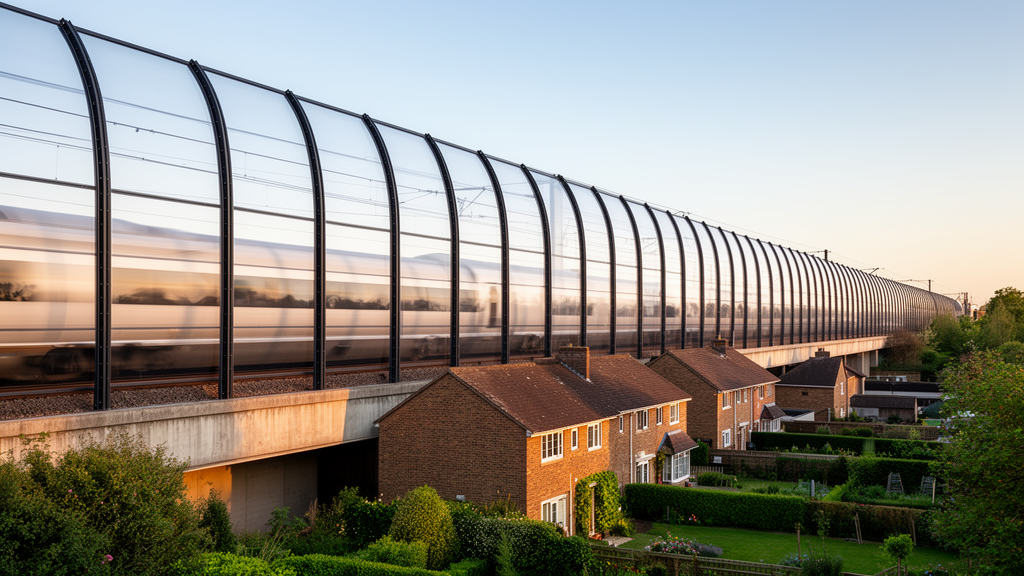
At 350 kilometers per hour, a high-speed train does not merely travel through the air—it attacks it. The blunt nose slams into oncoming airflow, the undercarriage churns it into turbulence, and the wake behind the last car sheds vortices like a storm tearing itself apart. All of that violence makes sound, and at these speeds, aerodynamic noise has overtaken the classic clatter of wheels on rails as the dominant nuisance radiating from the world’s fastest railways. Now, a team of Chinese researchers has run one of the most detailed numerical investigations to date into how the three main types of trackside sound barriers—vertical, semi-enclosed, and fully enclosed—actually perform against this broadband aerodynamic roar, and their verdict is unambiguous: seal the top, and the noise falls.
The study, published in Frontiers in Acoustics by Rui Zhang of the Jinan-Qingdao High-speed Railway, Hui Li of Shandong University’s School of Qilu Transportation, and colleagues including corresponding author Shengyou Yang of Shandong University’s School of Civil Engineering, tackles a problem that has grown acute as rail networks accelerate. Research cited in the paper indicates that once a train’s operating speed exceeds the critical threshold of 300 km/h, aerodynamic noise accounts for more than 50 percent of the total sound pressure level, surpassing wheel-rail noise as the leading source. At 350 km/h, the sound pressure level measured 12 meters from the track can reach 82 dB(A) or more—loud enough to create resonance inside passenger carriages and to sustain sound pollution within 200 meters of the railway, with prolonged exposure posing documented risks to human health.
To capture the physics at this speed, the team built a full-scale three-dimensional computational model in ANSYS Fluent that simulates a wind tunnel test of a train traveling at 350 km/h. The train geometry was based on the surface parameters of the CRH380A, measuring 3.38 meters wide, 3.70 meters high, and 74.28 meters long. The researchers deliberately simplified the model—treating the train surface as completely smooth and omitting structural details such as windows, doors, and bogies—while preserving the representative aerodynamic shapes that generate the noise. The computational domain exceeded the requirements of the CEN European Standard for railway aerodynamics, and the mesh was refined on the vehicle surface to a maximum size of 0.1 meters and a minimum of 0.05 meters to resolve the critical aerodynamic regions.
The turbulence modeling choice matters here. Because the curved wall surfaces of a train introduce distortion when calculated with the standard k-ε model, the team employed the Realizable k-ε turbulence model, which introduces constraint terms that prevent non-physical negative pressures caused by excessive time-averaged strain rates and incorporates quantities related to rotation and curvature—making it better suited to the rotational and mixed flows swirling around a speeding train. Because the train speed exceeds 0.3 Mach, compressibility was included in the analysis, with the SIMPLE algorithm handling pressure-velocity coupling and second-order upwind discretization applied to convection and dissipation terms.
On top of the flow solver, the researchers layered the Broadband Noise Source Model, an approach founded on Lighthill’s acoustic analogy theory from aeroacoustics. This model uses the statistical attributes of turbulence to characterize the vortex motion and acoustic radiation traits of noise sources, correlating the turbulent flow field with the acoustic field. It is valid under conditions of uniform isotropic turbulence, high Reynolds number, and low Mach number—precisely the regime of a high-speed train in open air. The model’s efficiency makes it a staple for preliminary noise prediction, and it allowed the team to compute the surface acoustic power distribution of the entire train, which peaked at the front of the vehicle where wind turbulence is most intense.
That peak at the train’s nose enabled a crucial computational shortcut. The integrated sound power level derived from the Fluent results came to 0.53295 watts, and because the sound power is concentrated at the front of the train, the problem could be simplified into a two-dimensional line sound source in COMSOL Multiphysics, with a line source intensity of 0.0071 watts per meter. The COMSOL model placed point A as the noise source and point B as the monitoring point, corresponding to the front of the vehicle, with perfectly matched boundaries simulating an infinite field. The accuracy of this hybrid approach was verified against real wind tunnel tests conducted in the 5.5 m × 4.0 m acoustic wind tunnel at the China Aerodynamics Research and Development Center in Mianyang, Sichuan, where a 1:8 scaled three-car train model was tested at 83.33 m/s in a fully anechoic chamber. The simulated sound pressure level at the monitoring point was 91.27 dB against 89.83 dB from the test data—a 1.4 dB error, comfortably within the acceptable range of 2 dB.
With the model validated, the team examined six scenarios: no barrier at all, a low-height vertical barrier, a high-height vertical barrier, a semi-enclosed barrier with a two-thirds opening, a semi-enclosed barrier with a one-third opening, and a fully enclosed barrier. The barrier material was modeled as built-in aluminum, with the barrier surface assumed flat and the track section near the barrier treated as straight. The results showed that the fully enclosed sound barrier delivered the lowest sound pressure levels at all testing points, achieving noise reductions of 4.5 to 6 dB, while the vertical barrier followed with reductions of about 4 dB. The fully enclosed barrier maintained reductions exceeding 4.5 dB up to 20 meters away, making it the clear leader across all frequency ranges.
The frequency-domain analysis revealed subtler structure beneath that headline ranking. Once the frequency surpassed 31 Hz, the no-barrier condition remained the highest across all frequencies, while the fully enclosed barrier stayed lowest at every frequency. But the semi-enclosed barriers behaved differently depending on the band: in the high-frequency range, the two-thirds-opening barrier actually outperformed the vertical barrier, ranking just behind the fully enclosed design. In the low-frequency range, however, its performance collapsed—at 16 Hz it recorded 91 dB, producing an overall sound pressure level that exceeded the other conditions. As frequency increased, noise reduction effectiveness correlated positively with the degree of confinement, with the ranking at 1,000 Hz aligning exactly with the level of airtightness. For high-frequency noise, in short, a higher sealing degree yields improved reduction; for low-frequency noise, greater confinement does not enhance the effect.
The mechanism behind these differences lies in how sound waves interact with barrier geometry. As sound waves encounter a barrier, three physical phenomena take place: diffraction, transmission, and reflection. High-frequency waves, with their shorter wavelengths, tend to diffract around the barrier’s edge, their energy diminishing geometrically with propagation distance. The sound-insulating capabilities of the barrier material limit transmission, while a sound-absorbing surface layer converts incoming sound energy into thermal energy through a porous design, reducing secondary reflections. Behind the barrier, the sound field splits into a sound brightness area outside the geometric shielding range and a sound shadow area on the noise-back side—the region crucial for protecting noise-sensitive targets through combined diffraction attenuation and transmission suppression.
The cloud maps of total sound pressure level made the consequences of top openings vividly clear. Increasing the opening at the top of the barrier caused a significant rise in the sound pressure distribution behind it: as the degree of diffraction grew, the sound shadow area shrank and the noise intensity within it rose, reflected in the warming colors of the region to the right of the barrier. A fully enclosed barrier blocks both direct sound and top-diffracted sound, producing the largest shadow area and the lowest levels. In a semi-closed structure, the top opening allows noise to escape behind the barrier through diffraction paths, weakening the shielding effect—a leakage that becomes pronounced when the opening is large. Strikingly, at distances greater than 10 meters, the noise intensity at the monitoring point with a two-thirds opening actually surpassed the intensity recorded with no barrier at all, meaning a poorly sealed barrier can be worse than nothing in the far field.
The practical implications are direct. The researchers conclude that for trains traveling at 350 km/h, fully enclosed sound barriers—with their greater noise reduction efficiency—are the optimal choice in noise-sensitive areas, even though they carry the highest construction cost. In regions where noise is a relatively lesser concern, lower-cost vertical barriers are advisable. The study also notes that analyzing frequency distribution is crucial when deploying vertical or semi-enclosed barriers, since their effectiveness varies across the spectrum. The team’s hybrid simulation technique—fine aerodynamic meshing only around the train in Fluent, high-density acoustic meshing only near the barrier and observation zones in COMSOL—significantly enhanced computational efficiency while preserving fidelity, offering a template for future studies of noise control on the world’s accelerating railways.
Subject of Research: Researchers in China used coupled ANSYS Fluent and COMSOL simulations, validated against wind tunnel tests, to show that fully enclosed sound barriers provide the best noise reduction against high-speed train aerodynamic noise, followed by vertical barriers, with sealing degree critical for high-frequency noise control.
Article Title: Study on the noise reduction effect of sound barriers on the aerodynamic noise of high-speed trains
Article References: Zhang, R., Li, H., Yang, J., Chen, X., & Yang, S. (2025). Study on the noise reduction effect of sound barriers on the aerodynamic noise of high-speed trains. Frontiers in Acoustics, 3, Article 1616806. https://doi.org/10.3389/facou.2025.1616806
Image Credits: AI Generated
DOI: 10.3389/facou.2025.1616806
Keywords: high-speed rail, aerodynamic noise, sound barriers, computational fluid dynamics, acoustics, noise control, COMSOL, ANSYS Fluent, noise, reduction, effect, sound
Cite Scienmag News
Audrey Campbell. (October 17, 2026). Fully Enclosed Sound Barriers Emerge as Best Defense Against High-Speed Train Noise. Scienmag. https://scienmag.com/fully-enclosed-sound-barriers-emerge-as-best-defense-against-high-speed-train-noise/
Audrey Campbell. "Fully Enclosed Sound Barriers Emerge as Best Defense Against High-Speed Train Noise." Scienmag, 17 October 2026, https://scienmag.com/fully-enclosed-sound-barriers-emerge-as-best-defense-against-high-speed-train-noise/. Accessed 17 October 2026.
Audrey Campbell. "Fully Enclosed Sound Barriers Emerge as Best Defense Against High-Speed Train Noise." Scienmag. October 17, 2026. https://scienmag.com/fully-enclosed-sound-barriers-emerge-as-best-defense-against-high-speed-train-noise/


