


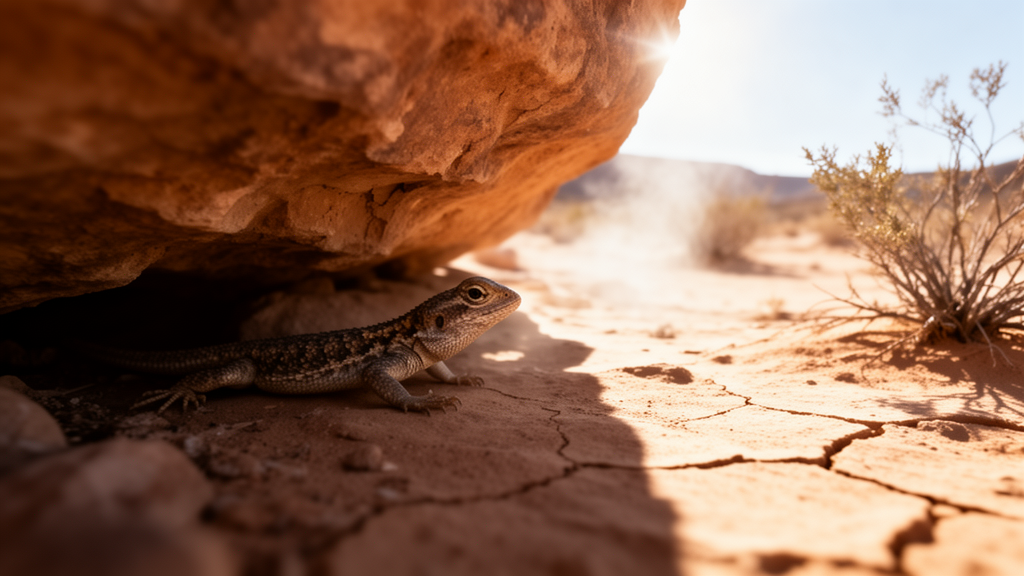
In the scorching dunes of Argentina’s Monte desert, two sister species of sand-dwelling lizards have pulled off a remarkable evolutionary trick: they survive midday heat that can exceed their lethal physiological limits. But according to a new four-year study published in Frontiers in Amphibian and Reptile Science, this survival strategy comes with a hidden price tag that could push the endangered of the two species toward an energetic tipping point as the climate continues to warm.
The research, led by Ana Gabriela Salva of the Universidad Nacional de Tucumán together with Cecilia Inés Robles and Félix Benjamín Cruz, focused on two closely related lizards, Liolaemus scapularis and Liolaemus riojanus, that live in geographically separated sandy habitats roughly 700 kilometers apart. Despite their shared ancestry and nearly identical body sizes, the species inhabit strikingly different social worlds. L. scapularis, found in the Calchaquí Valleys of Salta Province, lives alongside relatively few congeners and is listed as Endangered due to habitat loss from urbanization, agriculture, and mining. L. riojanus, found in Talampaya National Park in La Rioja Province, shares its dunes with two larger lizard species and is consistently subordinate in aggressive encounters with them.
Over four field seasons between 2018 and 2022, the team measured body temperatures of 376 active adult lizards, deployed copper models to record operative temperatures—the temperatures a non-thermoregulating animal would experience—in sun, filtered shade, and deep shade microhabitats, and brought individuals into the laboratory to determine preferred temperatures and critical thermal maxima, the point at which lizards lose the ability to right themselves. The result was one of the most integrative thermal datasets ever assembled for Neotropical sand lizards.
What the data revealed was a paradox. The desert environment offers astonishingly poor thermal quality: only 3 to 11 percent of available operative temperatures fell within the lizards’ preferred range. A lizard moving randomly through this landscape would almost never encounter its physiological optimum. Yet both species achieved remarkably high thermoregulatory effectiveness, exceeding 0.75 on a scale where 1.0 represents perfect precision. Active individuals kept their body temperatures within the preferred range 20 to 25 percent of the time—a 2.3- to 7.8-fold improvement over what the environment alone would allow.
This achievement, the authors argue, exemplifies what biologists call the Bogert effect: behavioral thermoregulation acts as a shield that buffers organisms from environmental selective pressures. Because the lizards are so effective at exploiting the thermal mosaic created by sparse desert shrubs—Larrea, Atriplex, Prosopis—their critical thermal limits are rarely tested by natural selection. The behavioral shield works so well that it may actually slow the evolution of heat tolerance, leaving the animals physiologically unprepared for the rapid warming now underway.
Even more striking was a counterintuitive seasonal pattern. Thermoregulatory effectiveness was significantly higher during the dry period (0.82) than during the humid period (0.75), even though the dry environment was objectively more thermally hostile. The explanation lies in cost-benefit models of thermoregulation: when environmental quality is extremely low, the cost of simply conforming to ambient temperatures becomes exponentially dangerous because it leads to temperatures near or exceeding lethal limits. The lizards are, in effect, forced into precision by the severity of their surroundings.
But this precision carries a severe opportunity cost. The team found that warming tolerance—defined as the difference between critical thermal maximum and maximum operative temperature—was consistently negative across all field trips, averaging -14.7°C and ranging from -6.7 to -22.9°C. These deeply negative values mean that maximum environmental temperatures routinely exceed the lizards’ physiological ceilings. Survival depends entirely on behavioral buffering: seeking shade, adjusting posture, or retreating below the sand surface. The consequence is that lizards must remain inactive for 18 to 50 percent of potential activity time, hours during which they cannot forage, defend territories, or seek mates.
The restriction was most acute for the endangered L. scapularis during the humid season, when it faced a full 50 percent loss of activity time. The mechanism behind this is not simply hotter sun but what the authors call thermal homogenization: during the humid period, shaded microhabitats themselves become too warm for too long, approaching the species’ critical thermal maximum. The lizards are forced into refugia not because the sun is hotter, but because the shade is no longer cool enough to provide a safe retreat. For an endangered species already hemmed in by habitat loss, this represents a demographic threat: when activity restriction exceeds roughly 60 to 70 percent of potential time, populations may become energetically unsustainable as individuals can no longer meet daily metabolic requirements.
One species offered a glimpse of adaptive flexibility. L. scapularis showed marked seasonal plasticity in its preferred temperature, shifting its thermal set-point upward by 1.6°C during the dry season—a substantial change for a trait generally considered phylogenetically conserved in Liolaemus. This physiological-behavioral coordination was absent in L. riojanus, which maintained stable preferences across seasons. The authors suggest this difference may reflect divergent evolutionary histories of thermal exposure, and that L. scapularis’ ability to adjust its set-point could confer greater resilience under progressive warming, while the static strategy of L. riojanus risks a widening mismatch between physiology and environment.
Under projected mid-century warming of 2 to 4°C for arid South America, the authors warn that further increases in maximum operative temperatures will not merely make environments less comfortable but will directly expand the temporal window during which surface conditions become physiologically lethal. The conservation implications are clear: protecting vegetation structure that maintains thermal heterogeneity is the primary viable mitigation strategy. The shrubs that provide shade are not merely habitat components but biological coolers that generate the thermal mosaics allowing these lizards to persist. Both species face equivalent thermal risks despite their different IUCN classifications, suggesting that conservation assessments based on habitat range alone can be deceptive when thermal vulnerability is considered. Preserving microhabitat heterogeneity, maintaining habitat connectivity, and monitoring populations during extreme heat events may determine whether these desert specialists can continue to outrun a thermal landscape that is closing in around them.
Subject of Research: Thermal ecology and climate vulnerability of two sister species of sand-dwelling Liolaemus lizards in the Argentine Monte desert
Article Title: High activity costs of behavioral buffering under negative warming tolerance in desert Liolaemus lizards
Article References: Salva, A. G., Robles, C. I., & Cruz, F. B. (2026). High activity costs of behavioral buffering under negative warming tolerance in desert Liolaemus lizards. Frontiers in Amphibian and Reptile Science, 4, Article 1814071. https://doi.org/10.3389/famrs.2026.1814071
Image Credits: AI Generated
DOI: 10.3389/famrs.2026.1814071
Keywords: Liolaemus, thermoregulation, desert lizards, warming tolerance, Bogert effect, Monte desert, climate change, thermal vulnerability, behavioral buffering, critical thermal maximum, Argentina, ectotherms
Cite Scienmag News
Gavin Prescott. (October 17, 2026). Desert Lizards Beat Deadly Heat by Hiding—and It’s Costing Them Half Their Day. Scienmag. https://scienmag.com/desert-lizards-beat-deadly-heat-by-hiding-and-its-costing-them-half-their-day/
Gavin Prescott. "Desert Lizards Beat Deadly Heat by Hiding—and It’s Costing Them Half Their Day." Scienmag, 17 October 2026, https://scienmag.com/desert-lizards-beat-deadly-heat-by-hiding-and-its-costing-them-half-their-day/. Accessed 17 October 2026.
Gavin Prescott. "Desert Lizards Beat Deadly Heat by Hiding—and It’s Costing Them Half Their Day." Scienmag. October 17, 2026. https://scienmag.com/desert-lizards-beat-deadly-heat-by-hiding-and-its-costing-them-half-their-day/


