


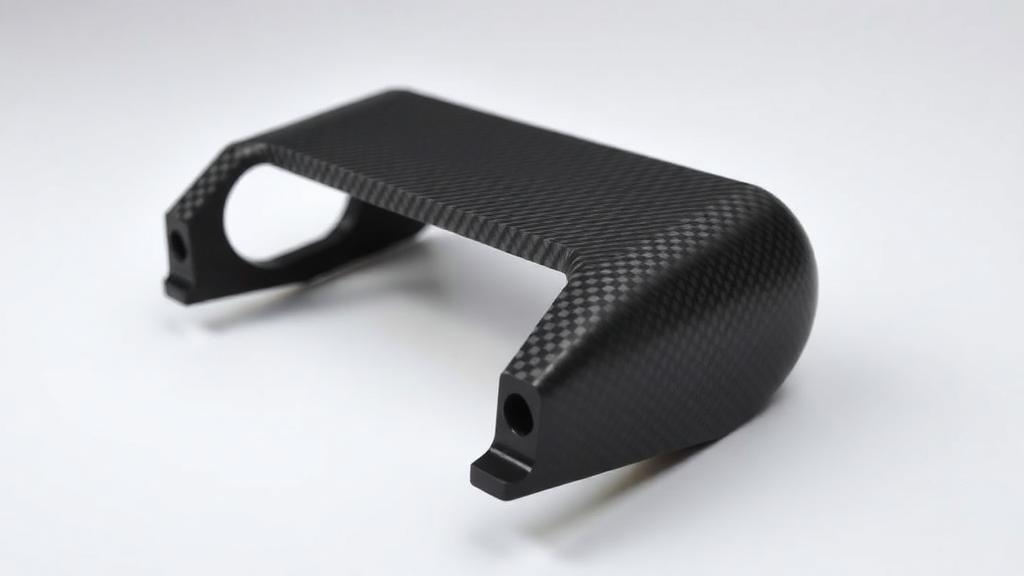
Every kilogram launched into orbit costs a fortune, and the structural parts that hold satellites together are prime targets for weight savings. A new study published in Polymer Bulletin by Jaya Kori, Somnath Chattopadhyaya, Sayan Chatterjee, and Madhulika Srivastava tackles a deceptively simple question: when you 3D print a load-bearing component for space, how dense should its internal structure actually be? The answer, it turns out, is not the obvious one. By systematically testing a carbon fiber reinforced polyamide composite at three different infill densities, the team has produced one of the most complete pictures yet of how the hidden interior of a printed part governs both its strength and its thermal behavior in the harsh environment beyond Earth.
The material at the heart of the study is PA12-CF, a composite of polyamide 12 nylon reinforced with short carbon fibers, printed through fused deposition modeling, the extrusion-based technique most people know as FDM. In FDM, a part is built layer by layer, and the slicer software can fill the interior either completely or with a partial lattice, leaving air pockets inside. That internal fill fraction, the infill density, is a free design variable: lower densities save material and mass, higher densities promise more strength. For aerospace engineers, who obsess over specific strength, meaning strength divided by weight, the trade-off is everything. A part that is slightly weaker but significantly lighter can still be the better choice, which is why the researchers normalized their mechanical results by density rather than reporting raw values alone.
The team printed specimens at 60, 80, and 100 percent infill density and then subjected them to a battery of standardized mechanical tests covering tensile strength, compressive strength, flexural strength, and fracture toughness, following established ASTM protocols for plastics and polymer composites. The results revealed a genuine tension between competing metrics. The fully dense parts delivered the highest specific compressive strength at 51.53 kN·m/kg, the highest specific flexural strength at 76.67 kN·m/kg, and the greatest fracture toughness, reaching 80.79 MPa. Those numbers make intuitive sense: with no voids inside, every load path is fully supported and cracks have no easy routes to propagate through internal porosity.
But the tensile results broke the pattern in a way that will surprise many practitioners. The highest specific tensile strength, 56.09 kN·m/kg, came not from the solid parts but from the 80 percent infill specimens, which outperformed the fully dense parts by 2.32 percent on a strength-per-mass basis. The likely explanation lies in how FDM parts are built. A 100 percent infill setting does not guarantee a void-free solid; the toolpath still lays down adjacent extrusion lines, and slight gaps between them can act as weak interfaces. At 80 percent infill, the internal lattice geometry may distribute load more favorably relative to the mass carried, allowing the part to punch above its weight in tension. For designers of satellite brackets and booms, where tensile loading dominates, that two percent edge on specific strength could translate into meaningful payload gains.
Strength alone does not make a spaceworthy material, and this is where the study goes beyond most infill optimization work. Spacecraft components must also manage heat, both the extreme temperature swings of orbital daylight and darkness and the thermal gradients that can distort precision structures. The researchers measured thermal conductivity and heat capacity using the hot disc transient plane source method, an ISO-standardized technique in which a heated sensor sandwiched between material samples tracks how quickly heat diffuses outward. Their findings were unambiguous: higher infill density produces higher thermal conductivity and higher volumetric heat capacity, peaking at 0.3873 W/m·K and 1.7620 MJ/m³·K respectively at full density. More material means more continuous carbon fiber networks to conduct heat and more thermal mass to buffer temperature changes.
Differential scanning calorimetry added a third thermal dimension, probing how the material behaves as it heats and revealing a maximum observed temperature of 170 degrees Celsius. That figure matters for mission planners because it marks the thermal envelope within which the printed composite retains its engineered properties. Combined with the transient plane source data, the calorimetry results give designers a coupled picture: a fully dense PA12-CF part not only resists compression, bending, and cracking best, it also conducts and stores heat most effectively, which can simplify thermal management around printed components in orbit.
Balancing so many competing criteria, four mechanical properties and multiple thermal ones, is exactly the kind of problem that benefits from formal multi-criteria optimization. The team turned to TOPSIS, the Technique for Order Preference by Similarity to Ideal Solution, a widely used decision-making method that ranks alternatives by how close they sit to a hypothetical ideal option and how far they sit from a worst-case anti-ideal. Each infill density becomes a candidate solution, each measured property a criterion, and the mathematics delivers a single ranked verdict. In this study, the TOPSIS analysis determined that 100 percent infill is the best overall solution for balancing the thermo-mechanical performance of PA12-CF parts, even though the 80 percent condition wins on specific tensile strength alone.
That verdict carries practical weight for the growing field of additively manufactured satellite hardware. The space sector has embraced polymer extrusion printing for everything from antenna structures to instrument housings, and short carbon fiber reinforced nylons are among the most printable high-performance options available. Previous studies have examined infill effects on individual properties, but comprehensive datasets that couple mechanical and thermal characterization with a formal optimization framework remain rare. By quantifying exactly how much performance is gained or lost at each density, and by expressing results as specific properties that account for mass, the study gives engineers a defensible basis for choosing print settings rather than relying on rules of thumb. The finding that full density is optimal for the balanced case also simplifies manufacturing, since solid infill avoids the variability that partial lattices can introduce between builds.
The broader context is the relentless economics of launch. Reducing the mass of structural components directly lowers launch cost and increases payload efficiency and mission performance, which is why low density, high strength materials are a critical priority for aerospace designers. Additive manufacturing offers a unique advantage here: because the printer controls the interior of every part, mass efficiency can be engineered into components in ways that traditional machining cannot match. Studies like this one convert that theoretical freedom into quantitative guidance, showing where the sweet spots lie for a specific material system under specific loading and thermal conditions.
There are, of course, limits to how far the conclusions generalize. The study examined a single material, PA12-CF, at three infill densities, and other polymer systems, other fiber loadings, and other infill patterns may shift the optimum. The authors note that the data supporting their findings are available upon reasonable request, and the work was conducted without external funding support, with the team drawing on facilities at the Indian Institute of Technology (Indian School of Mines) in Dhanbad, Jadavpur University in Kolkata, and Amrita Vishwa Vidyapeetham in Chennai. Still, the methodology, combining standardized mechanical testing, transient plane source thermal characterization, calorimetry, and TOPSIS-based multi-criteria ranking, offers a template that other labs can apply to any printable composite. As humanity sends more hardware to orbit and eventually to the Moon and Mars, the ability to print structural parts that are simultaneously light, strong, and thermally competent will only grow in importance. This study shows that sometimes the best answer to a lightweighting question is the least exotic one: print it solid, and let the numbers prove it.
Subject of Research: Infill density optimization of 3D-printed PA12-carbon fiber composites for thermo-mechanical performance in space applications
Article Title: Infill density optimization for enhanced specific strength and thermal properties of 3D printed components for space applications
Article References: Kori, J., Chattopadhyaya, S., Chatterjee, S., & Srivastava, M. (2026). Infill density optimization for enhanced specific strength and thermal properties of 3D printed components for space applications. Polymer Bulletin, 83(12), Article 677. https://doi.org/10.1007/s00289-026-06720-y
Image Credits: AI Generated
DOI: 10.1007/s00289-026-06720-y
Keywords: additive manufacturing, fused deposition modeling, PA12 carbon fiber composite, infill density, specific strength, thermal conductivity, TOPSIS optimization, space applications, satellite components, fracture toughness, differential scanning calorimetry, lightweight structures
Cite Scienmag News
Denise Maddox. (October 7, 2026). Full Infill Wins: Tuning 3D-Printed Carbon Fiber Parts for Space. Scienmag. https://scienmag.com/full-infill-wins-tuning-3d-printed-carbon-fiber-parts-for-space/
Denise Maddox. "Full Infill Wins: Tuning 3D-Printed Carbon Fiber Parts for Space." Scienmag, 7 October 2026, https://scienmag.com/full-infill-wins-tuning-3d-printed-carbon-fiber-parts-for-space/. Accessed 7 October 2026.
Denise Maddox. "Full Infill Wins: Tuning 3D-Printed Carbon Fiber Parts for Space." Scienmag. October 7, 2026. https://scienmag.com/full-infill-wins-tuning-3d-printed-carbon-fiber-parts-for-space/


