


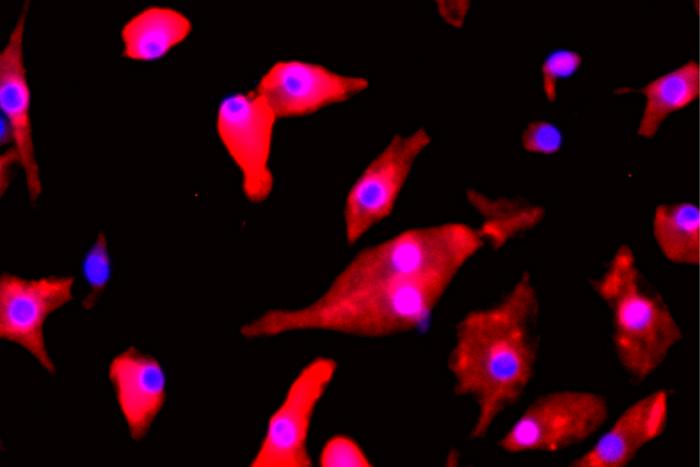
Florida State University researchers are giving oncologists another tool in their fight against pediatric brain cancer.

Credit: Courtesy of Amy Sang
Florida State University researchers are giving oncologists another tool in their fight against pediatric brain cancer.
In work published in Bioactive Materials, a research team led by Department of Chemistry and Biochemistry Professor Qing-Xiang “Amy” Sang showed the possibility of enhancing natural killer immune cells to improve their ability to attack a rare pediatric brain cancer.
”Natural killer cells are the policemen of the body,” Sang said. “They patrol the body and recognize viruses, bacteria and other pathogens, as well as cancer cells. Our goal is to enhance both the quantity and quality of these cells, making them more potent in their ability to combat cancer.”
Natural killer cells can target all types of cancer, and previous research has examined their effectiveness as a therapy. But this is the first study to test the ability of natural killer cells to destroy a specific variety of cancer known as a malignant rhabdoid tumor. When this tumor appears in the central nervous system, it is called an atypical teratoid rhabdoid tumor (ATRT). Although it is a rare disease, it accounts for 20% of all central nervous system tumors in children younger than 3.
“It’s a major unmet clinical need,” Sang said. “We still don’t have a standard, optimized therapy for children with cancer, especially children with brain cancer.”
Natural killer cells are a critical part of the human immune system, but they can be overwhelmed by cancer cells. Sang’s research team wanted to see if they could help the fight against this disease and develop a treatment with fewer side effects than traditional approaches such as chemotherapy or radiation therapy.
The researchers derived natural killer cells from human-induced pluripotent stem cells — cells from skin or blood that have been reprogrammed back into an embryonic-like state, allowing them to develop into any type of human cell. Unlike feeder cells from mice, which are typically used in similar studies, human-induced pluripotent stem cell-derived natural killer cells don’t pose a risk of rejection by a patient’s immune system.
They also enhanced the immune quality of those cells by using different proteins to stimulate them to have a stronger killing power.
Although more work is needed to develop a ready-to-use therapy for cancer patients, the research shows that natural killer cells derived from human-induced pluripotent stem cells could be the basis for future medicines to treat pediatric brain tumors.
“These findings pave the way for developing a safer and more effective immunotherapy for children with brain cancer,” Sang said.
This research built upon Sang’s previous work that was supported by several initiatives at FSU, including a grant from the FSU Council on Research and Creativity, the Pfeiffer Professorship for Cancer Research in Chemistry and Biochemistry from the College of Arts and Sciences, and an Endowed Chair Professorship in Cancer Research.
“FSU has been great in supporting cancer research and also rare pediatric disease research,” she said. “We used that seed funding to do preliminary studies to test novel ideas and get the project started. FSU has been very good in funding innovative ideas and new projects that enabled us to compete for external funding.”
This work was mainly supported by grants from the Florida Department of Health’s Live Like Bella Pediatric Cancer Research Initiative. It was also partially supported by the National Science Foundation and the FSU Institute for Pediatric Rare Diseases.
Co-authors on this work were graduate researchers Sonia Kiran, Yu Xue and Drishty Badhon Sarker in the Department of Chemistry and Biochemistry in the College of Arts and Sciences, and Yan Li, a professor in the Department of Chemical and Biomedical Engineering in the FAMU-FSU College of Engineering.
Journal
Bioactive Materials
Article Title
Feeder-free differentiation of human iPSCs into natural killer cells with cytotoxic potential against malignant brain rhabdoid tumor cells
Article Publication Date
8-Mar-2024
COI Statement
No competing interest.
Cite Scienmag News
Nathaniel Bowman. (August 12, 2024). FSU researchers show potential of new treatment for pediatric brain cancer. Scienmag. https://scienmag.com/fsu-researchers-show-potential-of-new-treatment-for-pediatric-brain-cancer/
Nathaniel Bowman. "FSU researchers show potential of new treatment for pediatric brain cancer." Scienmag, 12 August 2024, https://scienmag.com/fsu-researchers-show-potential-of-new-treatment-for-pediatric-brain-cancer/. Accessed 4 September 2026.
Nathaniel Bowman. "FSU researchers show potential of new treatment for pediatric brain cancer." Scienmag. August 12, 2024. https://scienmag.com/fsu-researchers-show-potential-of-new-treatment-for-pediatric-brain-cancer/

