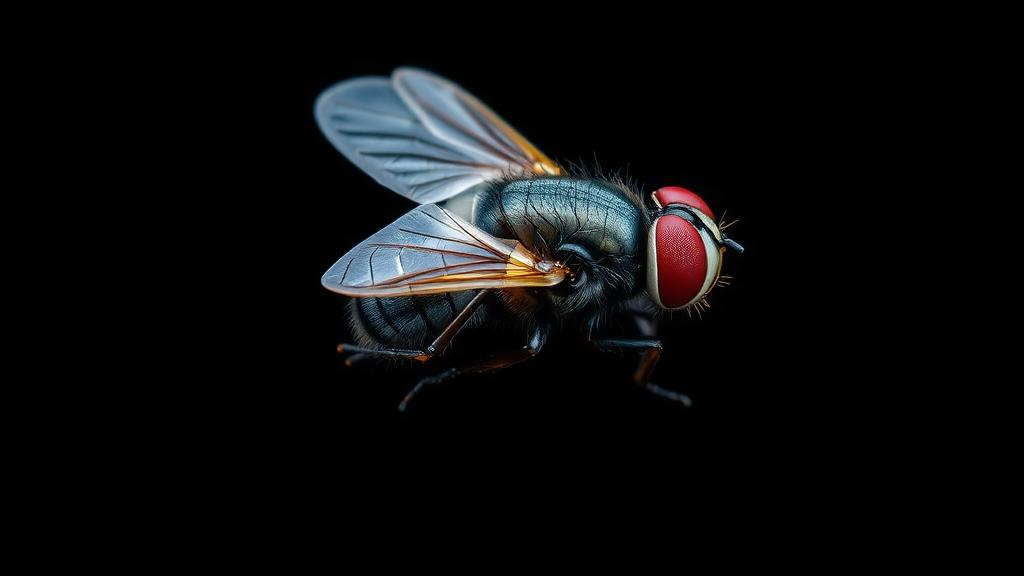
A tiny brain with fewer than 200,000 neurons has delivered one of the clearest pictures yet of how animals hold a thought in mind just long enough to act on it. In a study led by researchers at NYU Langone Health and NYU Grossman School of Medicine, fruit flies were shown to store a fleeting memory of an odor’s location using a neural circuit that scientists had long suspected must exist, but had never before caught in action. The work, published online in the journal Nature on October 7, demonstrates how a specific arrangement of neurons can both preserve a stable memory trace and switch it on or off almost instantly, a combination that lies at the heart of working memory in animals, including humans.
Working memory is the brain’s short-term scratchpad, the system that lets a person hold a few digits of a security code in mind for the seconds needed to type them. It is a remarkable balancing act. The memory must be stable enough to survive distractions and persist over a useful interval, yet it must also be rapidly deployable and just as rapidly discarded, because a brain that permanently memorized every number or smell it encountered would waste precious energy on useless information. Understanding how neural tissue achieves this dual demand of stability and flexibility has been a central puzzle in neuroscience, and the new fly study offers a concrete, experimentally verified answer in a system small enough to watch cell by cell.
The fruit fly has become one of neuroscience’s most powerful model organisms for precisely this kind of question. Although the human brain contains tens of billions of neurons and the fly brain fewer than 200,000, the two are organized in strikingly similar ways, with comparable principles governing how neurons communicate and how circuits are wired together. More importantly for researchers, every connection between every neuron in the fly brain, the complete wiring diagram known as the connectome, has been fully mapped. That means scientists can directly trace how individual neuron types interact to produce specific behaviors, rather than inferring those interactions indirectly as is often necessary in larger brains.
In the new experiments, the researchers exposed flies to a heady whiff of apple cider vinegar and watched what happened in the insects’ brains. The flies traveled toward the odor and continued moving toward its remembered location for a few seconds even after the smell itself disappeared, a behavior that depends on some internal record of where the odor had been. By monitoring brain activity during this process, the team found that two different types of neurons responded to the smell with similar patterns of electrical activity, suggesting that the cells were working together to control the flies’ movement in response to the odor. Those two cell types, known as PFG and hΔK neurons, turned out to be the key players in the memory mechanism.
What the researchers discovered is that PFG and hΔK neurons form what is called an attractor network, a type of neural circuit in which a set of neurons effectively talks to itself, with activity circulating among the cells until a stable signal emerges. Attractor networks have long been proposed as the theoretical substrate for working memory, because a self-sustaining loop of activity could hold information online after the original stimulus is gone. Scientists have assumed that an arrangement like this powers working memory, but the new experiments confirm that such an arrangement exists in a real brain and show exactly how it operates in a specific behavioral context, namely a fly navigating toward a remembered smell.
The twist is that this attractor network is not continuously active. Most of the time, communication between the PFG and hΔK neurons is blocked, with hΔK activity suppressed. During those blocked periods, the PFG neurons perform a different job: they track the fly’s orientation in space by receiving information from the fly’s internal compass system, continuously updating the animal’s heading. The circuit is therefore not a simple memory device but a versatile one whose function changes depending on whether the gate between its two components is open or closed.
When the block is lifted and the hΔK and PFG neurons are allowed to communicate, the fly becomes able to lock in on a particular origin, such as the source of an odor, and then move toward it. In that moment, the content of the memory, carried by the PFG neurons, is combined with a timing signal controlled by the hΔK neurons, and the communication block acts as a gate deciding when the memory is written. The researchers call this arrangement a split attractor network, a design in which the jobs of storing content, controlling timing, and gating access are divided among distinct elements of the same circuit. That division of labor, the study suggests, is what provides both the stability and the flexibility that working memory requires.
Senior investigator Katherine Nagel, PhD, an associate professor in the Department of Neuroscience at NYU Grossman School of Medicine, framed the finding as a confirmation of a long-standing hypothesis. According to Dr. Nagel, the study shows how a neuronal circuit forms a short-term memory in response to a fly sensing an odor, enabling the animal to remember a direction and travel toward a smell it wants to remember. She noted that scientists have long assumed an arrangement like this powers working memory, and that the experiments confirm this arrangement exists and reveal how it works in a specific context. Her hope, she said, is that the fly, which has an amazing track record for revealing how human biology works in a clear and simple way, will provide insight into processes like working memory that researchers have not yet had the tools to study in depth.
The study arrives at a moment when mapping specific network functions has become one of the frontiers of neuroscience. With complete connectomes now available for the fly and increasingly detailed wiring data emerging for other animals, researchers can move beyond asking whether particular brain regions are active during a task and begin asking what specific networks are actually doing, cell by cell and connection by connection. Dr. Nagel’s laboratory plans to pursue several questions raised by the current work, including how the circuit is controlled across different time frames, what kinds of information other types of neurons in the system are tracking, and how and why different regions of the brain are capable of controlling similar functions simultaneously. Answers to those questions could clarify whether split attractor designs are a general strategy that brains use to manage short-term memories of many kinds.
Because the fly brain and the human brain share deep organizational similarities, the mechanics uncovered in this study may illuminate principles that apply far beyond a vinegar-seeking insect. If the same logic of gated, split attractor circuits governs how mammalian brains write and erase short-term memories, the finding could eventually inform research into conditions in which working memory falters. For now, the study stands as a vivid demonstration of how a small, fully mapped brain can resolve a question that has hovered over neuroscience for decades: the memory that guides a fly toward a vanished smell is not a vague impression but a precisely engineered circuit state, written at the moment a gate opens, held stable by self-reinforcing activity, and ready to steer the animal until it is no longer needed. The work was supported by National Institutes of Health grants R01NS127129 and R01DC017979 and by National Science Foundation grant 2014217, with additional contributions from researchers including Aaron J. Lanz, Nicholas D. Kathman, and Emily Hao at NYU Langone and Bard Ermentrout at the University of Pittsburgh.
Subject of Research: Neural circuit mechanisms of working memory in the fruit fly brain
Article Title: Fruit fly study reveals mechanics of working memory
Article References: Fruit fly study reveals mechanics of working memory. (n.d.). Original publication
Image Credits: AI Generated
DOI: Not provided
Keywords: working memory, fruit fly, neuroscience, attractor network, connectome, PFG neurons, hΔK neurons, odor navigation, NYU Langone, Nature, neural circuits, short-term memory
Cite Scienmag News
Cassandra Pierce. (October 11, 2026). Fruit fly brain study reveals how working memory is written and switched off. Scienmag. https://scienmag.com/fruit-fly-brain-study-reveals-how-working-memory-is-written-and-switched-off/
Cassandra Pierce. "Fruit fly brain study reveals how working memory is written and switched off." Scienmag, 11 October 2026, https://scienmag.com/fruit-fly-brain-study-reveals-how-working-memory-is-written-and-switched-off/. Accessed 11 October 2026.
Cassandra Pierce. "Fruit fly brain study reveals how working memory is written and switched off." Scienmag. October 11, 2026. https://scienmag.com/fruit-fly-brain-study-reveals-how-working-memory-is-written-and-switched-off/