


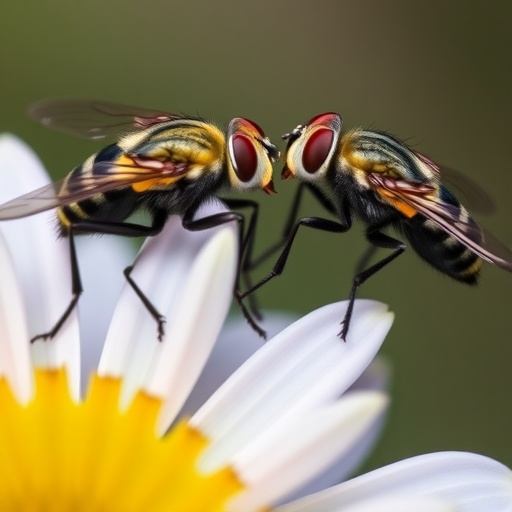
In the complex world of courtship behavior, the vinegar fly, Drosophila melanogaster, has long served as an invaluable model for neuroscientists aiming to decipher how sensory inputs shape mating rituals. Traditionally, the role of vision in these behaviors was considered rudimentary: male flies would detect the presence of a female visually, track her movements, and initiate pursuit. However, recent groundbreaking research from Washington University in St. Louis, led by Professor Yehuda Ben-Shahar, fundamentally challenges this simplistic view, revealing an intricate and finely tuned visual processing system that guides male courtship with surprising anatomical precision.
For decades, studies of Drosophila courtship focused heavily on chemical cues like pheromones and auditory signals such as the male’s characteristic courtship song. Visual cues were thought to be secondary or limited to motion detection at relatively long distances. Ben-Shahar’s team employed a cutting-edge approach harnessing computer vision combined with machine learning algorithms to delve deeper. This methodology allowed researchers to quantitatively map male courtship behaviors in relation to distinct anatomical features of the female, moving well beyond prior capabilities hampered by manual observation and subjective scoring.
Their findings indicate that male Drosophila utilize sophisticated spatial recognition to determine the anterior-posterior axis of the female body, a critical factor in modulating specific courtship behaviors. Visual recognition centers particularly on the female’s eyes, which act as landmarks signifying the “front” of the female. This precise identification enables the males to selectively deploy behaviors, such as courtship song, toward the female’s head region—a phenomenon lost when visual input is experimentally inhibited. Such data reveal that the male’s courtship repertoire is not merely a binary response triggered by generic visual cues but involves continuous sensory feedback integrating anatomical and positional information.
A particularly innovative aspect of this research is the use of automated high-resolution video tracking paired with machine-learned classifiers to monitor and analyze courtship activity. This approach drastically reduces human observational bias and captures the minute spatial biases in how males behave relative to the female’s body. The capacity to map behaviors with such spatial fidelity paves the way for a refined understanding of sensorimotor integration in these small but behaviorally rich organisms.
Neurobiologically, this work suggests that the spatial recognition of the female’s anatomy is orchestrated by multiple, independent populations of visual projection neurons rather than a dedicated single neural pathway. This distributed neural coding reflects the complexity of sensory processing underlying the precise calibration of courtship behavior. Such redundancy and multiplication of pathways may offer robustness and flexibility to behavioral outputs, a principle possibly conserved across taxa.
The implications of these findings extend well beyond entomology. Drosophila has served as a powerful model for understanding sensory processing and neural circuitry in animals, including humans. Enhanced frameworks for precise behavioral quantification and sensory integration analysis are critical tools that can accelerate research into the genetics and neurobiology of complex behaviors. The automated system developed by Ben-Shahar’s group not only sets a new standard for accuracy and reproducibility in behavioral neuroscience but also opens new avenues for investigating other behaviors occurring in two-dimensional spatial contexts.
Looking forward, the research team envisions expanding their computational framework to incorporate three-dimensional behavioral analysis. Such advancements would allow scientists to probe multifaceted interactions within more naturalistic environments, capturing subtleties necessary to unravel the neural basis of social, reproductive, and potentially aggressive behaviors in richer detail. This leap could facilitate unprecedented insights into how sensory information is integrated across modalities and dimensions to generate adaptive behavioral sequences.
Moreover, the discovery that vision informs the fine spatial deployment of courtship gestures challenges the traditional narrative of Drosophila mating as predominantly chemically driven and positions visual processing as an active modulator rather than a passive trigger. This insight demands a recalibration of our understanding of how multimodal sensory input orchestrates complex behavioral programs in animals.
At the heart of this study lies a powerful paradigm shift: courtship is no longer viewed as a static series of fixed actions but rather as a dynamic, continuously modulated behavioral program exquisitely tailored to sensory cues perceived in real time. This dynamic interplay between sensory perception and motor execution underscores the sophistication inherent even in the behavior of tiny flies and may reflect fundamental principles applicable across the animal kingdom.
In essence, Ben-Shahar and colleagues have transformed how we perceive the role of vision in Drosophila courtship, unveiling a sophisticated sensory mechanism by which male flies decode anatomical features to optimize mating success. This research not only enriches our knowledge of insect neuroethology but also exemplifies how technological innovations, such as machine learning and automated tracking, catalyze new discoveries at the intersection of behavior, neuroscience, and computational biology.
Cite Scienmag News
Cassandra Pierce. (February 25, 2026). Fruit Flies Reveal the Complexities of Courtship. Scienmag. https://scienmag.com/fruit-flies-reveal-the-complexities-of-courtship/
Cassandra Pierce. "Fruit Flies Reveal the Complexities of Courtship." Scienmag, 25 February 2026, https://scienmag.com/fruit-flies-reveal-the-complexities-of-courtship/. Accessed 3 September 2026.
Cassandra Pierce. "Fruit Flies Reveal the Complexities of Courtship." Scienmag. February 25, 2026. https://scienmag.com/fruit-flies-reveal-the-complexities-of-courtship/


