


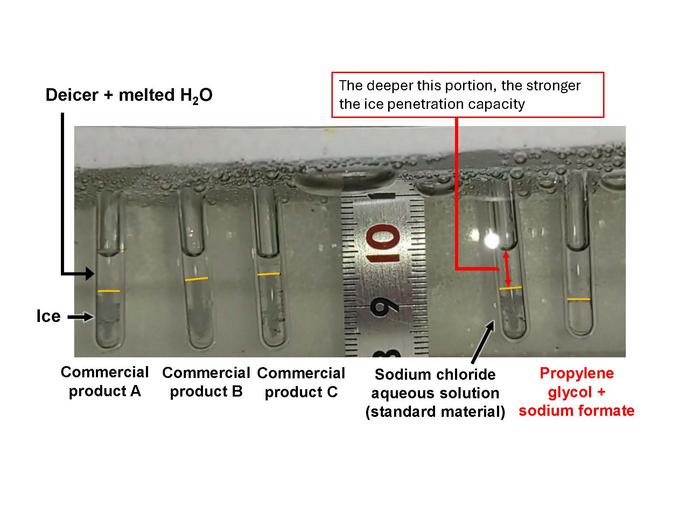
The dangers of frozen roads, airplane engines, and runways are well known, but the use of commercial products often means short-term safety over long-term environmental degradation. Seeking a better product, Osaka Metropolitan University researchers have developed a deicing mixture offering higher performance than deicers on the market while also having less impact on the environment.

Credit: Osaka Metropolitan University
The dangers of frozen roads, airplane engines, and runways are well known, but the use of commercial products often means short-term safety over long-term environmental degradation. Seeking a better product, Osaka Metropolitan University researchers have developed a deicing mixture offering higher performance than deicers on the market while also having less impact on the environment.
The team, made up of graduate student Kai Ito, Assistant Professor Arisa Fukatsu, Associate Professor Kenji Okada, and Professor Masahide Takahashi of the Graduate School of Engineering, used machine learning to analyze ice melting mechanisms of aqueous solutions of 21 salts and 16 organic solvents. The group then conducted experiments to find that a mixture of propylene glycol and aqueous sodium formate solution showed the best ice penetration capacity.
Because of the mixture’s effectiveness, less of the substance needs to be used, thereby also lessening the environmental impact. It is also not corrosive, preventing damage, for example, when used for airport runways.
“We are proposing an effective and environmentally friendly deicer that combines the advantages of salts and organic solvents,” exclaimed Dr. Fukatsu.
The results of this research, published in Scientific Reports on June 7, 2024, also provide new insights into the ice melting process.
“The development of highly efficient deicers is expected to make deicing and anti-icing operations easier,” Professor Takahashi added. “This will also lessen the environmental impact by reducing the amount of deicer used.”
###
About OMU
Established in Osaka as one of the largest public universities in Japan, Osaka Metropolitan University is committed to shaping the future of society through “Convergence of Knowledge” and the promotion of world-class research. For more research news, visit and follow us on social media: X, Facebook, Instagram, LinkedIn.
Journal
Scientific Reports
Method of Research
Data/statistical analysis
Subject of Research
Not applicable
Article Title
Machine learning-assisted chemical design of highly efficient deicers
Article Publication Date
7-Jun-2024
COI Statement
The authors declare no competing interests.
Cite Scienmag News
Bethany Barker. (June 7, 2024). Frozen? Let it melt with efficient new deicer friendly to the environment. Scienmag. https://scienmag.com/frozen-let-it-melt-with-efficient-new-deicer-friendly-to-the-environment/
Bethany Barker. "Frozen? Let it melt with efficient new deicer friendly to the environment." Scienmag, 7 June 2024, https://scienmag.com/frozen-let-it-melt-with-efficient-new-deicer-friendly-to-the-environment/. Accessed 6 September 2026.
Bethany Barker. "Frozen? Let it melt with efficient new deicer friendly to the environment." Scienmag. June 7, 2024. https://scienmag.com/frozen-let-it-melt-with-efficient-new-deicer-friendly-to-the-environment/

