

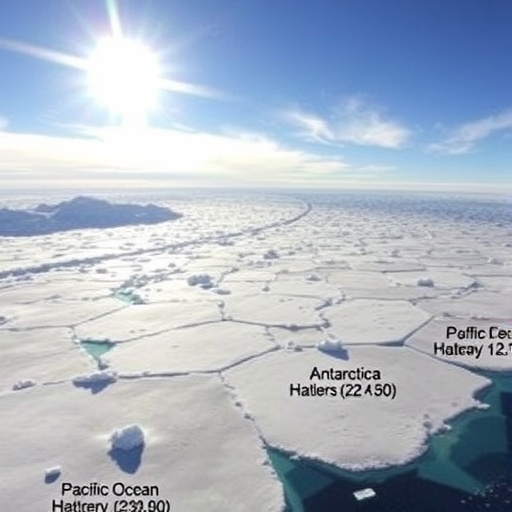
The vast expanse of the tropical Pacific Ocean and the icy realm of Antarctica are separated by more than 10,000 kilometers, yet recent research reveals an intriguing atmospheric connection linking these distant regions. Scientists have discovered that warming of sea surface temperatures (SSTs) in the Niño4 region of the tropical central Pacific during boreal winter months triggers a delayed, yet significant, warming response in the Antarctic stratosphere by the following austral winter. This groundbreaking finding provides a novel pathway to improve predictions of Southern Hemisphere climate variability months in advance, a long-standing challenge in climate science.
Published in Atmospheric Chemistry and Physics, an international team led by the Institute of Atmospheric Physics at the Chinese Academy of Sciences, in partnership with researchers from the University of Science and Technology of China, Dalhousie University, and the Bedford Institute of Oceanography in Canada, has meticulously analyzed observational and reanalysis data spanning over four decades, from 1980 to 2024. Their work elucidates the critical cross-seasonal teleconnection linking tropical Pacific oceanic warming to variations in the Antarctic stratospheric polar vortex, a high-altitude circulation of frigid air encircling the continent.
The Antarctic polar vortex, residing within the stratosphere roughly 15 to 50 kilometers above the surface, exerts profound influence not only on polar ozone chemistry but also on mid-latitude weather across the Southern Hemisphere. Historically, weakening or disruptions of this vortex have been associated with anomalous weather patterns, including shifts in storm tracks and altered precipitation regimes. However, reliably forecasting these stratospheric anomalies multiple months in advance has remained elusive.
This new investigation reveals a striking, reproducible pattern: when SST anomalies in the central tropical Pacific Niño4 region rise during December through February—the boreal winter—the Antarctic stratosphere experiences significant warming and a concurrent weakening of the polar vortex during the subsequent July–September austral winter. This lagged response, spanning half a year, implies a robust physical mechanism capable of bridging tropical oceanic conditions to remote polar atmospheric dynamics.
At the heart of their mechanistic explanation lies the amplification of tropical convection induced by warmer SSTs in the Niño4 region. Enhanced convection energizes the atmosphere and launches a planetary-scale wave train known as the Pacific–South American (PSA) pattern. These Rossby waves propagate southeastwards across the South Pacific Ocean, impacting the Amundsen and Ross Seas, regions critical for Antarctic sea ice dynamics. The atmospheric perturbations foster pronounced sea ice loss during the austral winter, exposing open ocean surfaces that continue to emit heat into the atmosphere.
This sustained heat release from reduced sea ice cover invigorates planetary wave activity, facilitating the upward propagation of waves into the stratosphere where they interact with and disrupt the normally strong, circumpolar vortex circulation. The resulting vortex weakening elevates stratospheric temperatures, altering the stability and transport processes of the polar atmosphere. These stratospheric changes manifest as large-scale climate anomalies with discernible impacts at the surface.
Employing robust statistical methodologies, the researchers demonstrated that combining the boreal winter Niño4 SST index with an index characterizing the PSA atmospheric circulation accounts for approximately 32% of the observed variability in Antarctic stratospheric temperature the following austral winter. This level of explained variance is unprecedented for such a long-distance and cross-seasonal connection, emphasizing the physical significance of this teleconnection rather than mere coincidental correlation.
Professor Xiao Ziniu, the study’s corresponding author, highlighted that “this cross-seasonal fingerprint links tropical Pacific SST anomalies directly to Antarctic stratospheric conditions over several months and thousands of kilometers, opening new avenues for longer-lead climate predictions relevant to Southern Hemisphere weather and ozone variability.” The nuanced understanding of this pathway offers clear potential for integration into seasonal forecasting frameworks, which could substantially enhance planning and risk mitigation in vulnerable polar and mid-latitude regions.
Intriguingly, the research underscores the repercussions of stratospheric warming on polar ozone chemistry. During periods of vortex weakening and elevated stratospheric temperatures, the usual chemical destruction of ozone by halogen compounds diminishes, allowing for partial ozone recovery or at least reduced depletion. Consequently, better forecasting of stratospheric temperature anomalies could inform expectations for ozone layer thickness and resilience, bearing implications for ultraviolet radiation exposure and environmental health.
Looking forward, the team raises an important question in the context of anthropogenic climate change: as global warming preferentially heats the tropical central Pacific SSTs, will the frequency or intensity of Antarctic stratospheric polar vortex disturbances—including rare but impactful Sudden Stratospheric Warming (SSW) events—increase? Answering this question demands further sophisticated modeling and observational campaigns, but it signals a critical area for future research with substantial societal relevance.
The implications of this teleconnection extend beyond academic intrigue. Improved prediction of polar vortex behavior months in advance could refine seasonal weather forecasts across the Southern Hemisphere mid-latitudes, enhancing preparedness for sudden weather disruptions. In addition, Antarctic logistical operations, which heavily depend on accurate climate projections for safety and efficiency, stand to benefit considerably. Further enhancement of our understanding and forecasting of ozone dynamics adds a vital component to global efforts aimed at monitoring stratospheric health in a warming world.
By delineating a coherent physical chain—from tropical ocean heat anomalies to remote polar atmospheric changes—the study exemplifies the power of interdisciplinary climate science to unravel complex Earth system interactions. This advance heralds a new era of predictive capability, bridging tropical meteorology, oceanography, stratospheric physics, and polar science, with tangible benefits for weather forecasting, environmental protection, and climate adaptation strategies.
As scientists worldwide grapple with the multifaceted impacts of climate change, this research charts a promising course for disentangling the intricate teleconnections that govern Earth’s climate system, harnessing them to generate actionable climate intelligence. It illustrates vividly how localized tropical ocean conditions ripple through the atmosphere to influence the farthest reaches of the Southern Hemisphere, reinforcing the profound interconnectedness of our planet’s climate machinery.
Subject of Research: Cross-seasonal teleconnections between tropical Pacific sea surface temperature anomalies and Antarctic stratospheric dynamics.
Article Title: Cross-Seasonal Impact of SST Anomalies over the Tropical Central Pacific Ocean on the Antarctic Stratosphere
News Publication Date: 10-Feb-2026
Web References: https://doi.org/10.5194/acp-26-2117-2026
Image Credits: Zi Yucheng
Keywords: Climate change, Antarctic stratosphere, tropical Pacific SST, polar vortex, teleconnection, Pacific–South American pattern, sea ice loss, planetary waves, seasonal prediction, ozone variability


