


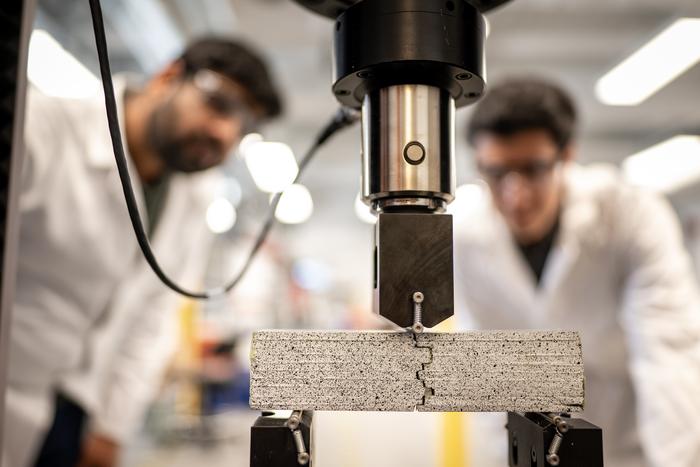
Inspired by the material that makes up oyster and abalone shells, engineers at Princeton have created a new cement composite that is 17 times more crack-resistant than standard cement and 19 times more able to stretch and deform without breaking. The findings could eventually help increase the crack resistance of a wide range of brittle ceramic materials, from concrete to porcelain.

Credit: Sameer Khan/Fotobuddy
Inspired by the material that makes up oyster and abalone shells, engineers at Princeton have created a new cement composite that is 17 times more crack-resistant than standard cement and 19 times more able to stretch and deform without breaking. The findings could eventually help increase the crack resistance of a wide range of brittle ceramic materials, from concrete to porcelain.
“If we can engineer concrete to resist crack propagation, we can make it tougher, safer and more durable,” said researcher Shashank Gupta, a graduate student in Reza Moini’s lab in the Department of Civil and Environmental Engineering.
In an article published June 10 in the journal Advanced Functional Materials, the research team led by Moini, an assistant professor of civil and environmental engineering, reported that creating alternating layers of tabulated cement paste and thin polymer can significantly increase crack resistance and the ability to deform without completely breaking (ductility).
Moini’s lab often looks to biology for inspiration in its work on building materials. In this case, the team developed a composite inspired by a natural material called nacre, or mother of pearl, which is found inside certain shells. Gupta said that at the microscopic level, nacre consists of hexagonal tablets of the hard mineral aragonite glued together by a soft biopolymer.
The aragonite tablets contribute significantly to nacre’s strength, while the biopolymer adds flexibility and crack resistance. The toughening mechanism involves the aragonite tablets sliding under stress, which, along with other mechanisms, allows the nacre to dissipate energy. This sliding action, combined with the crack deflection and biopolymer deformation, enables nacre to endure substantial mechanical stress while maintaining its structural integrity, making it both strong and resilient.
“This synergy between the hard and soft components is crucial to nacre’s remarkable mechanical properties,” Gupta said.
The Princeton team has developed innovative composites inspired by nacre, utilizing conventional construction materials like Portland cement paste combined with a limited amount of polymer. They alternated layers of cement paste sheets with a highly stretchable polymer, polyvinyl siloxane. The researchers created multi-layered small beams by alternating cement paste sheets with thin layers of polymer. These beams were then subjected to a notched three-point bending test, where each beam was tested under flexure to evaluate crack resistance (or fracture toughness).
In the experiment, the researchers produced three types of beams. The first type consisted of alternating layers of cement paste sheets and thin polymer. For the second type, they used a laser to engrave hexagonal grooves into the cement paste sheets. These grooved sheets were then stacked with thin polymer layers in between. The third type was similar to the third, but the researchers cut through the cement completely, creating separated hexagonal tablets connected by the polymer layer. These cement-paste tablets lay atop the polymer layer similarly to how aragonite lies on the biopolymer layer in nacre. These three types were compared against a reference solid (monolithic) cast cement paste counterpart.
The experiments revealed that the failure of the reference beams was brittle — meaning that the beams broke suddenly and completely upon reaching their failure point, with no ductility. The beams with alternating layers, both grooved and non-grooved, demonstrated increased ductility and resistance to cracking.
The most significant results were observed in the beams with completely separated hexagonal tablets, which are similar to nacre. These beams exhibited 19 times the ductility and 17 times the fracture toughness while retaining nearly the same strength as the solid cement paste beam.
“Our bio-inspired approach is not to simply mimic nature’s microstructure but to learn from the underlying principles and use that to inform the engineering of human-made materials. One of the key mechanisms that makes a nacreous shell tough is the sliding of the tablet at the nanometer level. Here, we focus on the mechanism of tablet sliding by engineering the built-in tabulated structure of cement paste in balance with the properties of the polymer and the interface between them.” Moini said. “In other words, we intentionally engineer defects in the brittle materials as a way to make them stronger by design.“
The researchers noted that the findings are based on lab conditions and that it would take additional work and research to develop the techniques for use in the field. They are working to determine whether the structures’ fracture toughness and ductility apply to other ceramic materials beyond cement paste, such as concrete.
“We are only scratching the surface; there will be numerous design possibilities to explore and engineer the constitutive hard and soft material properties, the interfaces, and the geometric aspects that play into the fundamental size effects in construction materials,” Moini said.
The paper, “Tough and Ductile Architected Nacre-Like Cementitious Composites,” was published June 10 in the journal Advanced Functional Materials. Besides Moini and Gupta, the article was coauthored by Hadi S. Esmaeeli, an associate research scholar at Princeton. The project was funded in part by National Science Foundation CAREER Award #2238992 through the Engineering for Civil Infrastructure program.
Journal
Advanced Functional Materials
Method of Research
Experimental study
Subject of Research
Not applicable
Article Title
Tough and Ductile Architected Nacre-Like Cementitious Composites
Article Publication Date
10-Jun-2024
Cite Scienmag News
Denise Maddox. (June 11, 2024). From seashells to cement, nature inspires tougher building material. Scienmag. https://scienmag.com/from-seashells-to-cement-nature-inspires-tougher-building-material/
Denise Maddox. "From seashells to cement, nature inspires tougher building material." Scienmag, 11 June 2024, https://scienmag.com/from-seashells-to-cement-nature-inspires-tougher-building-material/. Accessed 5 September 2026.
Denise Maddox. "From seashells to cement, nature inspires tougher building material." Scienmag. June 11, 2024. https://scienmag.com/from-seashells-to-cement-nature-inspires-tougher-building-material/

