

In the ever-evolving landscape of energy storage, electrochemical capacitors—commonly known as supercapacitors—stand out as the technological sprinters, capable of charging instantaneously and delivering swift, high-power bursts. However, their capacity to store substantial energy over time is significantly limited, largely due to rapid self-discharge and intrinsic energy density constraints. The pivotal bottleneck has long been the operating voltage ceiling, set by the chemical stability limits of the electrolytes used, which tend to degrade under stress at higher voltages. Addressing this challenge, a groundbreaking study now redefines what supercapacitors can achieve by innovatively designing the interaction between electrode materials and electrolytes, shattering the voltage barrier and opening a horizon of possibilities.
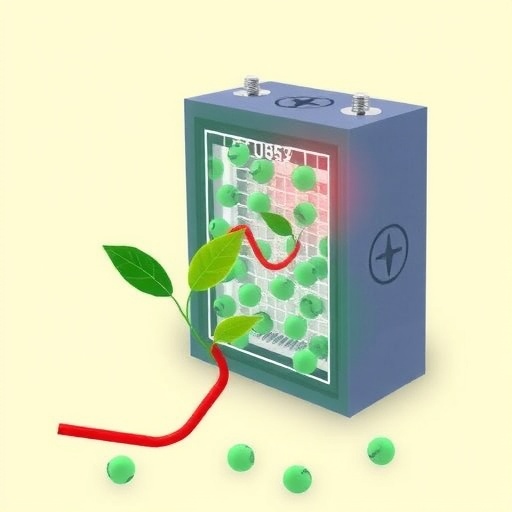
The researchers embarked on a novel “co-design” paradigm that integrates material structure and electrolyte chemistry to harness synergistic benefits. Rather than independently optimizing the solid electrode and the liquid electrolyte, this approach tailors both components to work harmoniously as a unified system. Central to this feat was the transformation of lignin, an abundant and renewable biopolymer derived from plant cell walls, into a hierarchical porous carbon electrode. This engineered carbon features meticulously controlled pore sizes on the sub-nanometer scale, optimizing ion accommodation and interaction dynamics to maximize energy storage potential.
Complementing this structural innovation, the electrolyte formulation was specifically engineered to match the unique porosity and chemistry of the electrode. By incorporating a weakly solvating lithium-based electrolyte interspersed with a specialized fluorinated diluent, the team effectively suppressed parasitic electrochemical reactions at elevated voltages. The fluorinated diluent acts as a molecular shield, preventing the degradation pathways that typically limit the voltage range and stability of conventional electrolytes, thus maintaining a consistent and durable interface under the rigorous conditions of high-voltage cycling.
This tailored electrode-electrolyte interplay enabled the device to operate stably at an unprecedented 4.0 volts—twice the typical voltage limit for most supercapacitors—without succumbing to rapid self-discharge or capacity fade. The advancement addresses a critical trade-off in energy storage technology: balancing power delivery speed with energy retention over extended periods, a feat previously deemed incompatible. The geometric confinement of solvated lithium ions within the lignin-derived carbon pores effectively concentrates charge carriers, thereby boosting the stored energy density immensely within a stable electrochemical environment.
One of the most striking achievements of this research is the device’s energy density, reaching an impressive 77.4 watt-hours per kilogram. This figure blurs the conventional boundary separating supercapacitors from batteries, indicating a paradigm where rapid charging capability no longer excludes substantial energy storage. The effective utilization of biomass-derived carbon material not only promotes sustainability but also leverages natural molecular architectures with inherent advantages for high-performance energy devices.
Stability and longevity often remain the Achilles’ heel for high-energy supercapacitors. Here, the incorporation of the fluorinated diluent exhibits a profound impact on the system’s robustness, conferring resistance against electrochemical degradation over thousands of cycles. The reported test results demonstrate remarkable endurance: after 10,000 charge-discharge cycles, the electrode retained over 90% of its initial capacity, showcasing an exceptional combination of durability and performance rarely observed in devices operating at similar voltage thresholds.
The intricate balance achieved between electrode porosity and electrolyte composition is a testament to the deliberate and systematic design approach exemplified by the research teams from Southeast University and Nanjing Normal University. Their collaboration through the Key Laboratory of Energy Thermal Conversion and Control and the Jiangsu Key Laboratory of New Power Batteries fostered a cross-disciplinary synergy pivotal for overcoming the entrenched difficulties in supercapacitor technology. Such integrative research emphasizes the significance of understanding molecular-level interactions alongside macroscopic material design.
At its core, this breakthrough highlights how integrating bio-based materials with advanced chemical engineering can transcend existing limitations in energy storage. The fine-tuned hierarchical carbon framework derived from lignin not only benefits from natural abundance and renewability but also leverages unique nanostructures that conventional synthetic carbons find challenging to replicate. This highlights a burgeoning field where green chemistry intersects with high-performance material science, charting a roadmap toward sustainable yet cutting-edge technological solutions.
From a practical perspective, the ability to reliably store and deploy energy at high voltages with low self-discharge drastically enhances the applicability of supercapacitors across various sectors. Industries ranging from fast-charging electric vehicles, aerospace, and portable electronics to smart power grids stand to gain substantially from such advances. The combination of rapid power delivery, improved energy density, and enhanced cycle life represents a trifecta that addresses many of the current limitations impeding widespread adoption.
Moreover, the approach demonstrated here can inspire further research into other biopolymer-derived materials and electrolyte systems, encouraging a broader exploration of green materials in high-tech applications. The principles of molecular matching and electronic compatibility between electrode pores and solvated ions underscore an emerging focus in electrochemical system design: precision tailoring at the nanoscale to unlock macroscopic gains in efficiency and reliability.
The implications of this research reverberate well beyond supercapacitors. By successfully elevating performance metrics through meticulously designed interfaces, it paves the way for future energy storage devices that combine eco-friendly materials with state-of-the-art electrochemical engineering. This synergy could redefine how the energy storage sector approaches challenges of scalability, sustainability, and integration, particularly as global demands for renewable energy solutions intensify.
In conclusion, the joint effort by Dr. Feng Gong and Dr. Hualin Ye’s teams exemplifies a milestone in supercapacitor technology. By fusing lignin-derived porous carbons with a custom-engineered fluorinated lithium electrolyte, they have demonstrated a high-voltage, low self-discharge electrochemical capacitor that achieves superior energy density and long-term stability. This work not only pushes the envelope of performance but also aligns with the growing imperative to develop sustainable, efficient energy storage technologies that can keep pace with the demands of modern industry and society.
Subject of Research: Electrochemical capacitors (supercapacitors) enhanced by lignin-derived porous carbon electrodes and custom lithium-based electrolytes
Article Title: Lignin-derived hierarchical porous carbons enabling high-voltage electrochemical capacitors with low self-discharge
News Publication Date: 28-Jan-2026
Web References:
https://doi.org/10.1007/s44246-025-00255-z
References:
Zhang, S., Liu, S., Si, S. et al. Lignin-derived hierarchical porous carbons enabling high-voltage electrochemical capacitors with low self-discharge. Carbon Res. 5, 11 (2026).
Image Credits: Shichao Zhang, Shenglin Liu, Suyang Si, Keqi Zeng, Chenxin Cai, Xiangzhou Yuan, Yawen Tang, Feng Gong & Hualin Ye
Keywords
Electrochemistry, Electrocatalysis, Fuel Cells, Porous Materials, Supercapacitors


