


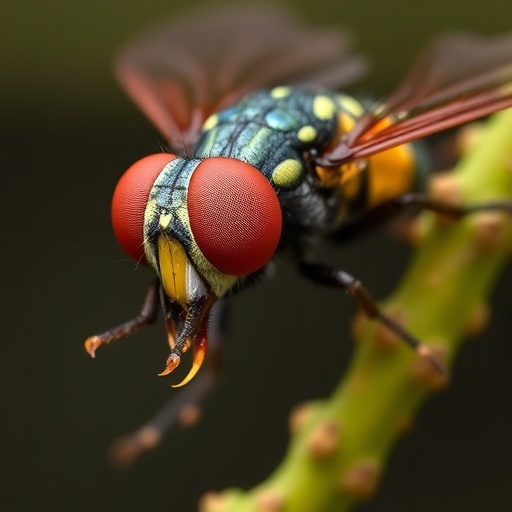
In the realm of evolutionary biology, the story of a peculiar fruit fly has recently come to light, challenging long-held perceptions of this commonly overlooked insect family. At Lund University, a team of dedicated researchers has embarked on a journey into the genomic depths of one of the most extraordinary fruit fly species known to science—Drosophila enhydrobia. Remarkably unlike its fruit-feeding relatives that infest kitchens worldwide, this amphibious insect has evolved a predatory lifestyle, living entirely submerged in rapidly flowing African streams and hunting other aquatic insects. This radical departure from the classic fruit fly diet and habits has sparked intense scientific curiosity and represents a striking example of evolutionary innovation.
The origins of Drosophila enhydrobia captivated scientists not only because of its unique ecological niche but also due to its mysterious status—it has not been observed in the wild since 1981. To bypass this obstacle, researchers turned to an unexpected but invaluable resource: a pinned specimen from a natural history museum in Zurich. Utilizing cutting-edge DNA sequencing technologies, the team extracted and reconstructed an almost complete genome from this decades-old specimen without compromising its physical integrity, a testament to advances in molecular biology techniques applied to museum collections.
Upon decoding the genome, the evolutionary narrative began to take shape. Contrary to earlier beliefs that Drosophila enhydrobia was an isolated evolutionary outlier with a unique lineage, the genetic analysis placed it firmly within a clade of flies that inhabit water-adjacent environments, predominantly in South Asia. This discovery suggests that the species’ striking aquatic adaptations are an extreme augmentation of traits present in a broader group adapted to semi-aquatic lifestyles, rather than a sudden, inexplicable leap.
At the genomic level, the species exhibits notable streamlining. Intriguingly, several gene families typically involved in olfaction, gustation, and metabolism have been reduced or entirely lost. These genetic losses underscore the fly’s specialized existential niche; no longer reliant on the sensory and metabolic pathways used for detecting fermenting fruit, its genome has “pruned” unnecessary functions. Meanwhile, the remaining sensory genes appear to have undergone functional refinement, becoming more finely tuned to detect chemical signals and environmental cues relevant in a dynamic underwater habitat.
This genomic specialization is akin to removing extraneous tools from a toolbox, leaving a more efficient and specialized set of implements suited exclusively for survival in an aquatic predatory environment. The adaptation profile reflects a shift not just in behavior but fundamental biological processes, illuminating the profound impacts of environmental shifts on the evolutionary trajectories of organisms. As Drosophila enhydrobia hunts beneath the surface, its survival hinges on a sensory apparatus honed expressly for life in running water, a dramatic departure from the airborne, fruit-laden world of its kin.
This research carries substantial implications for evolutionary biology. It highlights that even the most bizarre and seemingly isolated evolutionary strategies may be elaborations of pre-existing lineages, underscoring the versatility and plasticity of genetic and phenotypic traits. Such insights challenge the way biologists conceptualize the pathways through which extreme adaptations emerge and are fine-tuned by natural selection.
Furthermore, the study underscores the critical role natural history museums play in contemporary science. Specimens collected for cataloging purposes decades or even centuries ago can become invaluable repositories of genetic information, especially for species that have become rare, elusive, or extinct. The successful sequencing of a near-complete genome from a pinned insect specimen exemplifies the symbiosis of classical specimen collection and modern molecular genetics, enabling discoveries that would have been impossible a generation ago.
Beyond the evolutionary curiosities, this work also provides a window into how species may respond to future environmental changes. Understanding the genomic architecture that enables such a specialized lifestyle affords predictions about how similar organisms might adapt—or fail to adapt—to shifting habitats, climate change, or anthropogenic impacts. The adaptive strategies of Drosophila enhydrobia present a model system for exploring ecological resilience mediated by genetic reconfiguration.
The multidisciplinary team at Lund University emphasizes that we are just beginning to unlock the vast troves of data concealed within museum collections. As sequencing technologies continue to advance, these biological archives will become increasingly vital for mapping the tapestry of life’s history and tracing the mechanisms by which organisms respond to their environments over evolutionary timescales.
In summary, the mapping of the Drosophila enhydrobia genome offers a pioneering glimpse into the molecular foundations of an aquatic predatory lifestyle in a traditionally terrestrial group, reshaping our understanding of evolutionary possibilities. It spotlights the intricate ways gene loss and specialization facilitate adaptation and demonstrates how historical specimens can illuminate contemporary scientific frontiers. This research not only retraces the steps of a lost species but also charts innovative approaches to unraveling the mysteries of biodiversity and evolution.
This landmark study, published in the journal Current Biology, exemplifies the marriage of traditional collection-based science with modern genetics, heralding a new era of evolutionary inquiry rooted in the past yet embracing the future.
News Publication Date: 5-May-2026
Web References:
10.1016/j.cub.2026.04.024
Cite Scienmag News
Gavin Prescott. (May 8, 2026). From Odd Insect to Underwater Predator: The Remarkable Evolution of a Bloodthirsty Fruit Fly. Scienmag. https://scienmag.com/from-odd-insect-to-underwater-predator-the-remarkable-evolution-of-a-bloodthirsty-fruit-fly/
Gavin Prescott. "From Odd Insect to Underwater Predator: The Remarkable Evolution of a Bloodthirsty Fruit Fly." Scienmag, 8 May 2026, https://scienmag.com/from-odd-insect-to-underwater-predator-the-remarkable-evolution-of-a-bloodthirsty-fruit-fly/. Accessed 6 September 2026.
Gavin Prescott. "From Odd Insect to Underwater Predator: The Remarkable Evolution of a Bloodthirsty Fruit Fly." Scienmag. May 8, 2026. https://scienmag.com/from-odd-insect-to-underwater-predator-the-remarkable-evolution-of-a-bloodthirsty-fruit-fly/


