


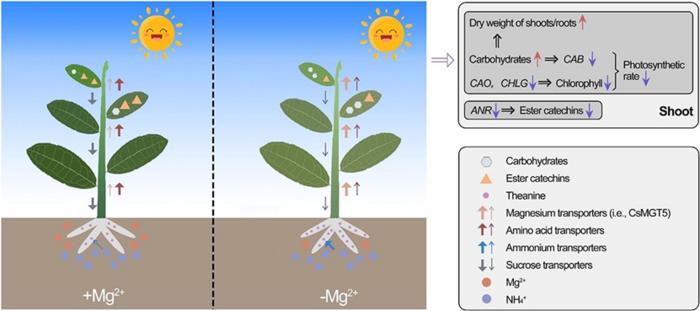
A pivotal study illuminates the essential function of magnesium in the metabolic and genetic makeup of tea plants. The research uncovers how magnesium deficiency impacts key growth processes and the synthesis of compounds that dictate tea’s taste and quality. The identification of the CsMGT5 gene as a critical magnesium transporter offers a significant breakthrough, paving the way for enhancing tea cultivation and improving the final product’s flavor profile.
Magnesium plays a vital role in the growth and quality of tea plants, influencing key processes such as photosynthesis and the synthesis of important metabolites. However, tea plants often suffer from magnesium deficiency due to factors like poor soil conditions and unbalanced fertilization. This deficiency can lead to reduced tea quality, impacting taste and market value. Given these issues, it is crucial to explore how magnesium affects tea plants at a molecular level, paving the way for more effective nutrient management strategies in tea cultivation.
A team from the National Key Laboratory for Germplasm Innovation and Utilization of Horticultural Crops at Huazhong Agricultural University published a study (DOI: 10.1093/hr/uhae152) in Horticulture Research on June 3, 2024. The research focuses on understanding the effects of magnesium deficiency on tea plants, particularly through the role of the CsMGT5 gene. This study utilized metabolomics and transcriptomics to uncover how magnesium scarcity impacts tea quality.
The study revealed that magnesium deficiency in tea plants significantly disrupts their physiological and metabolic functions. Key findings showed a decline in photosynthetic efficiency, with lower chlorophyll content in tea shoots, directly impacting the plant’s overall health and quality. The CsMGT5 gene was identified as a crucial regulator of magnesium homeostasis, playing a central role in maintaining magnesium levels under stress conditions. Additionally, the research highlighted alterations in metabolite profiles, particularly a reduction in catechins and certain amino acids, which are essential for the flavor and quality of tea. The study also suggested that CsMGT5 may work synergistically with ammonium transporters to help stabilize amino acid levels, providing a potential pathway for improving tea quality through better nutrient management. These insights offer a deeper understanding of magnesium’s role in tea plants, with practical implications for enhancing tea production.
Dr. Mingle Wang, the lead researcher, commented, “Our findings shed light on the critical role of magnesium in tea plant health and quality. Understanding how CsMGT5 regulates magnesium homeostasis opens up new possibilities for enhancing tea quality through better nutrient management. This study lays the groundwork for future research into optimizing tea cultivation practices.”
The insights from this study have significant implications for the tea industry. By understanding the role of magnesium and CsMGT5, tea growers can improve nutrient management practices, potentially leading to higher quality tea. This research also sets the stage for further exploration into the molecular mechanisms underlying nutrient deficiencies in other crops, offering broader agricultural applications.

Credit: Horticulture Research
A pivotal study illuminates the essential function of magnesium in the metabolic and genetic makeup of tea plants. The research uncovers how magnesium deficiency impacts key growth processes and the synthesis of compounds that dictate tea’s taste and quality. The identification of the CsMGT5 gene as a critical magnesium transporter offers a significant breakthrough, paving the way for enhancing tea cultivation and improving the final product’s flavor profile.
Magnesium plays a vital role in the growth and quality of tea plants, influencing key processes such as photosynthesis and the synthesis of important metabolites. However, tea plants often suffer from magnesium deficiency due to factors like poor soil conditions and unbalanced fertilization. This deficiency can lead to reduced tea quality, impacting taste and market value. Given these issues, it is crucial to explore how magnesium affects tea plants at a molecular level, paving the way for more effective nutrient management strategies in tea cultivation.
A team from the National Key Laboratory for Germplasm Innovation and Utilization of Horticultural Crops at Huazhong Agricultural University published a study (DOI: 10.1093/hr/uhae152) in Horticulture Research on June 3, 2024. The research focuses on understanding the effects of magnesium deficiency on tea plants, particularly through the role of the CsMGT5 gene. This study utilized metabolomics and transcriptomics to uncover how magnesium scarcity impacts tea quality.
The study revealed that magnesium deficiency in tea plants significantly disrupts their physiological and metabolic functions. Key findings showed a decline in photosynthetic efficiency, with lower chlorophyll content in tea shoots, directly impacting the plant’s overall health and quality. The CsMGT5 gene was identified as a crucial regulator of magnesium homeostasis, playing a central role in maintaining magnesium levels under stress conditions. Additionally, the research highlighted alterations in metabolite profiles, particularly a reduction in catechins and certain amino acids, which are essential for the flavor and quality of tea. The study also suggested that CsMGT5 may work synergistically with ammonium transporters to help stabilize amino acid levels, providing a potential pathway for improving tea quality through better nutrient management. These insights offer a deeper understanding of magnesium’s role in tea plants, with practical implications for enhancing tea production.
Dr. Mingle Wang, the lead researcher, commented, “Our findings shed light on the critical role of magnesium in tea plant health and quality. Understanding how CsMGT5 regulates magnesium homeostasis opens up new possibilities for enhancing tea quality through better nutrient management. This study lays the groundwork for future research into optimizing tea cultivation practices.”
The insights from this study have significant implications for the tea industry. By understanding the role of magnesium and CsMGT5, tea growers can improve nutrient management practices, potentially leading to higher quality tea. This research also sets the stage for further exploration into the molecular mechanisms underlying nutrient deficiencies in other crops, offering broader agricultural applications.
###
References
Original Source URL
Funding information
This research was funded by the National Natural Science Foundation of China (32272765), the Natural Science Foundation of Hubei Province (2023AFB877), the Knowledge Innovation Program of Wuhan-Shuguang Project (2023020201020348), and the Fundamental Research Funds for the Central Universities (2662023PY022).
About Horticulture Research
Horticulture Research is an open access journal of Nanjing Agricultural University and ranked number two in the Horticulture category of the Journal Citation Reports ™ from Clarivate, 2023. The journal is committed to publishing original research articles, reviews, perspectives, comments, correspondence articles and letters to the editor related to all major horticultural plants and disciplines, including biotechnology, breeding, cellular and molecular biology, evolution, genetics, inter-species interactions, physiology, and the origination and domestication of crops.
Journal
Horticulture Research
Subject of Research
Not applicable
Article Title
Metabolome profiling and transcriptome analysis unveiling the crucial role of magnesium transport system for magnesium homeostasis in tea plants
Article Publication Date
3-Jun-2024
COI Statement
The authors declare that they have no competing interests.
Cite Scienmag News
Daisy Hatcher. (August 26, 2024). From leaf to cup: The essential role of magnesium in tea plant metabolism. Scienmag. https://scienmag.com/from-leaf-to-cup-the-essential-role-of-magnesium-in-tea-plant-metabolism/
Daisy Hatcher. "From leaf to cup: The essential role of magnesium in tea plant metabolism." Scienmag, 26 August 2024, https://scienmag.com/from-leaf-to-cup-the-essential-role-of-magnesium-in-tea-plant-metabolism/. Accessed 4 September 2026.
Daisy Hatcher. "From leaf to cup: The essential role of magnesium in tea plant metabolism." Scienmag. August 26, 2024. https://scienmag.com/from-leaf-to-cup-the-essential-role-of-magnesium-in-tea-plant-metabolism/

