


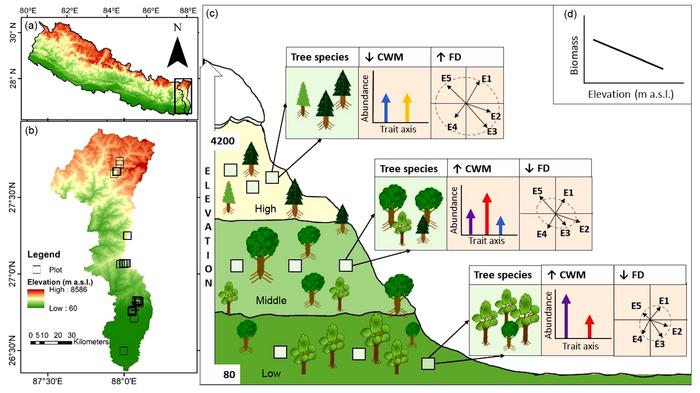
The growth, development, and functioning of plants in various environments depend on multiple elements. However, our understanding of how the element concentrations in leaves that are associated with plant functioning and adaptation affect biomass in tree communities along elevation has been limited. A study led by Prof. Eryuan Liang (Institute of Tibetan Plateau Research, Chinese Academy of Sciences), and Dr. Nita Dyola (Institute of Tibetan Plateau Research, Chinese Academy of Sciences and Université du Québec à Chicoutimi), together with the co-authors, demonstrated the linkages of ten leaf element (carbon, nitrogen, phosphorus, potassium, calcium, magnesium, zinc, iron, copper and manganese) contents in 1,859 trees from 116 species in shaping biomass accumulation from tropical forests (80 m asl) to alpine treeline (4200 m asl) in the Kangchenjunga Landscape, located in the eastern Nepal Himalayas, which is one of the most diverse regions in the world.

Credit: ©Science China Press
The growth, development, and functioning of plants in various environments depend on multiple elements. However, our understanding of how the element concentrations in leaves that are associated with plant functioning and adaptation affect biomass in tree communities along elevation has been limited. A study led by Prof. Eryuan Liang (Institute of Tibetan Plateau Research, Chinese Academy of Sciences), and Dr. Nita Dyola (Institute of Tibetan Plateau Research, Chinese Academy of Sciences and Université du Québec à Chicoutimi), together with the co-authors, demonstrated the linkages of ten leaf element (carbon, nitrogen, phosphorus, potassium, calcium, magnesium, zinc, iron, copper and manganese) contents in 1,859 trees from 116 species in shaping biomass accumulation from tropical forests (80 m asl) to alpine treeline (4200 m asl) in the Kangchenjunga Landscape, located in the eastern Nepal Himalayas, which is one of the most diverse regions in the world.
The study, published in the Science China Earth Sciences, explored the mechanisms regulating forest biomass by assessing the relative change in the mass-ratio effect (i.e., indicating dominant trait affecting biomass) and complementarity effect (i.e., indicating partitioning of resources) based on multiple leaf elements. The study highlighted that elevation plays a crucial role in regulating trait diversity among plant species and their biomass accumulation in the Himalayas (see the figure below).
The study revealed that a combination of elements and elevation better explained the variation in biomass, accounting for 52.2% of the variance, compared to the individual elemental diversity, which accounted for 0.05% to 21% of the variance in biomass. The findings highlighted the significance of resource partitioning at low elevations and competition in the middle elevations, both of which were positively associated with forest biomass. Although high variation in leaf nutrients improves species’ adaptability to changing environments, it also poses challenges by reducing biomass accumulation in stressful sites at higher elevations.
This study provides a roadmap to comprehend and predict the effect of elevation-dependent environmental shifts, on the functional diversity of elemental traits that shape biomass accumulation across biomes. This knowledge presents a new approach to explore the range of chemical traits that modulate biomass and ecosystem functioning, which is crucial for conserving and managing biodiversity in mountain ecosystems.
See the article:
Dyola N, Liang E, Peñuelas J, Camarero JJ, Sigdel SR, Aryal S, Lin W, Liu X, Liu Y, Xu X, Rossi S. 2024. Linking leaf elemental traits to biomass across forest biomes in the Himalayas. Science China Earth Sciences, 67(5): 1518-1528.
Journal
Science China Earth Sciences
Cite Scienmag News
Violet Maxwell. (May 20, 2024). From leaf elements to biomass across forest biomes in the Himalayas. Scienmag. https://scienmag.com/from-leaf-elements-to-biomass-across-forest-biomes-in-the-himalayas/
Violet Maxwell. "From leaf elements to biomass across forest biomes in the Himalayas." Scienmag, 20 May 2024, https://scienmag.com/from-leaf-elements-to-biomass-across-forest-biomes-in-the-himalayas/. Accessed 5 September 2026.
Violet Maxwell. "From leaf elements to biomass across forest biomes in the Himalayas." Scienmag. May 20, 2024. https://scienmag.com/from-leaf-elements-to-biomass-across-forest-biomes-in-the-himalayas/

