
Wednesday, March 4, 2026
Science
No Result
View All Result
  • Login
  • HOME
  • SCIENCE NEWS
  • CONTACT US
  • HOME
  • SCIENCE NEWS
  • CONTACT US
No Result
View All Result
Scienmag
No Result
View All Result
Home Science News Chemistry

From disorder to order: flocking birds and “spinning” particles

April 26, 2024
in Chemistry
Reading Time: 3 mins read
0
A strange similarity between flocking birds and ferromagnetic order in particles
66
SHARES
603
VIEWS
Share on FacebookShare on Twitter
ADVERTISEMENT

Researchers Kazuaki Takasan and Kyogo Kawaguchi of the University of Tokyo with Kyosuke Adachi of RIKEN, Japan’s largest comprehensive research institution, have demonstrated that ferromagnetism, an ordered state of atoms, can be induced by increasing particle motility and that repulsive forces between atoms are sufficient to maintain it. The discovery not only extends the concept of active matter to quantum systems but also contributes to the development of novel technologies that rely on the magnetic properties of particles, such as magnetic memory and quantum computing. The findings were published in the journal Physical Review Research.

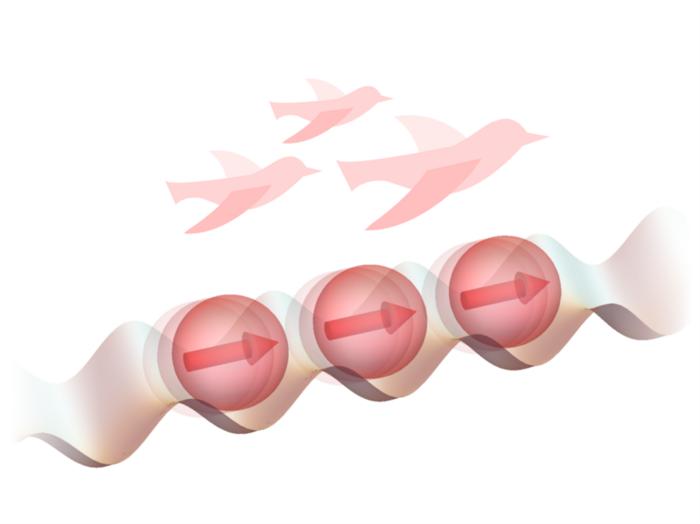
A strange similarity between flocking birds and ferromagnetic order in particles

Credit: Takasan et al 2024

Researchers Kazuaki Takasan and Kyogo Kawaguchi of the University of Tokyo with Kyosuke Adachi of RIKEN, Japan’s largest comprehensive research institution, have demonstrated that ferromagnetism, an ordered state of atoms, can be induced by increasing particle motility and that repulsive forces between atoms are sufficient to maintain it. The discovery not only extends the concept of active matter to quantum systems but also contributes to the development of novel technologies that rely on the magnetic properties of particles, such as magnetic memory and quantum computing. The findings were published in the journal Physical Review Research.

Flocking birds, swarming bacteria, cellular flows. These are all examples of active matter, a state in which individual agents, such as birds, bacteria, or cells, self-organize. The agents change from a disordered to an ordered state in what is called a “phase transition.” As a result, they move together in an organized fashion without an external controller.

“Previous studies have shown that the concept of active matter can apply to a wide range of scales, from nanometers (biomolecules) to meters (animals),” says Takasan, the first author. “However, it has not been known whether the physics of active matter can be applied usefully in the quantum regime. We wanted to fill in that gap.”

To fill the gap, the researchers needed to demonstrate a possible mechanism that could induce and maintain an ordered state in a quantum system. It was a collaborative work between physics and biophysics. The researchers took inspiration from the phenomena of flocking birds because, due to the activity of each agent, the ordered state is more easily achieved than in other types of active matter. They created a theoretical model in which atoms were essentially mimicking the behavior of birds. In this model, when they increased the motility of the atoms, the repulsive forces between atoms rearranged them into an ordered state called ferromagnetism. In the ferromagnetic state, spins, the angular momentum of subatomic particles and nuclei, align in one direction, just like how flocking birds face the same direction while flying.

“It was surprising at first to find that the ordering can appear without elaborate interactions between the agents in the quantum model,” Takasan reflects on the finding. “It was different from what was expected based on biophysical models.”

The researcher took a multi-faceted approach to ensure their finding was not a fluke. Thankfully, the results of computer simulations, mean-field theory, a statistical theory of particles, and mathematical proofs based on linear algebra were all consistent. This strengthened the reliability of their finding, the first step in a new line of research.

“The extension of active matter to the quantum world has only recently begun, and many aspects are still open,” says Takasan. “We would like to further develop the theory of quantum active matter and reveal its universal properties.”


Journal

Physical Review Research

Method of Research

Computational simulation/modeling

Subject of Research

Not applicable

Article Title

Activity-induced ferromagnetism in one-dimensional quantum many-body systems

Article Publication Date

26-Apr-2024

Share26Tweet17
Previous Post

Revolutionizing memory technology: multiferroic nanodots for low-power magnetic storage

Next Post

Mobile device location data is already used by private companies, so why not for studying human-wildlife interactions, scientists ask

Related Posts

blank
Chemistry

New Insights into Cosmic Ray Acceleration and Propagation in the Milky Way from the Tibet ASγ Experiment

March 4, 2026
blank
Chemistry

Breakthrough Label-Free Microscope Unveils the Nano-World Within Living Cells

March 4, 2026
blank
Chemistry

New UNC Charlotte Study Uncovers How Three Molecules Trigger Gene-Silencing Condensates to Organize the Epigenome and Direct Stem Cell Differentiation

March 4, 2026
blank
Chemistry

Versatile Bioisosteres from Bicyclobutanes Synthesized

March 4, 2026
blank
Chemistry

Machine Learning Uncovers Raman Signatures Indicating Liquid-Like Ion Conduction in Solid Electrolytes

March 4, 2026
blank
Chemistry

SimTac: A Physics-Driven Simulator Advancing Vision-Based Tactile Sensing with Biomimetic Designs

March 4, 2026
Next Post
Bison road crossing

Mobile device location data is already used by private companies, so why not for studying human-wildlife interactions, scientists ask

  • Mothers who receive childcare support from maternal grandparents show more parental warmth, finds NTU Singapore study

    Mothers who receive childcare support from maternal grandparents show more parental warmth, finds NTU Singapore study

    27619 shares
    Share 11044 Tweet 6903
  • University of Seville Breaks 120-Year-Old Mystery, Revises a Key Einstein Concept

    1024 shares
    Share 410 Tweet 256
  • Bee body mass, pathogens and local climate influence heat tolerance

    665 shares
    Share 266 Tweet 166
  • Researchers record first-ever images and data of a shark experiencing a boat strike

    533 shares
    Share 213 Tweet 133
  • Groundbreaking Clinical Trial Reveals Lubiprostone Enhances Kidney Function

    518 shares
    Share 207 Tweet 130
Science

Embark on a thrilling journey of discovery with Scienmag.com—your ultimate source for cutting-edge breakthroughs. Immerse yourself in a world where curiosity knows no limits and tomorrow’s possibilities become today’s reality!

RECENT NEWS

  • A Promising New Therapeutic Approach for Treating Rett Syndrome
  • AI-Powered Liquid Biopsy Shows Promise in Detecting Liver Fibrosis, Cirrhosis, and Chronic Disease Indicators
  • New Insights into Cosmic Ray Acceleration and Propagation in the Milky Way from the Tibet ASγ Experiment
  • Breakthrough Research Offers New Hope for Treating Rett Syndrome, a Rare Disorder Without a Cure

Categories

  • Agriculture
  • Anthropology
  • Archaeology
  • Athmospheric
  • Biology
  • Biotechnology
  • Blog
  • Bussines
  • Cancer
  • Chemistry
  • Climate
  • Earth Science
  • Editorial Policy
  • Marine
  • Mathematics
  • Medicine
  • Pediatry
  • Policy
  • Psychology & Psychiatry
  • Science Education
  • Social Science
  • Space
  • Technology and Engineering

Subscribe to Blog via Email

Enter your email address to subscribe to this blog and receive notifications of new posts by email.

Join 5,190 other subscribers

© 2025 Scienmag - Science Magazine

Welcome Back!

Login to your account below

Forgotten Password?

Retrieve your password

Please enter your username or email address to reset your password.

Log In
No Result
View All Result
  • HOME
  • SCIENCE NEWS
  • CONTACT US

© 2025 Scienmag - Science Magazine

Discover more from Science

Subscribe now to keep reading and get access to the full archive.

Continue reading