


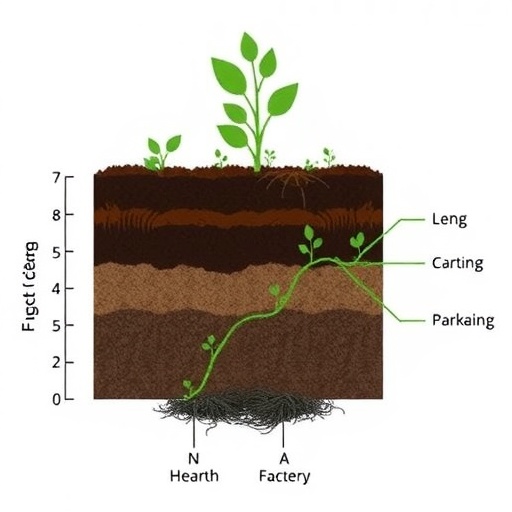
A groundbreaking twelve-year field study has emerged, shedding light on the nuanced effects of biochar—a highly porous, carbon-rich substance produced via biomass pyrolysis—on soil carbon sequestration through microbial activity. This investigation reveals that while biochar can significantly bolster the storage of microbial-derived carbon in the upper soil layers of croplands, its impact varies dramatically with soil depth, prompting a reevaluation of previous assessments of biochar’s carbon sequestration potential.
Soil microbes play an indispensable role in stabilizing soil organic carbon through the formation of microbial necromass, the residual biomass of dead microbes, which is notably more resistant to decomposition than plant residues. As soil represents Earth’s largest terrestrial carbon reservoir, surpassing atmospheric and vegetative carbon stores, understanding how biochar influences these microbial-mediated processes is critical for leveraging soil’s potential in mitigating climate change.
The research team conducted extensive experiments across two distinct cropland soil types, tracing microbial necromass carbon across varying soil depths, from nutrient-rich topsoil to subsoil layers several tens of centimeters below the surface. Their methodology included direct soil sampling, microbial biomass assays, and advanced isotopic tracing techniques, enhanced by a comprehensive meta-analysis of 23 global studies, emphasizing the depth-dependent responses to biochar amendments.
Results indicated that biochar’s influence on microbial necromass carbon is markedly positive in the upper soil horizons, with increases up to 39 percent. This enhancement largely stems from biochar’s ability to improve soil nutrient availability, particularly nitrogen and phosphorus, sustain larger microbial biomass populations, and boost microbial carbon use efficiency. The promotion of fungal necromass was especially pronounced, which is significant given fungi’s capacity to contribute more recalcitrant carbon compounds to soil organic matter.
Conversely, the subsoil layers exhibited a counterintuitive trend, with microbial necromass carbon decreasing by approximately 30 percent following biochar application. This decline is attributed to nutrient stratification induced by biochar, which tends to immobilize nutrients near the surface layers, creating a nutrient-limited environment at depth. Consequently, subsoil microorganisms increase their metabolic rates to scavenge scarce nutrients, accelerating the decomposition of existing organic matter and undermining carbon stabilization in these deeper horizons.
This vertical disparity in biochar’s effects accentuates the critical importance of considering soil depth gradients in carbon cycling studies. Surface-focused measurements risk overestimating the long-term carbon sequestration benefits of biochar amendments. The complex interactions between biochar, microbial ecology, and soil chemistry underscore the need for integrating depth-resolved approaches in the development of biochar-based soil management strategies.
Further analysis illuminated that the degree of biochar’s impact is modulated by climatic and edaphic conditions. Soils characterized by low initial organic carbon content, sandy textures with greater porosity, and environments possessing warmer and wetter climates showed more substantial microbial carbon accrual after biochar incorporation. Additionally, the carbon benefits were cumulative, with optimal enhancements observed in long-term applications exceeding a decade, highlighting the importance of sustained biochar integration for meaningful soil carbon gains.
The meta-analysis corroborated these empirical findings, demonstrating that more than 80 percent of reviewed studies reported an increase in microbial necromass carbon following biochar additions across varied ecosystems worldwide. On average, biochar amendments resulted in a 10 percent global increase in microbially derived soil carbon, emphasizing its broad applicability as a soil health and climate mitigation tool.
Importantly, researchers caution that microbial necromass comprises only a fraction of the total soil organic carbon pool. Given that biochar itself directly contributes a significant reservoir of stable carbon, the proportional representation of microbial necromass within total soil organic carbon may decrease, even while its absolute content grows. This nuance invites further inquiry into the relative contributions and turnover dynamics of different carbon pools within amended soils.
The study’s insights unveil intricate soil-microbe-biochar interactions, underscoring biochar’s potential as a transformative amendment for sustainable agriculture and climate change mitigation. Nonetheless, it advocates for a refined understanding of spatially and temporally heterogeneous soil processes to optimize biochar use, ensuring both ecological efficacy and practical feasibility in diverse agronomic contexts.
These revelations herald a paradigm shift in soil carbon research, advocating for depth-sensitive, long-term investigations that factor in microbial functioning and nutrient distributions. Such comprehensive approaches are pivotal to harnessing biochar’s full potential in enhancing soil carbon sinks, promoting environmental resilience, and addressing the pressing global challenge of anthropogenic carbon emissions.
In conclusion, while biochar emerges as a promising avenue for bolstering soil carbon sequestration, its effectiveness hinges on precise management strategies that accommodate soil profile heterogeneity and evolving microbial dynamics. The study calls for integrated soil carbon models incorporating vertical stratification and microbial feedbacks to drive smarter, evidence-based interventions toward climate-smart agriculture.
News Publication Date: March 16, 2026.
Web References:
Biochar Journal
DOI: 10.1007/s42773-026-00577-0
References:
Song, K., Liu, Z., Ma, R. et al. Depth-dependent microbial necromass carbon accumulation responses to long-term biochar amendment in croplands. Biochar 8, 78 (2026).
Keywords
Biochar, soil carbon sequestration, microbial necromass, soil microbiology, carbon cycling, soil depth stratification, cropland soils, environmental remediation, sustainable agriculture, climate mitigation, long-term soil amendments, microbial carbon efficiency.
Cite Scienmag News
Morgan Morrow. (April 3, 2026). Biochar Enhances Soil Carbon Storage via Microbial Activity, with Effects Differing by Soil Depth. Scienmag. https://scienmag.com/biochar-enhances-soil-carbon-storage-via-microbial-activity-with-effects-differing-by-soil-depth/
Morgan Morrow. "Biochar Enhances Soil Carbon Storage via Microbial Activity, with Effects Differing by Soil Depth." Scienmag, 3 April 2026, https://scienmag.com/biochar-enhances-soil-carbon-storage-via-microbial-activity-with-effects-differing-by-soil-depth/. Accessed 3 September 2026.
Morgan Morrow. "Biochar Enhances Soil Carbon Storage via Microbial Activity, with Effects Differing by Soil Depth." Scienmag. April 3, 2026. https://scienmag.com/biochar-enhances-soil-carbon-storage-via-microbial-activity-with-effects-differing-by-soil-depth/


